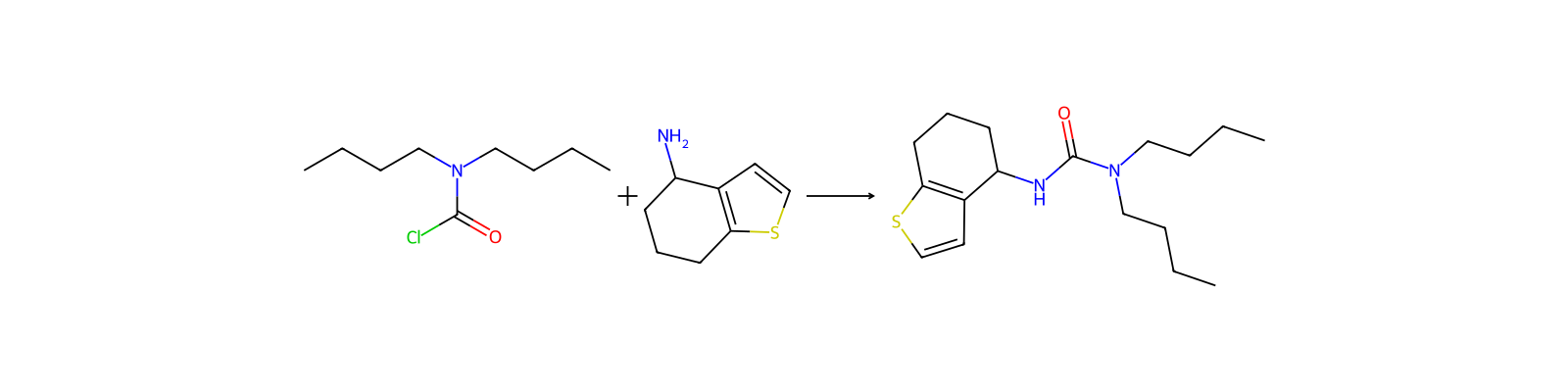
HRID 193250反応物として
Dibutylcarbamoyl chloride
データを補完しています。しばらくしてからページを更新すると最新の内容を表示できます

13358-73-1CCCCN(CCCC)C(=O)ClOSWBZCCZJXCOGL-UHFFFAOYSA-N13358-73-1DTXSID10158187安全情報は参考情報です。供給元の安全データシート(SDS)、適用法令、専門家による評価に代わるものではありません。
Danger
H314 (100%): Causes severe skin burns and eye damage [Danger Skin corrosion/irritation]
P260, P264, P264+P265, P280, P301+P330+P331, P302+P361+P354, P304+P340, P305+P354+P338, P316, P317, P321, P363, P405, and P501 (click each P-code to see the statement)
Aggregated GHS information provided per 39 reports by companies from 1 notifications to the ECHA C&L Inventory. Each notification may be associated with multiple companies.
使用It is reported that Dibutylcarbamoyl Chloride is used as a reagent for the preparation of 7-azaindole-1,3-dicarboxamide hydroxyethylamine which exhibited potent BACE-1 enzyme inhibition. Also it is used for the preparation of copper salicylaldehyde semicarbazone complex which showed cytotoxicity in human cancer cells.
製造方法In a 100 mL roundbottomed flask were placed dibutylamine (6.45 g, 0.05 mol), pyridine (4.0 g, 0.05 mol), N-cyclohexyl-N0,N0,N00,N00-tetraethylguanidine (12.7 g, 0.05 mol), and toluene (40 mL). The resulting solution was cooled to 10 °C using an ice/salt bath and carbon dioxide was bubbled into the cooled solution for 30 min. After this period of time, the pre-formed carbamate solution was added in a single portion via a cannula to a cooled ( 10 °C) solution of thionyl chloride (6 g, 0.05 mol) in toluene (40 mL). The reaction mixture was stirred at 10 °C for 45 min. It was then poured into 0.1 m aq. HCl (100 mL), giving rise to two layers. The organic layer was separated, dried over anhydrous Mg2SO4, filtered, and the solvent was removed in vacuo. The residue was distilled in vacuo (1 mmHg) at 95–98 °C to give 7.62 g (79%) of N,N-dibutyl carbamoyl chloride.