1,3-ジクロロ-5,5-ジメチルヒダントイン
1,3-ジクロロ-5,5-ジメチルヒダントイン · 1,3-ジクロロ-5,5-ジメチル-2,4-イミダゾリジンジオン · 1,3-ジクロロ-5,5-ジメチルイミダゾリジン-2,4-ジオン · 5,5-ジメチル-1,3-ジクロロヒダントイン · ハラン · ダクチン · 1,3-ジクロロ-4,4-ジメチルイミダゾリジン-2,5-ジオン · N,N-ジクロロ-5,5-ジメチルヒダントイン
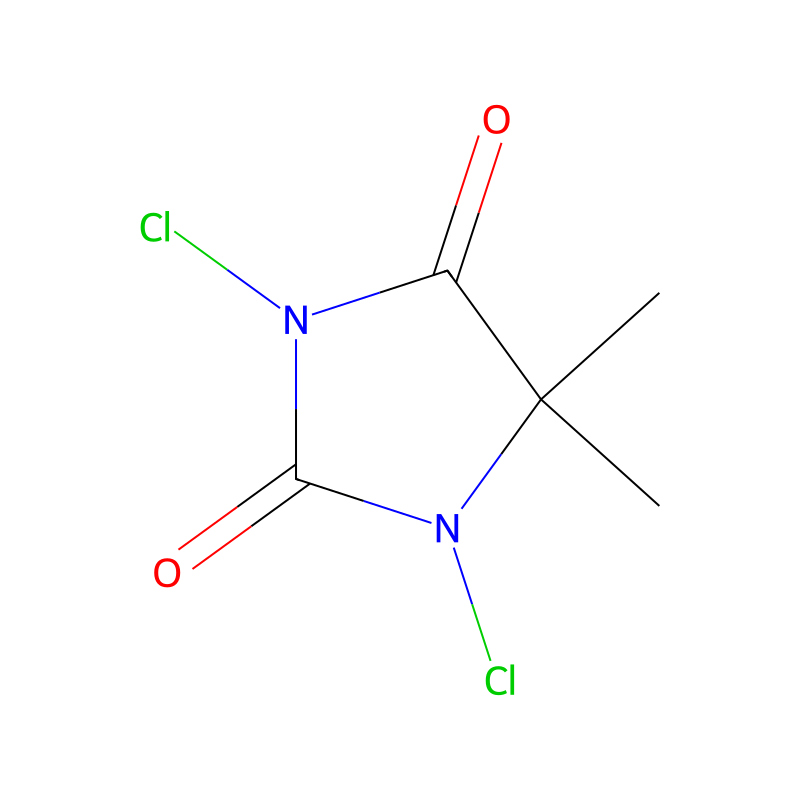
識別子と物理属性
| CAS No. | 118-52-5 |
|---|---|
| 分子式 | C5H6Cl2N2O2 |
| 平均分子量 | 197.02 g/mol |
| 単同位体質量 | 195.98063279 g/mol |
| SMILES | CC1(C)C(=O)N(Cl)C(=O)N1Cl |
| InChIKey | KEQGZUUPPQEDPF-UHFFFAOYSA-N |
| PubChem CID | 8360 |
| ChEMBL | CHEMBL1899986 |
| EC No. | 204-258-7 |
| DTXSID | DTXSID4024985 |
| 現地名 | 1,3-ジクロロ-5,5-ジメチルヒダントイン |
化学・物理的性質
| XLogP | 1.1 |
|---|---|
| 極性表面積 | 40.6 |
| 水素結合供与体数 | 0 |
| 水素結合受容体数 | 2 |
| 回転可能結合数 | 0 |
| 重原子数 | 11 |
| 形式電荷 | 0 |
| 複雑度 | 229 |
| 物質分類 | Nitrogen Compounds -> Other Nitrogen Compounds |
| pH | pH of aqueous soln about 4.44.4 (H2O)(HSDB) |
| SpringerMaterials Properties | Nuclear quadrupole resonance spectroscopy |
| 臭い | Chlorine-like odor |
| 密度 | 1.5 at 68 °F (NTP, 1992) - Denser than waterwill sink1.5 at 20 °C/20 °C1,5 g/cm3 |
| Color/Form | Four-sided, pointed prisms from chloroformWhite powder |
| 溶解度 | Reaction (NTP, 1992)Solubility (at 25 °C): 12.5% in carbon tetrachloride, 14% in chloroform, 30% in methylene chloride, 32.0% in ethylene dichloride, 17% in sym-tetrachlorethane, 9.2% in benzeneIn water, 0.5 g/L at 20 °C1.3 g/L at 40 °C.0.2%水: 可溶0.21% at 25°C(lit.)0.21g/100mL(25℃) |
| Corrosivity | PRESUMABLY LESS CORROSIVE THAN HYPOCHLORITE SOLUTIONS WITH SAME CONCN OF AVAILABLE CHLORINE |
| 引火点 | 346 °F (NIOSH, 2024)171 °C |
| 沸点 | Sublimes at 212 °F (NTP, 1992)212 ° (sublimes)214.7±23.0 °C(Predicted) |
| Decomposition | When heated to decomposition it emits toxic vapors of /nitrogen oxide and hydrogen chloride/. |
| 融点 | 270 °F (NTP, 1992)132 °C132-134 °C (lit.) |
| 蒸気圧 | 0.003Pa |
| 屈折率 | 1.5720 (estimate) |
| 貯蔵条件 | Keep in dark place,Sealed in dry,Room Temperature |
| pKa(酸解離定数) | -3.44±0.40(Predicted) |
| 外観・状態 | 結晶性粉末 |
| 色 | 白い |
| Merck | 14,3065 |
| BRN | 146013 |
| ヘンリー定数 | 9.9×100 mol/(m3Pa) at 25℃, HSDB (2015) |
| 安定性 | 安定しているが強力な酸化剤であり、可燃物と接触すると火災を引き起こす可能性がある.還元剤、酸、強塩基とは相容れない。湿気に敏感。 |
| InChI | 1S/C5H6Cl2N2O2/c1-5(2)3(10)8(6)4(11)9(5)7/h1-2H3 |
| InChIKey | KEQGZUUPPQEDPF-UHFFFAOYSA-N |
| SMILES | CC1(C)N(Cl)C(=O)N(Cl)C1=O |
| LogP(分配係数) | -0.94 |
| CAS データベース | 118-52-5(CAS DataBase Reference) |
| EPAの化学物質情報 | 1,3-Dichloro-5,5-dimethylhydantoin (118-52-5) |
化学的特性
DCDMH is a combustible, white powder. Chlorine-like odor.
安全性と法規制
| GHS 分類 | DangerH272 (53.1%): May intensify fireoxidizer [Danger Oxidizing liquidsOxidizing solids]P210, P220, P233, P260, P261, P264, P264+P265, P270, P271, P272, P273, P280, P284, P301+P317, P301+P330+P331, P302+P352, P302+P361+P354, P304+P340, P305+P351+P338, P305+P354+P338, P316, P319, P321, P330, P332+P317, P333+P317, P337+P317, P342+P316, P362+P364, P363, P370+P378, P391, P403, P403+P233, P405, and P501 (click each P-code to see the statement)Aggregated GHS information provided per 130 reports by companies from 15 notifications to the ECHA C&L Inventory. Each notification may be associated with multiple companies.WarningH302: Harmful if swallowed [Warning Acute toxicity, oral] |
|---|---|
| 規制情報 | Chemical: 2,4-Imidazolidinedione, 1,3-dichloro-5,5-dimethyl-2,4-Imidazolidinedione, 1,3-dichloro-5,5-dimethyl- is listed on the EPA's Chemical Data Reporting (CDR) system. Manufacturers and importers of 2,4-Imidazolidinedione, 1,3-dichloro-5,5-dimethyl- are required to report information about their production and use of this chemical to the EPA under the Toxic Substances Control Act (TSCA). (40 eCFR Part 711)Dantochlor (BCDMH) is listed in the dataset of EPA Human Health Benchmarks for Pesticides under the Safe Drinking Water Act (40 eCFR 141)Status: Active Update: 02-04-2020 https://echa.europa.eu/registration-dossier/-/registered-dossier/181811,3-Dichloro-5,5-dimethylhydantoin: Does not have an individual approval but may be used under an appropriate group standard |
| 輸送ラベル(DOT) | Oxidizer |
| 火災危険 | Flash point data for this chemical are not available. It is probably combustible. (NTP, 1992) |
| 火災の可能性 | ... /It is/ combustible with evolution of chlorine at 210 °C. |
| 健康有害性 | Excerpt from NIOSH Pocket Guide for 1,3-Dichloro-5,5-dimethylhydantoin: |
| 有害性の概要 | Hypochlorous acid is released upon contact with water. A concentration of 10 ppm is the maximum level recommended to prevent respiratory irritation when used to sanitize swimming pools. A worker exposed to a concentration exceeding 0.2 mg/m3 complained of cough and chest discomfort. [ACGIH] Corrosive to skin and eyesMay cause respiratory sensitization |
用途
用途
ポリ塩化ビニルの安定剤、アミノ酸、医薬、農薬の中間体
使用
Dantoin(R) DCDMH is an industrial bleaching agent based on dimethyl hydantoin. This product finds application wherever solid bleach is desired.
一般的な説明
White powder with a weak chlorine odor. Conflagrates at 414°F (turns brown). Chlorine gas evolves > 410°F.
製法・合成法
純化方法
Purify it by dissolving in conc H2SO4 and diluting with ice H2O, collect the solid, dry it in a vacuum and recrystallise it from CHCl3. It sublimes at 100o in a vacuum. It exhibits time-dependent hydrolysis at pH 9. [Petterson & Grzeskowiak J Org Chem 24 1414 1959, Beilstein 24 III/IV 1100.]