
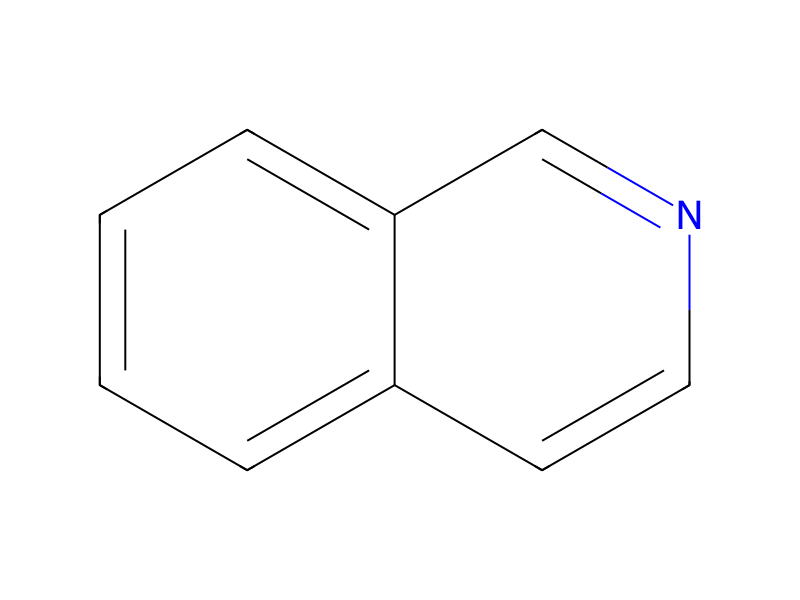
基本情報
- 標準SMILES
c1ccc2cnccc2c1- InChIKey
AWJUIBRHMBBTKR-UHFFFAOYSA-N- 分子式
- C9H7N
- 平均分子量
- 129.16 g/mol
- 単同位体質量
- 129.05784923
名称と識別子
- 優先名称
- Isoquinoline
- IUPAC
- isoquinoline
- 現地名
- イソキノリン
- 英語名
- Isoquinoline
- 分子式
- C9H7N
- 分子量
- 129.16
名称と別名
ISOQUINOLINE119-65-32-Benzazine2-AzanaphthaleneLeucolinebeta-QuinolineIsochinolinBenzo[c]pyridine3,4-BenzopyridineBenzo(c)pyridineFEMA No. 2978DTXSID2047644
名称をさらに表示
イソキノリンβ-キノリン3,4-ベンゾピリジンロイコリン2-ベンゾアジンイソキノリン標準品イソキノリン, 97+%イソキノリン, 50 µg/mL in Toluene2-ベンズアジンISOQUINOLINBenzopyridineFEMA 2978ISOQINOLINEIsoquinoL
JGX76Y85M6NSC-3395DTXCID0027644CHEBI:16092RefChem:792283204-341-87-methoxy-1,6-dimethylisoquinoline-5,8-dione2-Benzanine
データベース識別子
- CAS
119-65-3- PubChem CID
- 8405
- DTXSID
DTXSID2047644- ChEMBL
CHEMBL12315- ChEBI
CHEBI:16092- UNII
- JGX76Y85M6
- EC Number
- 204-341-8
- Nikkaji
- J43.394B
物性
構造計算による物性
- XLogP
- 2.1
- 極性表面積
- 12.9 Ų
- 水素結合供与体数
- 0
- 水素結合受容体数
- 1
- 回転可能結合数
- 0
- 重原子数
- 10
- 形式電荷
- 0
- 複雑度
- 111
実験および物理化学的性質
LogP
2.08
2.08
LogS-1.45
Density1.097-1.103
Solubility
4520
4.52 mg/mL at 25 °C
Slightly soluble in water
Soluble (in ethanol)
Boiling Point
243.2
242.00 to 243.00 °C. @ 760.00 mm Hg
242-243 °C
Melting Point
26.47
25.5 - 26 °C
Refractive Index1.621-1.627
Physical Description
Liquid
Liquid or hygroscopic solid with a pungent odor like anise oil mixed with benzaldehyde; mp = 26.48 deg C; [Merck Index] Light brown; mp = 24-28 deg C; [Acros Organics MSDS]
Solid
Colourless liquid, hygroscopic platelets when solid; Heavy-sweet balsamic, herbaceous aroma
Dissociation Constants5.42 (at 20 °C)
Kovats Retention Index
1225.2;1251;1269;1251;1269;1248;1272.9;1250.7;1240;1241.6;213.19
1255;1261;1225;1268;1261;1265;1275.5;1261.2;214;212.1;214.14;214.68;214.41;214.09;214.14;215.61
1934;1958;1934;1958;1934;1958;1955;1980
Collision Cross Section122.3 Ų [M+H]+ [CCS Type: DT; Buffer gas: N2; Ionization: APCI+; Dataset: TOXCAST; Source Identifier: DTXSID2047644]
物理化学的性質
- 融点
- 26 · 26-28 °C (lit.)
- 沸点
- 242 · 242-243 °C (lit.)
- 比重(密度)
- 1.099 g/mL · 1.099 g/mL at 25 °C (lit.)
- 蒸気圧
- 5 Pa · 5Pa at 20℃
- FEMA
- 2978 · 2978 | ISOQUINOLINE
- 屈折率
- 20 · n20/D 1.623(lit.)
- 闪点
- 225 °F · 225 °F
- 貯蔵温度
- 2 · 2-8°C
- 溶解性
- 5 g/リットル · 5g/リットル
- 酸解離定数(Pka)
- 5.42 · 5.42(at 20℃)
- 外見
- 低融点固体
- 色
- ライト・ブラウン
- PH
- 7.5 · 7.5 (5g/l, H2O, 20℃)
- 臭い (Odor)
- 0.1 %。スイートバルサム · トリアセチン中0.10%。スイートバルサム ハーブ ベンズアルデヒド アニス
- においのタイプ
- バルサミコ
- 水溶解度
- 実質的に不溶
- 比熱容量
- 1.52 J/ · Cp(liquid): 1.52 J/(g·K), at 25℃
- JECFA Number
- 1303 · 1303
- Merck
- 14 · 14,5222
- BRN
- 107549 · 107549
- Henry's Law Constant
- 5.2 · 5.2×10-2 mol/(m3Pa) at 25℃, Mackay et al. (2006)
- Dielectric constant
- 10.7 · 10.7(20℃)
- InChI
- 1S/C9H7N/c1-2-4-9-7-10-6-5-8(9)3-1/h1-7H
- InChIKey
- AWJUIBRHMBBTKR-UHFFFAOYSA-N
- SMILES
- c1ccc2cnccc2c1
- LogP
- 2.08 · 2.08
- CAS データベース
- 119 · 119-65-3(CAS DataBase Reference)
- NISTの化学物質情報
- Isoquinoline(119-65-3)
- EPAの化学物質情報
- Isoquinoline (119-65-3)
化学的性質
化学的特性Isoquinoline is a colorless hygroscopic liquid at temperatures above its melting point with a heavy sweet balsamic, herbaceous odor. Impure samples can appear brownish, as is typical for nitrogen heterocycles. Isoquinoline is a slightly stronger base than quinoline (pKa=5.14) and has a larger dipole of 2.60D.
化学性质黄褐色の板状結晶,融点25?26℃,沸点242℃(99.35 kPa),水に不溶
安全と法規制
GHS分類
GHS Classification
This chemical does not meet GHS hazard criteria for < 0.1% (1 of 1677) of reports.
Danger
H302 (> 99.9%): Harmful if swallowed [Warning Acute toxicity, oral];H311 (99.6%): Toxic in contact with skin [Danger Acute toxicity, dermal];H315 (93.4%): Causes skin irritation [Warning Skin corrosion/irritation];H319 (93.4%): Causes serious eye irritation [Warning Serious eye damage/eye irritation]
P262, P264, P264+P265, P270, P280, P301+P317, P302+P352, P305+P351+P338, P316, P321, P330, P332+P317, P337+P317, P361+P364, P362+P364, P405, and P501 (click each P-code to see the statement)
Aggregated GHS information provided per 1677 reports by companies from 8 notifications to the ECHA C&L Inventory. Each notification may be associated with multiple companies.;Reported as not meeting GHS hazard criteria per 1 of 1677 reports by companies.;There are 7 notifications provided by 1676 of 1677 reports by companies with hazard statement code(s).;Information may vary between notifications depending on impurities, additives, and other factors. The percentage value in parenthesis indicates the notified classification ratio from companies that provide hazard codes. Only hazard codes with percentage values above 10% are shown. For more detailed information, please visit ECHA C&L website.
危険有害性情報
Regulatory Information
Chemical: Isoquinoline
Commission Regulation (EC) No 1565/2000 (Repealed by Com. Implementing Reg. (EU) No 872/2012)
Isoquinoline is listed on the EPA's Chemical Data Reporting (CDR) system. Manufacturers and importers of Isoquinoline are required to report information about their production and use of this chemical to the EPA under the Toxic Substances Control Act (TSCA). (40 eCFR Part 711)
Status: Active Update: 07-01-2011 https://echa.europa.eu/registration-dossier/-/registered-dossier/5236;Status: No longer Valid Update: 30-09-2010 https://echa.europa.eu/registration-dossier/-/registered-dossier/1356
Isoquinoline: Does not have an individual approval but may be used under an appropriate group standard
Hazards SummaryA moderate skin irritant; [RTECS] Safe when used as a flavoring agent in food; [JECFA] An irritant; Highly toxic by skin absorption; Harmful by ingestion; [Acros Organics MSDS] See Quinoline.
Hazard Classes and Categories
Acute Tox. 4 (> 99.9%);Acute Tox. 3 (99.6%);Skin Irrit. 2 (93.4%);Eye Irrit. 2 (93.4%)
Acute toxicity (Oral) - Category 4;Hazardous to the aquatic environment (Acute) - Category 3;Hazardous to the aquatic environment (Long-term) - Category 3
毒性情報
USGS Health-Based Screening Levels for Evaluating Water-Quality
Isoquinoline
Waste-water effluent contaminant
Smith, C.D. and Nowell, L.H., 2024. Health-Based Screening Levels for evaluating water-quality data (3rd ed.). DOI:10.5066/F71C1TWP
法規制情報
Regulatory Information
Chemical: Isoquinoline
Commission Regulation (EC) No 1565/2000 (Repealed by Com. Implementing Reg. (EU) No 872/2012)
Isoquinoline is listed on the EPA's Chemical Data Reporting (CDR) system. Manufacturers and importers of Isoquinoline are required to report information about their production and use of this chemical to the EPA under the Toxic Substances Control Act (TSCA). (40 eCFR Part 711)
Status: Active Update: 07-01-2011 https://echa.europa.eu/registration-dossier/-/registered-dossier/5236;Status: No longer Valid Update: 30-09-2010 https://echa.europa.eu/registration-dossier/-/registered-dossier/1356
Isoquinoline: Does not have an individual approval but may be used under an appropriate group standard
安全データ
- wgk
- 2
- tsca
- TSCA listed
- rtecs
- NW6825000
- ridadr
- UN 2811 6.1/PG 3
- 毒性
- LD50 orally in rats: 360 mg/kg (Smyth)
- hs_code
- 29334900
- risk_code
- 22-24-38-52/53-36/38-21/22-45
- 化審法
- (5)-3758
- hazard_code
- T
- safety_code
- 36/37-45-36/37/39-61-53
- hazard_class
- 6.1
- packing_group
- II
- Hazard Classifications
- Acute Tox. 3 DermalAcute Tox. 4 OralAquatic Chronic 3Eye Irrit. 2Skin Irrit. 2
- ストレージクラス
- 6.1C - Combustible acute toxic Cat.3toxic compounds or compounds which causing chronic effects
化学と産業
薬理情報
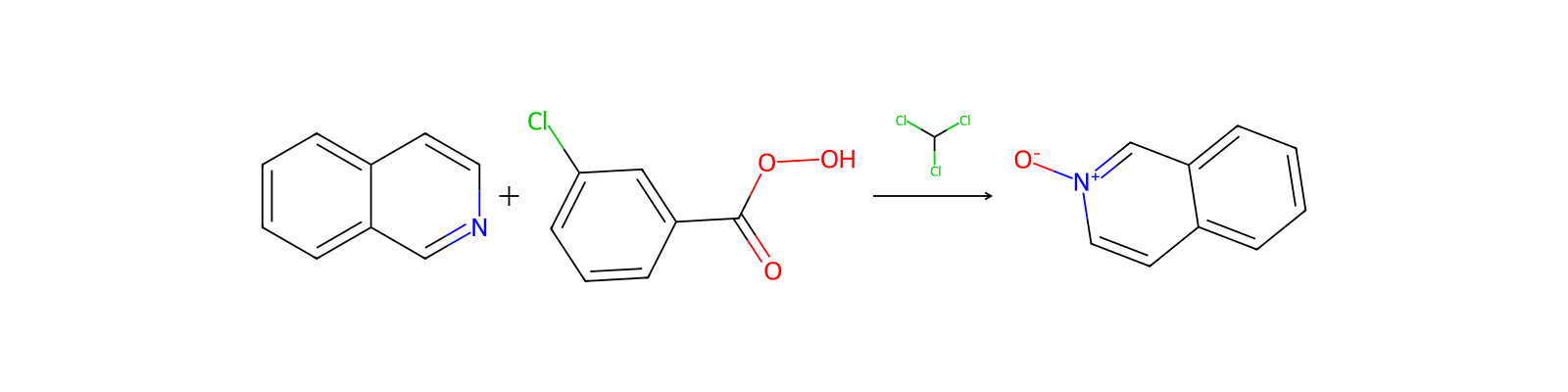
Metabolism/MetabolitesIsoquinoline has known human metabolites that include isoquinoline N-oxide.
Cellular LocationsCytoplasm;Extracellular
用途と製造
UsesPresent in coal tar; Used to make dyes, insecticides, antimalarials, and rubber accelerators; [Merck Index] Used as flavoring agent or adjuvant; [FDA]
U.S. Production2023: 25,000,000 - <75,000,000 lb;2022: 75,000,000 - <150,000,000 lb;2021: 150,000,000 - <500,000,000 lb;2020: 25,000,000 - <75,000,000 lb
Industry UsesCatalyst
Use Classification
Flavouring Agent -> FLAVOURING_AGENT -> JECFA Functional Classes
Flavoring Agents -> JECFA Flavorings Index
Flavouring Agent -> FLAVOURING_AGENT -> JECFA Functional Classes
Flavouring Agent -> FLAVOURING_AGENT -> JECFA Functional Classes
Flavouring Agent -> FLAVOURING_AGENT -> JECFA Functional Classes
General Manufacturing Information
Plastics Material and Resin Manufacturing
Isoquinoline: ACTIVE
応用分野
解説benzo[c]pyridine.C9H7N(129.16).イソキノリンは,キノリンの異性体.コールタール中に存在する.ベンズアルデヒドと2-アミノアセトアルデヒド=ジエチルアセタールとの反応,またはホモフタルイミドの亜鉛末蒸留により得られる.キノリン様の臭いをもつ無色の板状晶.融点26.5 ℃,沸点243.3 ℃.水に不溶,希鉱酸および普通の有機溶媒に可溶.酸化するとフタル酸およびシンコメロン酸を生じる.医薬,染料,殺虫剤,ゴム加硫促進剤などの合成原料に使われる.天然物であるアルカロイドにこのイソキノリン骨格をもつものが多い。キノリン様の特異な臭いをもつので密閉して保存する。森北出版「化学辞典(第2版)
用途医薬?農薬原料
説明Isoquinoline, also known as 2-azanaphthalene, benzo[c]pyridine, or 2-benzanine, is a structural isomer of quinoline. It has structural and spectroscopic properties similar to quinoline. Isoquinoline was first isolated in 1885 by Hoogewerf and van Dorp from the quinoline fraction of coal tar by fractional crystallization. It is used to prepare dyes, insecticides, and antimalarial compounds, among other things.
使用Isoquinolines are used in the manufacture of dyes, paints, insecticides and antifungals. It is also used as a solvent for the extraction of resins and terpenes, and as a corrosion inhibitor.Isoquinoline (isq) has been used:in the preparation of cis-[(dcbH2)2Ru(isq)2](ClO4)2 [dcbH2 = 4,4′-(CO2H)2-2,2′-bipyridine].to investigate the toxicity of three two-ring and five three-ring azaarenes to the green alga Scenedesmus acuminatus and its relationship with molecular structure.
一般的な説明Isoquinoline is one of the very few heterocyclic compounds in which numbering of the ring atoms does not start on the hetero atom.It consists of a benzene ring fused to the β- and Y-positions of a pyridine ring.Isoquinoline has an odor reminiscent of benzaldehyde and anise. Isoquinoline may be obtained from coal tar (238 - 250°C boiling fraction); it is isolated as the sulfate or as is by repeated freezing.
使用用途1. 医薬品 イノキノリンおよびイソキノリンの誘導体は、主に医薬品分野において使用されます。具体的な使用例を挙げると、麻酔薬、抗高血圧剤、血管拡張剤などに使用されます。 麻酔薬 キニソカインなどの薬品が実用化されていおり、神経のナトリウムチャネルをブロックすることで局部麻酔作用を発揮します。 抗高血圧剤 キナプリルなどの薬品が実用化されています。この薬は、高血圧を誘導するアンジオテンシンという物質を合成する酵素を働かなくさせることで、血圧を下げる働きを持ちます。 血管拡張剤 パパべリンという薬品が使われています。この薬品は、血管や腸の運動を支配している平滑筋に存在するアセチルコリン受容体などの受容体に作用して、血管の拡張を行います。その主な作用機序は、血管平滑筋へのカルシウムイオンの流入を阻止することによるものです。 その他にも、医薬品としては抗マラリア剤、抗真菌剤、消毒薬としても用いられています。 2. 染料 また、イソキノリンは、染料を合成する際の原料として利用されており、イソキノリン系の染料として多くの物質がイソキノリン骨格を持っています。イソキノリンは適切な光の波長を吸収する上に、さまざまな誘導体を合成しやすいことから、多種多様な染料が合成されています。 さらに、イソキノリンは殺虫用途の農薬の製造時の合成原料として使用されます。イソキノリンは3級アミンの部分を持っており、この部分が昆虫のコリンエステラーゼを阻害し、アセチルコリンの濃度を大幅に上昇させることで作用を発揮します。 その他、イソキノリンは製造業分野でも使用され、製造時の触媒や腐食抑制剤としても有用です。
調製方法
High-temperature coal tar contains an average of 0.2% isoquinoline. It is separated by distillation from the lower-boiling quinoline and the higherboiling 2-methylquinoline of the quinoline base mixture. Further refining is based on the fact that isoquinoline, in contrast to quinoline and 2-methylquinoline, cannot be hydrated but can be crystallized at low temperature. Isoquinoline can by synthesized, for example, via the Bischler–Napieralski reaction by cyclodehydration of N-acyl derivatives of b-phenylethylamine with Lewis acids and subsequent dehydrogenation.
製造方法Bischler-Napieralski synthesis is used to synthesize isoquinolines. β-phenylethylamine is acylated, and then cyclodehydrated using phosphoryl chloride, phosphorus pentoxide or other Lewis acids to yield dihydroisoquinoline, which can be aromatized by dehydrogenation with palladium, for example in the synthesis of papaverine, a pharmacologically active isoquinoline alkaloid.Pictet-Spengler synthesis is another method of preparing isoquinolines. β-phenylethylamine reacts with an aldehyde to produce an imine, which undergoes acid-catalysed cyclization, resulting in the synthesis of the tetrahydroisoquinoline system. Again, tetrahydroisoquinoline can be aromatized by palladium dehydrogenation to produce an isoquinoline system.
純化方法Dry isoquinoline with Linde type 5A molecular sieves or Na2SO4 and fractionally distil at reduced pressure. Alternatively, it can be refluxed with, and distilled from, BaO. It is also purified by fractional crystallisation from the melt and distilled from zinc dust. It forms a phosphate (m 135o) and a picrate (m 223o), which are purified by crystallisation, and the free base can be recovered and distilled. [Packer et al. J Am Chem Soc 80 905 1958.] The procedure for purification via the picrate comprises the addition of quinoline to picric acid dissolved in the minimum volume of 95% EtOH to yield yellow crystals which are washed with EtOH and air dried before recrystallising from acetonitrile. The crystals are dissolved in dimethyl sulfoxide (previously dried over 4A molecular sieves) and passed through a basic alumina column, on which picric acid is adsorbed. The free base in the effluent is extracted with n-pentane and distilled under vacuum. Traces of solvent from small quantities are removed by vapour phase chromatography. The hydrochloride crystallises from EtOH with m 193o. [Mooman & Anton J Phys Chem 80 2243 1976, Beilstein 20 II 236, 20 III/IV 3410, 20/7 V 333.]
上流・下流製品情報
上流原料
下流製品
補足説明
定義ChEBI: Isoquinoline is an ortho-fused heteroarene that is a benzopyridine in which the N atom not directly attached to the benzene ring. It is a mancude organic heterobicyclic parent, an azaarene, an ortho-fused heteroarene and a member of isoquinolines.
関連反応
279 件




関連ノート
読み込み中…