
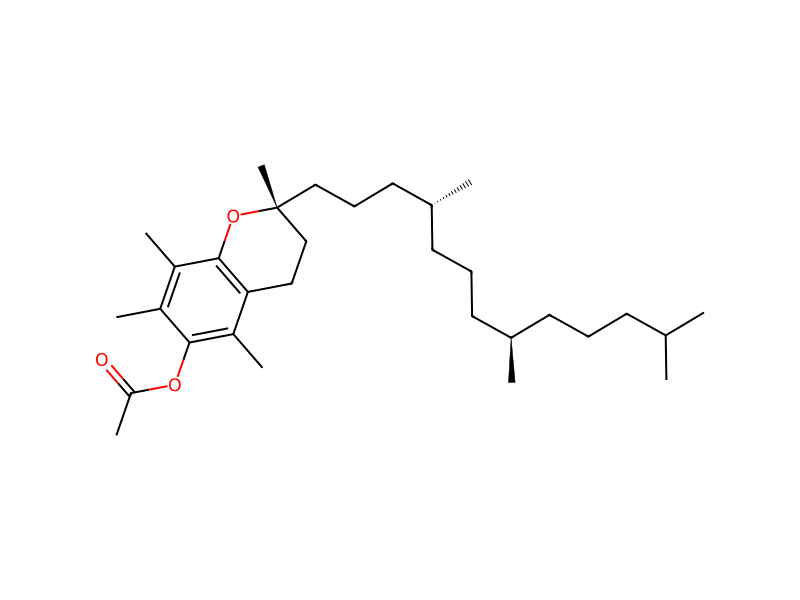
基本情報
- 標準SMILES
CC(=O)Oc1c(C)c(C)c2c(c1C)CC[C@@](C)(CCC[C@H](C)CCC[C@H](C)CCCC(C)C)O2- InChIKey
ZAKOWWREFLAJOT-CEFNRUSXSA-N- 分子式
- C31H52O3
- 平均分子量
- 472.7 g/mol
概要
D-alpha-tocopheryl acetate appears as odorless off-white crystals. Darkens at 401 °F. (NTP, 1992)
名称と識別子
- 優先名称
- Alpha-Tocopherol Acetate
- IUPAC
- [(2R)-2,5,7,8-tetramethyl-2-[(4R,8R)-4,8,12-trimethyltridecyl]-3,4-dihydrochromen-6-yl] acetate
名称と別名
alpha-Tocopherol acetateAlfacolEcofrolContopheronTofaxinEconEphynal acetateCombinal EEvipherolTocopherexTocophrinErevit
名称をさらに表示
GevexTocopherol acetateTokoferol acetateEndo E DompeJuvelaCopherol 1250Covitol 1100Covitol 1360
データベース識別子
- CAS
52225-20-4、58-95-7、7695-91-2- PubChem CID
- 86472
- ChEMBL
CHEMBL1047、CHEMBL3989859- ChEBI
CHEBI:32321- UNII
- A7E6112E4N
- EC Number
- 200-405-4、231-710-0、692-041-1
- Nikkaji
- J24.807J
物性
構造計算による物性
- XLogP
- 10.8
- 極性表面積
- 35.5 Ų
- 水素結合供与体数
- 0
- 水素結合受容体数
- 3
- 回転可能結合数
- 14
- 重原子数
- 34
- 形式電荷
- 0
- 複雑度
- 601
実験および物理化学的性質
Chemical ClassesBiological Agents -> Vitamins and Derivatives
DrugsPharmaceuticals -> Listed in ZINC15
FragrancesFragrance Ingredient (2H-1-Benzopyran-6-ol, 3,4-dihydro-2,5,7,8-tetramethyl-2-(4,8,12-trimethyltridecyl)-, acetate) -> IFRA transparency List
Food AdditivesNUTRIENT SUPPLEMENT -> FDA Substance added to food
Density0.9507 at 78.1 °F (NTP, 1992) - Less dense than water; will float
Solubility
less than 1 mg/mL at 63 °F (NTP, 1992)
Insoluble in cold water and hot water
Human Drugs
FDA approved drugs -> Active ingredient
FDA approved drugs -> Active ingredient
FDA approved drugs -> Active ingredient
Boiling Point
363 °F at 0.01 mmHg (NTP, 1992)
>343 degrees Celcius
Melting Point82 °F (NTP, 1992)
Physical Description
D-alpha-tocopheryl acetate appears as odorless off-white crystals. Darkens at 401 °F. (NTP, 1992)
Large Crystals
Light yellow liquid that crystallizes at -30 deg C; mp = 26.5-27.5 deg C; [Merck Index] Off-white odorless solid; mp = 28 deg C; [NTP] Light yellow semi-solid/liquid; mp = 25 deg C; [Sigma-Aldrich MSDS]
Collision Cross Section226.4 Ų [M+H]+ [CCS Type: DT; Buffer gas: N2; Ionization: ESI+; Dataset: TOXCAST; Source Identifier: DTXSID3021356]
安全と法規制
GHS分類
GHS Classification
This chemical does not meet GHS hazard criteria for 95.4% (1849 of 1939) of all reports.
Not Classified
Aggregated GHS information provided per 1939 reports by companies from 5 notifications to the ECHA C&L Inventory.
This chemical does not meet GHS hazard criteria for 36.3% (102 of 281) of reports.
H413 (63.7%): May cause long lasting harmful effects to aquatic life [Hazardous to the aquatic environment, long-term hazard]
P273, and P501 (click each P-code to see the statement)
危険有害性情報
Regulatory Information
Chemical: 2H-1-Benzopyran-6-ol, 3,4-dihydro-2,5,7,8-tetramethyl-2-[(4R,8R)-4,8,12-trimethyltridecyl]-, 6-acetate, (2R)-
Chemical: 2H-1-Benzopyran-6-ol, 3,4-dihydro-2,5,7,8-tetramethyl-2-(4,8,12-trimethyltridecyl)-, 6-acetate
Regulation (EC) No 1935/2004 (amended)
2H-1-Benzopyran-6-ol, 3,4-dihydro-2,5,7,8-tetramethyl-2-(4,8,12-trimethyltridecyl)-, 6-acetate is listed on the EPA's Chemical Data Reporting (CDR) system. Manufacturers and importers of 2H-1-Benzopyran-6-ol, 3,4-dihydro-2,5,7,8-tetramethyl-2-(4,8,12-trimethyltridecyl)-, 6-acetate are required to report information about their production and use of this chemical to the EPA under the Toxic Substances Control Act (TSCA). (40 eCFR Part 711)
Status: Active Update: 08-10-2019 https://echa.europa.eu/registration-dossier/-/registered-dossier/13377
Tocopherol acetate: Does not have an individual approval but may be used under an appropriate group standard
Other Safety Information
Evaluation - Tocopherols and their salts and esters
Evaluation - Tocopherols and their salts and esters
Fire HazardsFlash point data for this chemical are not available. It is probably combustible. (NTP, 1992)
Hazards SummaryMay cause irritation; [Sigma-Aldrich MSDS] See alpha-Tocopherol.
Reactive GroupEsters, Sulfate Esters, Phosphate Esters, Thiophosphate Esters, and Borate Esters
EPA Safer Chemical
Chemical: Tocopherol acetate
Chemical: Vitamin E acetate
Reactivity Profile
An ester. Esters react with acids to liberate heat along with alcohols and acids. Strong oxidizing acids may cause a vigorous reaction that is sufficiently exothermic to ignite the reaction products. Heat is also generated by the interaction of esters with caustic solutions. Flammable hydrogen is generated by mixing esters with alkali metals and hydrides.
Air and Water ReactionsThis chemical may be sensitive to prolonged exposure to light and air. (NTP, 1992). Insoluble in water.
Hazard Classes and Categories
Aquatic Chronic 4 (63.7%)
Not Classified
安全と保護具
Fire FightingFires involving this material can be controlled with a dry chemical, carbon dioxide or Halon extinguisher. (NTP, 1992)
First Aid
EYES: First check the victim for contact lenses and remove if present. Flush victim's eyes with water or normal saline solution for 20 to 30 minutes while simultaneously calling a hospital or poison control center. Do not put any ointments, oils, or medication in the victim's eyes without specific instructions from a physician. IMMEDIATELY transport the victim after flushing eyes to a hospital even if no symptoms (such as redness or irritation) develop.
Nonfire Spill Response
SMALL SPILLS AND LEAKAGE: Should a spill occur while you are handling this chemical, FIRST REMOVE ALL SOURCES OF IGNITION, then you should dampen the solid spill material with 60-70% ethanol and transfer the dampened material to a suitable container. Use absorbent paper dampened with 60-70% ethanol to pick up any remaining material. Seal the absorbent paper, and any of your clothes, which may be contaminated, in a vapor-tight plastic bag for eventual disposal. Solvent wash all contaminated surfaces with 60-70% ethanol followed by washing with a soap and water solution. Do not reenter the contaminated area until the Safety Officer (or other responsible person) has verified that the area has been properly cleaned.
Personal Protective Equipment (PPE)
RECOMMENDED RESPIRATOR: Where the neat test chemical is weighed and diluted, wear a NIOSH-approved half face respirator equipped with an organic vapor/acid gas cartridge (specific for organic vapors, HCl, acid gas and SO2) with a dust/mist filter. (NTP, 1992)
化学と産業
薬理情報
Protein Binding
_In addition to any following information, owing to d-alpha-Tocopherol acetate's closely related chemical nature with alpha-Tocopherol acetate, please also refer to the drug information page for alpha-Tocopherol acetate for further data._ Bound to beta-lipoproteins in blood.
Data regarding the protein binding of alpha-tocopherol is not readily accessible at the moment. In fact, the existence of alpha-tocopherol binding proteins in tissues other than the liver is involved in ongoing investigations.
Pharmacodynamics
_In addition to any following information, owing to d-alpha-Tocopherol acetate's closely related chemical nature with alpha-Tocopherol acetate, please also refer to the drug information page for alpha-Tocopherol acetate for further data._ Vitamin E has antioxidant activity. It may also have anti-atherogenic, antithrombotic, anticoagulant, neuroprotective, antiviral, immunomodulatory, cell membrane-stabilizing and antiproliferative actions. Vitamin E is a collective term used to describe eight separate forms, the best-known form being alpha-tocopherol. Vitamin E is a fat-soluble vitamin and is an important antioxidant. It acts to protect cells against the effects of free radicals, which are potentially damaging by-products of the body's metabolism. Vitamin E is often used in skin creams and lotions because it is believed to play a role in encouraging skin healing and reducing scarring after injuries such as burns. There are three specific situations when a vitamin E deficiency is likely to occur. It is seen in persons who cannot absorb dietary fat, has been found in premature, very low birth weight infants (birth weights less than 1500 grams, or 3½ pounds), and is seen in individuals with rare disorders of fat metabolism. A vitamin E deficiency is usually characterized by neurological problems due to poor nerve conduction. Symptoms may include infertility, neuromuscular impairment, menstrual problems, miscarriage and uterine degradation. Preliminary research has led to a widely held belief that vitamin E may help prevent or delay coronary heart disease. Antioxidants such as vitamin E help protect against the damaging effects of free radicals, which may contribute to the development of chronic diseases such as cancer. It also protects other fat-soluble vitamins (A and B group vitamins) from destruction by oxygen. Low levels of vitamin E have been linked to increased incidence of breast and colon cancer.
Of the eight separate variants of vitamin E, alpha-tocopherol is the predominant form of vitamin E in human and animal tissues, and it has the highest bioavailability. This is because the liver preferentially resecretes only alpha-tocopherol by way of the hepatic alpha-tocopherol transfer protein (alpha-TTP); the liver metabolizes and excretes all the other vitamin E variants, which is why blood and cellular concentrations of other forms of vitamin E other than alpha-tocopherol are ultimately lower. Furthermore, the term alpha-tocopherol generally refers to a group of eight possible stereoisomers which is often called all-rac-tocopherol for being a racemic mixture of all eight stereoisomers. Of the eight stereoisomers, the RRR-alpha-tocopherol - or sometimes referred to as the d-alpha-tocopherol - stereoisomer is the naturally occurring form of alpha-tocopherol that is perhaps best recognized by the alpha-TTP and has been reported to demonstrate approximately twice the systemic availability of all-rac-tocopherol. As a result, often times (but certainly not always) the discussion of vitamin E - at least within the context of using the vitamin for health-related indications - is generally in reference to the use of RRR- or d-alpha-tocopherol.
Mechanism of Action
_In addition to any following information, owing to d-alpha-Tocopherol acetate's closely related chemical nature with alpha-Tocopherol acetate, please also refer to the drug information page for alpha-Tocopherol acetate for further data._ Although all forms of Vitamin E exhibit antioxidant activity, it is known that the antioxidant activity of vitamin E is not sufficient to explain the vitamin's biological activity. <br/>Vitamin E's anti-atherogenic activity involves the inhibition of the oxidation of LDL and the accumulation of oxLDL in the arterial wall. It also appears to reduce oxLDL-induced apoptosis in human endothelial cells. Oxidation of LDL is a key early step in atherogenesis as it triggers a number of events which lead to the formation of atherosclerotic plaque. In addition, vitamin E inhibits protein kinase C (PKC) activity. PKC plays a role in smooth muscle cell proliferation, and, thus, the inhibition of PKC results in inhibition of smooth muscle cell proliferation, which is involved in atherogenesis. <br/>Vitamin E's antithrombotic and anticoagulant activities involves the downregulation of the expression of intracellular cell adhesion molecule(ICAM)-1 and vascular cell adhesion molecule(VCAM)-1 which lowers the adhesion of blood components to the endothelium. In addition, vitamin E upregulates the expression of cytosolic phospholipase A2 and cyclooxygenase (COX)-1 which in turn enhances the release of prostacyclin. Prostacyclin is a vasodilating factor and inhibitor of platelet aggregation and platelet release. It is also known that platelet aggregation is mediated by a mechanism involving the binding of fibrinogen to the glycoprotein IIb/IIIa (GPIIb/IIIa) complex of platelets. GPIIb/IIIa is the major membrane receptor protein that is key to the role of the platelet aggregation response. GPIIb is the alpha-subunit of this platelet membrane protein. Alpha-tocopherol downregulates GPIIb promoter activity which results in reduction of GPIIb protein expression and decreased platelet aggregation. Vitamin E has also been found in culture to decrease plasma production of thrombin, a protein which binds to platelets and induces aggregation. A metabolite of vitamin E called vitamin E quinone or alpha-tocopheryl quinone (TQ) is a potent anticoagulant. This metabolite inhibits vitamin K-dependent carboxylase, which is a major enzyme in the coagulation cascade.<br/>The neuroprotective effects of vitamin E are explained by its antioxidant effects. Many disorders of the nervous system are caused by oxidative stress. Vitamin E protects against this stress, thereby protecting the nervouse system. <br/>The immunomodulatory effects of Vitamin E have been demonstrated in vitro, where alpha-tocopherol increases mitogenic response of T lymphocytes from aged mice. The mechanism of this response by vitamin E is not well understood, however it has been suggested that vitamin E itself may have mitogenic activity independent of its antioxidant activity. <br/>Lastly, the mechanism of action of vitamin E's antiviral effects (primarily against HIV-1) involves its antioxidant activity. Vitamin E reduces oxidative stress, which is thought to contribute to HIV-1 pathogenesis, as well as to the pathogenesis of other viral infections. Vitamin E also affects membrane integrity and fluidity and, since HIV-1 is a membraned virus, altering membrane fluidity of HIV-1 may interfere with its ability to bind to cell-receptor sites, thus decreasing its infectivity.
Vitamin E's antioxidant capabilities are perhaps the primary biological action associated with alpha-tocopherol. In general, antioxidants protect cells from the damaging effects of free radicals, which are molecules that consist of an unshared electron. These unshared electrons are highly energetic and react rapidly with oxygen to form reactive oxygen species (ROS). In doing so, free radicals are capable of damaging cells, which may facilitate their contribution to the development of various diseases. Moreover, the human body naturally forms ROS when it converts food into energy and is also exposed to environmental free radicals contained in cigarette smoke, air pollution, or ultraviolet radiation from the sun. It is believed that perhaps vitamin E antioxidants might be able to protect body cells from the damaging effects of such frequent free radical and ROS exposure. Specifically, vitamin E is a chain-breaking antioxidant that prevents the propagation of free radical reactions. The vitamin E molecule is specifically a peroxyl radical scavenger and especially protects polyunsaturated fatty acids within endogenous cell membrane phospholipids and plasma lipoproteins. Peroxyl free radicals react with vitamin E a thousand times more rapidly than they do with the aforementioned polyunsaturated fatty acids. Furthermore, the phenolic hydroxyl group of tocopherol reacts with an organic peroxyl radical to form an organic hydroperoxide and tocopheroxyl radical. This tocopheroxyl radical can then undergo various possible reactions: it could (a) be reduced by other antioxidants to tocopherol, (b) react with another tocopheroxyl radical to form non-reactive products like tocopherol dimers, (c) undergo further oxidation to tocopheryl quinone, or (d) even act as a prooxidant and oxidize other lipids. In addition to the antioxidant actions of vitamin E, there have been a number of studies that report various other specific molecular functions associated with vitamin E. For example, alpha-tocopherol is capable of inhibiting protein kinase C activity, which is involved in cell proliferation and differentiation in smooth muscle cells, human platelets, and monocytes. In particular, protein kinase C inhibition by alpha-tocopherol is partially attributable to its attenuating effect on the generation of membrane-derived dialglycerol, a lipid that facilitates protein kinase C translocation, thereby increasing its activity. In addition, vitamin E enrichment of endothelial cells downregulates the expression of intercellular cell adhesion molecule (ICAM-1) and vascular cell adhesion molecule-1 (VCAM-1), thereby decreasing the adhesion of blood cell components to the endothelium. Vitamin E also upregulates the expression of cytosolic phospholipase A2 and cyclooxygenase-1. The increased expression of these two rate-limiting enzymes in the arachidonic acid cascade explains the observation that vitamin E, in a dose-dependent fashion, enhanced the release of prostacyclin, a potent vasodilator and inhibitor of platelet aggregation in humans. Furthermore, vitamin E can inhibit platelet adhesion, aggregation, and platelet release reactions. The vitamin can also evidently inhibit the plasma generation of thrombin, a potent endogenous hormone that binds to platelet receptors and induces aggregation of platelets. Moreover, vitamin E may also be able to decrease monocyte adhesion to the endothellium by downregulating expression of adhesion molecules and decreasing monocyte superoxide production. Given these proposed biological activities of vitamin E, the substance continues to generate ongoing interest and studies in whether or not vitamin E can assist in delaying or preventing various diseases with any one or more of its biologic actions. For instance, studies continue to see whether vitamin E's ability to inhibit low-density lipoprotein oxidation can aid in preventing the development of cardiovascular disease or atherogenesis. Similarly, it is also believed that if vitamin E can decrease the chance of cardiovascular disease then it can also decrease the chance of related diabetic disease and complications. In much the same way, it is also believed that perhaps the antioxidant abilities of vitamin E can neutralize free radicals that are constantly reacting and damaging cellular DNA. Furthermore, it is also believed that free radical damage does contribute to protein damage in the ocular lens - another free radical-mediated condition that may potentially be prevented by vitamin E use. Where it is also suggested that various central nervous system disorders like Parkinson's disease, Alzheimer's disease, Down's syndrome, and Tardive Dyskinesia possess some form of oxidative stress component, it is also proposed that perhaps vitamin E use could assist with its antioxidant action. There have also been studies that report the possibility of vitamin E supplementation can improve or reverse the natural decline in cellular immune function in healthy, elderly individuals. As of this time however, there is either only insufficient data or even contradicting data (where certain doses of vitamin E supplementation could even potentially increase all-cause mortality) on which to suggest the use of vitamin E could formally benefit in any of these proposed indications.
Biological Half-Life
_In addition to any following information, owing to d-alpha-Tocopherol acetate's closely related chemical nature with alpha-Tocopherol acetate, please also refer to the drug information page for alpha-Tocopherol acetate for further data._
The apparent half-life of RRR- or d-alpha-tocopherol in normal subjects is approximately 48 hours.
Metabolism/Metabolites
_In addition to any following information, owing to d-alpha-Tocopherol acetate's closely related chemical nature with alpha-Tocopherol acetate, please also refer to the drug information page for alpha-Tocopherol acetate for further data._ Hepatic.
Primary hepatic metabolism of alpha-tocopherol begins in the endoplasmic reticulum with CYP4F2/CYP3A4 dependent ω-hydroxylation of the aliphatic side-chain, which forms the 13’-hydroxychromanol (13’-OH) metabolite. Next, peroxisome ω-oxidation results in 13’-carboxychromanol (13’-COOH). Following these two steps are five consecutive β-oxidation reactions which serve to shorten the alpha-tocopherol metabolite side-chains. The first of these β-oxidations occurs still in the peroxisome environment, generating carboxydimethyldecylhydroxychromanol (CDMDHC, 11’-COOH). Then, in the mitochondrion, the second β-oxidation step forms the carboxymethyloctylhydroxychromanol (CDMOHC, 9’-COOH) metabolite. Since both CDMDHC and CDMOHC possess a side-chain length of between 13 to 9 carbon units, they are considered long-chain metabolites. The hydrophobicity of these long-chain metabolites means they are not excreted in the urine but have been found in human microsomes, serum, and feces. The next two β-oxidation reactions, still within the mitochondrion environment, produce two intermediate chain metabolites: carboxymethylhexylhydroxychromanol (CDMHHC, 7’-COOH), followed by carboxymethylbutylhydroxychromanol (CMBHC, 5’-COOH). Both of these intermediate chain metabolites are found in human plasma, feces, and urine. Finally, the last mitochrondrion β-oxidation generates the catabolic end product of alpha-tocopherol metabolism: carboxyethyl-hydroxychromans (CEHC, 3'-COOH), which is considered a short-chain metabolite. CEHC has been observed in human plasma, serum, urine, and feces.
MeSH Pharmacological Classification
Naturally occurring or synthetic substances that inhibit or retard oxidation reactions. They counteract the damaging effects of oxidation in animal tissues.
Organic substances that are required in small amounts for maintenance and growth, but which cannot be manufactured by the human body.
Absorption, Distribution and Excretion
_In addition to any following information, owing to d-alpha-Tocopherol acetate's closely related chemical nature with alpha-Tocopherol acetate, please also refer to the drug information page for alpha-Tocopherol acetate for further data._ 50 to 80% absorbed from gastrointestinal tract.
_In addition to any following information, owing to d-alpha-Tocopherol acetate's closely related chemical nature with alpha-Tocopherol acetate, please also refer to the drug information page for alpha-Tocopherol acetate for further data._
_In addition to any following information, owing to d-alpha-Tocopherol acetate's closely related chemical nature with alpha-Tocopherol acetate, please also refer to the drug information page for alpha-Tocopherol acetate for further data._
_In addition to any following information, owing to d-alpha-Tocopherol acetate's closely related chemical nature with alpha-Tocopherol acetate, please also refer to the drug information page for alpha-Tocopherol acetate for further data._
When vitamin E is ingested, intestinal absorption plays a principal role in limiting its bioavailability. It is known that vitamin E is a fat-soluble vitamin that follows the intestinal absorption, hepatic metabolism, and cellular uptake processes of other lipophilic molecules and lipids. The intestinal absorption of vitamin E consequently requires the presence of lipid-rich foods. In particular, stable alpha-tocopherol acetate undergoes hydrolysis by bile acid-dependant lipase in the pancreas or by an intestinal mucosal esterase. Subsequent absorption in the duodenum occurs by way of transfer from emulsion fat globules to water-soluble multi- and unilamellar vesicles and mixed micelles made up of phospholipids and bile acids. As the uptake of vitamin E into enterocytes is less efficient compared to other types of lipids, this could potentially explain the relatively low bioavailability of vitamin E. Alpha-tocopherol acetate itself is embedded in matrices where its hydrolysis and its uptake by intestinal cells are markedly less efficient than in mixed micelles. Subsequently, the intestinal cellular uptake of vitamin E from mixed micelles follows in principle two different pathways across enterocytes: (a) via passive diffusion, and (b) via receptor-mediated transport with various cellular transports like scavenger receptor class B type 1, Niemann-Pick C1-like protein, ATP-binding cassette (ABC) transporters ABCG5/ABCG8, or ABCA1, among others. Vitamin E absorption from the intestinal lumen is dependent upon biliary and pancreatic secretions, micelle formation, uptake into enterocytes, and chylomicron secretion. Defects at any step can lead to impaired absorption.. Chylomicron secretion is required for vitamin E absorption and is a particularly important factor for efficient absorption. All of the various vitamin E forms show similar apparent efficiencies of intestinal absorption and subsequent secretion in chylomicrons. During chylomicron catabolism, some vitamin E is distributed to all the circulating lipoproteins. Chylomicron remnants, containing newly absorbed vitamin E, are then taken up by the liver. Vitamin E is secreted from the liver in very low density lipoproteins (VLDLs). Plasma vitamin E concentrations depend upon the secretion of vitamin E from the liver, and only one form of vitamin E, alpha-tocopherol, is ever preferentially resecreted by the liver. The liver is consequently responsible for discriminating between tocopherols and the preferential plasma enrichment with alpha-tocopherol. In the liver, the alpha-tocopherol transfer protein (alpha-TTP) likely is in charge of the discriminatory function, where RRR- or d-alpha-tocopherol possesses the greatest affinity for alpha-TTP. It is nevertheless believed that only a small amount of administered vitamin E is actually absorbed. In two individuals with gastric carcinoma and lymphatic leukemia, the respective fractional absorption in the lymphatics was only 21 and 29 percent of label from meals containing alpha-tocopherol and alpha-tocopheryl acetate, respectively. Additionally, after feeding three separate single doses of 125 mg, 250 mg, and 500 mg to a group of healthy males, the observed plasma peak concentrations (ng/mL) were 1822 +/- 48.24, 1931.00 +/- 92.54, and 2188 +/- 147.61, respectively.
The major route of excretion of ingested vitamin E is fecal elimination because of its relatively low intestinal absorption. Excess alpha-tocopherol, as well as forms of vitamin E not preferentially used, are probably excreted unchanged in bile.
用途と製造
Uses
Used as an antioxidant in oils and vitamin E supplement; [Merck Index] The most common form of vitamin E used in sunscreen and skin care products; [ExPub: EC: SCCNFP] Used as a nutritional supplement; [FDA] Permitted for use as an inert ingredient in non-food pesticide products; [EPA]
U.S. Production2023: 75,000 - <500,000 lb
Consumer UsesAntioxidant
Industry UsesUV stabilizer
Household Products
Information on 8 consumer products that contain D-alpha-Tocopheryl acetate in the following categories is provided:
Information on 12 consumer products that contain Tocopherol acetate in the following categories is provided:
Use Classification
EPA Safer Chemical Functional Use Classes -> Preservatives and Antioxidants
Safer Chemical Classes -> Green circle - The chemical has been verified to be of low concern
EPA Safer Chemical Functional Use Classes -> Preservatives and Antioxidants
Safer Chemical Classes -> Green circle - The chemical has been verified to be of low concern
Fragrance Ingredients
General Manufacturing Information
Plastics Material and Resin Manufacturing
2H-1-Benzopyran-6-ol, 3,4-dihydro-2,5,7,8-tetramethyl-2-[(4R,8R)-4,8,12-trimethyltridecyl]-, 6-acetate, (2R)-: ACTIVE
2H-1-Benzopyran-6-ol, 3,4-dihydro-2,5,7,8-tetramethyl-2-(4,8,12-trimethyltridecyl)-, 6-acetate: ACTIVE
関連反応
12 件


関連ノート
読み込み中…