
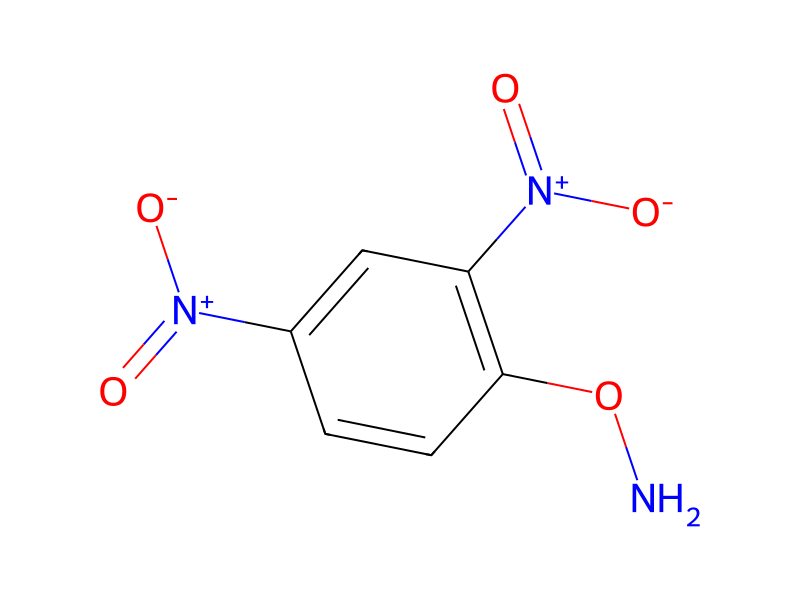
基本情報
- 標準SMILES
NOc1ccc([N+](=O)[O-])cc1[N+](=O)[O-]- InChIKey
YLACRFYIUQZNIV-UHFFFAOYSA-N- 分子式
- C6H5N3O5
- 平均分子量
- 199.12 g/mol
- 単同位体質量
- 199.02292026
概要
structure given in first source
名称と識別子
- 優先名称
- O-(2,4-dinitrophenyl)hydroxylamine
- IUPAC
- O-(2,4-dinitrophenyl)hydroxylamine
- 現地名
- O-(2,4-ジニトロフェニル)ヒドロキシルアミン
- 英語名
- O-(2,4-dinitrophenyl)hydroxylamine
- 分子式
- C6H5N3O5
- 分子量
- 199.12
名称と別名
O-(2,4-Dinitrophenyl)hydroxylamine17508-17-72,4-Dinitrophenoxyamine2,4-Nitrophenoxyamine1-Aminooxy-2,4-dinitrobenzeneI1308NOV00NSC-148499DTXSID20169926RefChem:855089DTXCID4092417241-512-6Hydroxylamine, O-(2,4-dinitrophenyl)-
名称をさらに表示
O-(2,4-ジニトロフェニル)ヒドロキシルアミン2,4-ジニトロフェノキシアミン(2,4-ジニトロフェノキシ)アミン2,4-DinitrophenylhydroxylamineNSC 1484994-dinitrophenyl)hydroxylamine1-aMinooxy-2,4-dinitro-benzeneHydroxylaMine,O-(2,4-dinitrophenyl)-O-(2,4-Dinitrophenyl)hydroxylamine,98%TIANFUCHEM--17508-17-7---O-(2,4-dinitrophenyl)hydroxylamine
DNPAC6H5N3O5MFCD00075001O-(2,4-dinitro-phenyl)-hydroxylamineUNII-I1308NOV001-(aminooxy)-2,4-dinitrobenzene1-Aminooxy-2,4-dinitrobenzene; 2,4-Dinitrophenoxyamine; 2,4-Nitrophenoxyamine; DNPA; NSC 148499;EINECS 241-512-6
データベース識別子
- CAS
17508-17-7- PubChem CID
- 87140
- DTXSID
DTXSID20169926- UNII
- I1308NOV00
- EC Number
- 241-512-6
- Nikkaji
- J287.066E
物性
構造計算による物性
- XLogP
- 0.7
- 極性表面積
- 127 Ų
- 水素結合供与体数
- 1
- 水素結合受容体数
- 6
- 回転可能結合数
- 1
- 重原子数
- 14
- 形式電荷
- 0
- 複雑度
- 235
物理化学的性質
- 融点
- 112.5 °C · 112.5°C
- 沸点
- 336.62 °C · 336.62°C (rough estimate)
- 比重(密度)
- 1.6937 · 1.6937 (rough estimate)
- 屈折率
- 1.691 · 1.6910 (estimate)
- 貯蔵温度
- 2 · 2-8°C(protect from light)
- 溶解性
- DMSO (Sparingly), Methanol (Slightly)
- 外見
- 個体
- 酸解離定数(Pka)
- -1.07 · -1.07±0.70(Predicted)
- 色
- 黄色
- InChI
- InChI=1S/C6H5N3O5/c7-14-6-2-1-4(8(10)11)3-5(6)9(12)13/h1-3H,7H2
- InChIKey
- YLACRFYIUQZNIV-UHFFFAOYSA-N
- SMILES
- NOC1=CC=C([N+]([O-])=O)C=C1[N+]([O-])=O
化学的性質
化学的特性Light yellow solid
安全と法規制
GHS分類
GHS Classification
Warning
H302 (95.6%): Harmful if swallowed [Warning Acute toxicity, oral]
P261, P264, P270, P272, P280, P301+P317, P302+P352, P321, P330, P333+P317, P362+P364, and P501 (click each P-code to see the statement)
Aggregated GHS information provided per 45 reports by companies from 6 notifications to the ECHA C&L Inventory. Each notification may be associated with multiple companies.
危険有害性情報
Hazard Classes and CategoriesAcute Tox. 4 (95.6%)
安全データ
- tsca
- No
- hs_code
- 29221990
- risk_code
- 22-36/37/38
- safety_code
- 26
化学と産業
応用分野
使用O-(2,4-Dinitrophenyl)hydroxylamine is a rapid active-site-directed inhibitor of D-amino acid oxidase; modification results in specific incorporation of an amine group into an accessible nucleophilic r esidue with concomitant release of 2,4-dinitrophenol.
調製方法
製造方法To a stirred solution of 13.3 gm (0.1 mole) of t-butyl JV-hydroxycar-bamate and 5.6 gm (0.1 mole) of potassium hydroxide in 200 ml of absolute ethanol is added 20.2 gm (0.1 mole) of 2,4-dinitrochlorobenzene. The resultant deep red solution is stirred at room temperature for 1 hr; then enough glacial acetic acid is added dropwise to produce a light yellow solution. The solution is poured into 1.5 liters of cold water. The yellow oil which separates is gradually converted to crystals. The solid -butyl JV-(2,4-dinitrophenoxy)carbamate is separated, dried, and recrystallized from an ethyl acetate-hexane mixture to afford 16.4 gm (53%), m.p. 74-75°C. To 15 ml of trifluoroacetic acid is added 4 gm (0.0133 mole) of the i-butyl J/V-(2,4-dinitrophenoxy)carbamate. After the evolution of carbon dioxide has subsided, the solution is poured into 100 ml of ice water. The resultant oily layer crystallizes on standing to afford 2.5 gm (95%), m.p. 112°C (from ethanol). Recently it was discovered that the alkylation of ethyl JV-hydroxy-carbamate under alkaline conditions, particularly in a DMF medium at 60°C in the presence of sodium bicarbonate, leads to the ultimate formation of O-alkylated hydroxylamines. On the other hand, at 80-85°C, the direct alkylation without the presence of a base ultimately leads to N-alkylhydrox-ylamines (see Table I) [59]. The reaction of ethylazidoformate with an alcohol, while perhaps hazardous, may have some merit (Eqs. 31-33). The overall yield, based on ethyl chloroformate, is said to be on the order of 60%.
上流・下流製品情報
上流原料
サプライヤー50 社
合肥翰刚医药科技有限公司+8618062405514 · [email protected]
T&W GROUP021-61551611 13296011611 · [email protected]
Dayang Chem (Hangzhou) Co.,Ltd.+86-0571-88938639 17705817739 · [email protected]
韶远科技(上海)有限公司021-50795510 4000665055 · [email protected]
北京华威锐科化工有限公司0757-86329057 18934348241 · [email protected]
Wuhan EnTai Technology Development Co,.Ltd86-27-82330560 · [email protected]
上海德默医药科技有限公司400-021-7337 2355568890 · [email protected]
安耐吉化学&3A(安徽泽升科技股份有限公司)400-0056266 · [email protected]
上海柏卡化学技术有限公司400-026-1533/(021) 6478-0600 · [email protected]
上海瀚鸿科技股份有限公司021-54306202 13764082696 · [email protected]
南京圣亿来化工有限公司19951936396 · [email protected]
上海钰康生物科技有限公司+86-18930848214 +86-021-56762820 · [email protected]
上海相辉医药科技有限公司13761987713 · [email protected]
上海隆盛化工有限公司58099637 13585536065 · [email protected]
凯试(上海)科技有限公司021-50135380 · [email protected]
郑州研德生物科技有限公司0371-63682289 15538176268 · [email protected]
医恩医疗系统研发(上海)有限公司021-58958002 18930822973 · [email protected]
宁波四明化工有限公司(宁波欧迅化学新材料技术有限公司)0574-86508062 18058587104 · [email protected]
苏州施亚生物科技有限公司86(512)5235 8471 17715136450 · [email protected]
HONG KONG IPURE BIOLOGY CO.,LIMITED86 18062405514 18062405514 · [email protected]
Xiamen AmoyChem Co., Ltd+86-86-5926051114 · [email protected]
上海钰康生物科技有限公司15618758386 15618758386 · [email protected]
上海拓朴医药科技有限公司+86 (21) 5196-9732
郑州今斯孚化学有限公司0371-56635027 13838252817 · [email protected]
北京泰亚杰科技有限公司021-33690831-8001 13552411790;18616022633 · [email protected]
上海特伯化学科技有限公司+86-21-60341587 · [email protected]
南京诺利斯医药科技有限公司13901585132 · [email protected]
江苏艾康生物医药研发有限公司025-66113011 13913916777 · [email protected]
TCI AMERICA800-4238616 · [email protected]
TOKYO CHEMICAL INDUSTRY CO., LTD.03-36680489 · [email protected]
TCI Europe320-37350700 · [email protected]
赛纳斯特化学(欢迎点击联系)021-60343070
上海笛柏生物科技有限公司400-008-9730,021-54359730 400-008-9730 · [email protected]
上海石洋化工有限公司021-56795766 · [email protected]
凯方医药科技(上海)有限公司021-67220633 021-54824098 · [email protected]
湖南华腾制药有限公司400-8592883 · [email protected]
上海鑫圭生物科技有限公司15121041756 · [email protected]
上海麦克林生化科技股份有限公司15221275939 15221275939 · [email protected]
上海纳谦化学科技有限公司13598610367 13598610367 · [email protected]
上海嵩爰化工科技有限公司010-1234567 18521000990 · [email protected]
南京恰风和医药科技有限公司025-57018978 18251899859 · [email protected]
上海堃睿化工科技有限公司+86-021-50935922
苏州新凯生物医药技术有限公司0512-67213637 13952409868 · [email protected]
重庆奥舍生物化工有限公司023-63225655 13320248848 · [email protected]
Henan Alfa Chemical Co., Ltd+8618339805032 · [email protected]
厦门志信化学有限公司+86-5922680277 +86-13806087780 · [email protected]
sgtlifesciences pvt ltd+91-8790379245 · [email protected]
陕西缔都医药化工有限公司+86-29-81139210 +86-17392587031 · [email protected]
成都叮当时代医药科技有限公司028-86040038 · [email protected]
上海天习化工有限公司021-20960837,QQ1332204249 · [email protected]
関連反応
86 件


関連ノート
読み込み中…