
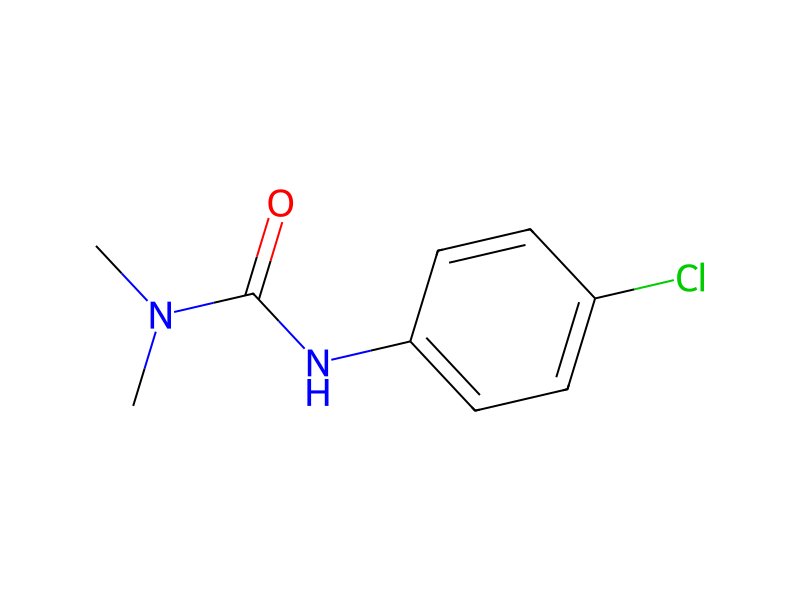
基本情報
- 標準SMILES
CN(C)C(=O)Nc1ccc(Cl)cc1- InChIKey
BMLIZLVNXIYGCK-UHFFFAOYSA-N- 分子式
- C9H11ClN2O
- 平均分子量
- 198.65 g/mol
- 単同位体質量
- 198.05599065
概要
Monuron appears as white crystalline solid or white powder with a slight odor. Melting point 175 °C. Moderately toxic by ingestion. Used as an herbicide.
名称と識別子
- 優先名称
- Monuron
- IUPAC
- 3-(4-chlorophenyl)-1,1-dimethylurea
- 現地名
- 3-(4-クロロフェニル)-1,1-ジメチル尿素
- 英語名
- MONURON
- 分子式
- C9H11ClN2O
- 分子量
- 198.65
名称と別名
MONURON150-68-53-(4-Chlorophenyl)-1,1-dimethylureaChlorfenidimLirobetarexMonuruonMonurexTelvarMonuuronMonuroxHerbicides, monuron1-(4-Chlorophenyl)-3,3-dimethylurea
名称をさらに表示
3-(4-クロロフェニル)-1,1-ジメチル尿素3-(p-クロロフェニル)-1,1-ジメチル尿素モニュロン1,1-ジメチル-3-(4-クロロフェニル)尿素CMU剤1,1-ジメチル-3-(p-クロロフェニル)尿素N'-(4-クロロフェニル)-N,N-ジメチル尿素1,1-ジメチル-3-[4-クロロフェニル]尿素テルバル1-(4-クロロフェニル)-3,3-ジメチル尿素モヌロンN,N-ジメチル-N'-(4-クロロフェニル)尿素3-(4-クロロフェニル)-1,1-ジメチルウレアモヌロン標準品3(pクロロフェニル)1,1ジメチル尿素3‐(4‐クロロフェニル)‐1,1‐ジメチル尿素モニュロン STANDARDモニュロン Standard, 0.1 mg/mL in Acetonitrileモニュロン Standard, 100 µg/mL in MeOHソジオオキシほう素オキシド/塩素酸ナトリウム/N′-(4-クロロフェニル)-N,N-ジメチル尿素CMUCMU(R)karmexwrosuranusafp-8
Usaf p-83-(p-Chlorophenyl)-1,1-dimethylureaUsaf xr-41N'-(4-Chlorophenyl)-N,N-dimethylureaKarmex monuron herbicideMonuroun1,1-Dimethyl-3-(p-chlorophenyl)ureaChlorea
データベース識別子
- CAS
150-68-5- PubChem CID
- 8800
- DTXSID
DTXSID0020311- ChEMBL
CHEMBL467623- ChEBI
CHEBI:38214- UNII
- I99GAK5X1D
- EC Number
- 205-766-1
- Nikkaji
- J2.553D
物性
構造計算による物性
- XLogP
- 1.9
- 極性表面積
- 32.3 Ų
- 水素結合供与体数
- 1
- 水素結合受容体数
- 1
- 回転可能結合数
- 1
- 重原子数
- 13
- 形式電荷
- 0
- 複雑度
- 176
実験および物理化学的性質
pH6.26 SATURATED AQ SOLUTION
SpringerMaterials PropertiesBoiling point
Pesticides
Herbicides
Active substance -> EU Pesticides database: Not approved
Pesticides -> Herbicides, Urea Derivative
Herbicides
Pesticide (Monuron) -> USDA PDB
LogP2.01
Odor
SLIGHT ODOR
Odorless solid
Density
1.27 at 68 °F (NTP, 1992) - Denser than water; will sink
1.27 @ 20 °C/20 °C
Color/Form
WHITE PLATES FROM METHANOL
THIN RECTANGULAR PRISMS FROM METHANOL
Platelets
Solubility
less than 1 mg/mL at 70.7 °F (NTP, 1992)
Monuron-TCA is a crystalline solid; mp 78-81 °C. Solubility (room temperature): 918 mg/l water; 400 g/kg 1,2-dichloroethane; 177 g/kg methanol; 91 g/kg xylene. It is acidic in reaction and incompatible with alkaline materials. /Monuron Trichloroacetate/
VERY SLIGHTLY SOL IN NUMBER 3 DIESEL OIL; MODERATELY SOL IN METHANOL, ETHANOL, PRACTICALLY INSOL IN HYDROCARBON SOLVENTS
SLIGHTLY SOL IN OIL & POLAR SOLVENTS
Solubility (ppm): water 230 (@ 25 °C), acetone 52,000 (@ 27 °C), benzene 2900 (@ 27 °C)
Sol in benzene: 3 g/kg at 27 °C
CorrosivityNON-CORROSIVE
Boiling Point365 to 392 °F at 760 mmHg (decomposes) (NTP, 1992)
DecompositionWhen heated to decomposition it emits very toxic fumes of oxides of nitrogen and /hydrogen/ chloride ions.
Melting Point
338.9 to 340.7 °F (NTP, 1992)
170.5-171.5 °C
物理化学的性質
- 融点
- 173 · 173-174 °C (lit.)
- 沸点
- 301.31 °C · 301.31°C (rough estimate)
- 比重(密度)
- 1 · 1,27 g/cm3
- 蒸気圧
- 0 Pa · 0Pa at 20℃
- 屈折率
- 1.533 · 1.5330 (estimate)
- 貯蔵温度
- 0 · 0-6°C
- 酸解離定数(Pka)
- 14.22 · 14.22±0.70(Predicted)
- 外見
- 結晶性固体
- 色
- 白い
- 水溶解度
- 262 mg/L · 262mg/L(25℃)
- Merck
- 14 · 14,6261
- BRN
- 2097922 · 2097922
- Henry's Law Constant
- 1.7 · 1.7×104 mol/(m3Pa) at 25℃, HSDB (2015)
- InChI
- 1S/C9H11ClN2O/c1-12(2)9(13)11-8-5-3-7(10)4-6-8/h3-6H,1-2H3,(H,11,13)
- InChIKey
- BMLIZLVNXIYGCK-UHFFFAOYSA-N
- SMILES
- CN(C)C(=O)Nc1ccc(Cl)cc1
- LogP
- 1.94 at · 1.94 at 20℃
- EPAの化学物質情報
- Monuron (150-68-5)
化学的性質
化学的特性White, crystalline solid; odorless. Very low solubility in water and hydrocarbonsolvents; slightly soluble in oils; partially soluble inalcohols; stable toward oxidation and moisture.
安全と法規制
GHS分類
GHS Classification
Warning
H302: Harmful if swallowed [Warning Acute toxicity, oral]
P203, P264, P270, P273, P280, P301+P317, P318, P330, P391, P405, and P501 (click each P-code to see the statement)
Warning
H302 (100%): Harmful if swallowed [Warning Acute toxicity, oral]
P203, P264, P270, P273, P280, P301+P317, P318, P330, P391, P405, and P501 (click each P-code to see the statement)
危険有害性情報
Regulatory Information
Chemical: Urea, N'-(4-chlorophenyl)-N,N-dimethyl-
Commission Regulation (EC) No 1490/2002
2002/2076
Status: Active Update: 27-04-2020 https://echa.europa.eu/registration-dossier/-/registered-dossier/24776
Urea, N'-(4-chlorophenyl)-N,N-dimethyl-: Does not have an individual approval but may be used as a component in a product covered by a group standard. It is not approved for use as a chemical in its own right.
The New Jersey Worker and Community Right to Know Act requires public and private employers to provide information about hazardous substances at their workplaces. (N.J.S.A. 34:5A-1 et. seq.)
DOT LabelClass 9
Fire HazardsFlash point data for this chemical are not available; however, it is probably combustible. (NTP, 1992)
Fire Potential... NON-FLAMMABLE.
Health Hazards
SYMPTOMS: Symptoms of exposure to this compound may include fall in blood pressure, convulsions or coma. Other symptoms may include ataxia, drowsiness, hyporeflexia, pallor, tachypnea, dacryorrhea, aciduria, diarrhea, epistaxis, hyperreflexia and irritability.
Hazards Summary
Urea-derived herbicides have low toxicity in animal feeding studies; May induce methemoglobinemia; [HSDB] Systemic toxicity unlikely unless large amounts ingested; [EPA Pesticides, p. 122] Causes anemia and methemoglobinemia in animal experiments; [Merck Index]
Reactive GroupAmides and Imides
Special ReportsDHHS/NTP; Toxicology & Carcinogenesis Studies of Monuron in F344/N Rats and B6C3F1 Mice (Feed Studies) Technical Report Series No. 266 (1988) NIH Publication No. 88-2522
FIFRA Requirements
As the federal pesticide law FIFRA directs, EPA is conducting a comprehensive review of older pesticides to consider their health and environmental effects and make decisions about their future use. Under this pesticide reregistration program, EPA examines health and safety data for pesticide active ingredients initially registered before November 1, 1984, and determines whether they are eligible for reregistration. In addition, all pesticides must meet the new safety standard of the Food Quality Protection Act of 1996. Monuron is found on List A, which contains most food use pesticides and consists of the 194 chemical cases (or 350 individual active ingredients) for which EPA issued registration standards prior to FIFRA, as amended in 1988. Case No: 0045; Pesticide type: Herbicide; Registration Standard Date: 06/30/83,07/01/83; Case Status: No products containing the pesticide are actively registered ... The case /is characterized/ as "cancelled." Under FIFRA, pesticide producers may voluntarily cancel their registered products. EPA also may cancel pesticide registrations if registrants fail to pay required fees or make/meet certain reregistration commitments, or if EPA reaches findings of unreasonable adverse effects.; Active ingredient (AI): Monuron; AI Status: The active ingredient is no longer contained in any registered pesticide products ... "cancelled."
Reactivity Profile
MONURON is a chlorinated urea derivative. May react with azo and diazo compounds to generate toxic gases. May react with strong reducing agents to generate flammable gases. Reacts as a weak base. Combustion generates mixed oxides of nitrogen (NOx).
Air and Water ReactionsInsoluble in water. Is hydrolyzed slowly by acids and alkalis, and more rapidly on heating (NTP, 1992).
Hazard Classes and Categories
Acute Tox. 4 (100%)
Carcinogenicity - category 2
Acute toxicity (Oral) - Category 4
Carc. 2
安全と保護具
Fire FightingFires involving this material can be controlled with a dry chemical, carbon dioxide or Halon extinguisher. (NTP, 1992)
First Aid
EYES: First check the victim for contact lenses and remove if present. Flush victim's eyes with water or normal saline solution for 20 to 30 minutes while simultaneously calling a hospital or poison control center. Do not put any ointments, oils, or medication in the victim's eyes without specific instructions from a physician. IMMEDIATELY transport the victim after flushing eyes to a hospital even if no symptoms (such as redness or irritation) develop.
Fire Fighting ProceduresSelf-contained breathing apparatus, rubber gloves, hats, suits, and boots must be worn.
Storage ConditionsKeep in well ventilated area.
Nonfire Spill Response
SMALL SPILLS AND LEAKAGE: Should a spill occur while you are handling this chemical, FIRST REMOVE ALL SOURCES OF IGNITION, then you should dampen the solid spill material with 60-70% ethanol and transfer the dampened material to a suitable container. Use absorbent paper dampened with 60-70% ethanol to pick up any remaining material. Seal the absorbent paper, and any of your clothes, which may be contaminated, in a vapor-tight plastic bag for eventual disposal. Solvent wash all contaminated surfaces with 60-70% ethanol followed by washing with a soap and water solution. Do not reenter the contaminated area until the Safety Officer (or other responsible person) has verified that the area has been properly cleaned.
Disposal Methods
Treatment at elevated temp by acid or base yields dimethylamine and 3,4-dichloroaniline. Hydrolysis is not recommended as a disposal procedure because of the generation of the toxic product, 3,4-dichloraniline and dimethylamine. Recommendable method: Incineration. Not recommendable method: Hydrolysis. Peer review: Incineration in a unit with effluent gas scrubbing is recommendable. (Peer-review conclusions of an IRPTC expert consultation May 1985))
Preventive MeasuresAVOID INHALING ANY DUST, SPRAY MIST & STRONG VAPOR. /HERBICIDES/
Isolation and EvacuationExcerpt from ERG Guide 171 [Substances (Low to Moderate Hazard)]:
Personal Protective Equipment (PPE)
RECOMMENDED RESPIRATOR: Where the neat test chemical is weighed and diluted, wear a NIOSH-approved half face respirator equipped with a combination filter cartridge, i.e. organic vapor/acid gas/HEPA (specific for organic vapors, HCl, acid gas, SO2 and a high efficiency particulate filter). (NTP, 1992)
PROTECT SKIN & HAIR ... USE ONLY APPROVED RESPIRATORY PROTECTIVE EQUIPMENT, WHEN LABEL DIRECTIONS ADVISE NEED. /HERBICIDES/
Wear rubber gloves for all handling.
毒性情報
Interactions
IN PRESENCE OF MODERATE AMT OF CARBARYL, DEGRADATION /OF MONURON IN COTTON PLANTS/ BEYOND MONO-DEMETHYLATION WAS INHIBITED. ... 4-BENZOTHIOPHENE-N-METHYLCARBAMATE WAS AS EFFECTIVE AS CARBARYL.
FLAVINS (FLAVINMONONUCLEOTIDE) HAVE BEEN SHOWN TO CAUSE PHOTOINACTIVATION OF PHENYLUREAS, SUCH AS MONURON, IN VITRO.
Ecotoxicity Values
LC50 BOBWHITE QUAIL GREATER THAN 5000 PPM/5 DAYS (AGE 17 DAYS, NO MORTALITY TO 5000 PPM)
LC50 JAPANESE QUAIL GREATER THAN 5000 PPM/5 DAYS (AGE 12 DAYS, NO MORTALITY AT 1250 PPM, 7% AT 2500 PPM, 21% AT 5000 PPM)
LC50 RING-NECKED PHEASANT 4682 PPM/5 DAYS (AGE 15 DAYS, 95% CONFIDENCE LIMIT 3902-5746 PPM)
LC50 MALLARD DUCK GREATER THAN 5000 PPM/5 DAYS (AGE 10 DAYS, NO MORTALITY AT 1250 PPM, 10% AT 2500 PPM, 10% AT 5000 PPM)
LC50 Japanese quail (Coturnix japonica), 14 days old, oral (5 day ad libitum in diet) >5,000 ppm
Environmental Fate
TERRESTRIAL FATE: Biodegradation appears to be the major process by which monuron may be lost from most soils(1-2). The loss of monuron from soil surface by photolysis may account for a small fraction of loss of monuron as most of the monuron would move deeper into soil with rain(1). Volatilization loss of monuron from dry soil or wet soils should not be important(1). Monuron may moderately leach in most soils(3-4). Depending on the nature of soil and climatic conditions, the field half-life of monuron in soil range from less than 30 days to 166 days(5-7).
AQUATIC FATE: At low concns (on the order of ug/l), the major process for the loss of monuron from water appears to be biodegradation(1-2). Neither hydrolysis nor any other chemical reaction is important for the loss of monuron in water(1,3). Monuron may photolyze in surface layers of water where sunlight penterates(1). The photolysis half-life of monuron in aqueous solution by natural sunlight is estimated to be 15 days(4). Photolysis is accelerated by the presence of surfactants(5). Based upon the low vapor pressure(6) and high water solubility(7), monuron should not volatilize from water. Monuron is not expected to bioconcentrate in aquatic organisms(7).
ATMOSPHERIC FATE: Based upon on its vapor pressure, 5.03X10⁻⁷ mm Hg at 25 °C(1), monuron is expected to be present partially in the vapor phase and partially in the particulate form in air(2,SRC). Vapor phase monuron will react with photochemically produced hydroxyl radicals with a half-life of 6.7 hr(3-4). Monuron may also be removed from the atmosphere by dry and wet deposition(SRC).
Adverse EffectsMethemoglobinemia - The presence of increased methemoglobin in the blood; the compound is classified as secondary toxic effect
Milk ConcentrationsIN RATS GIVEN 875 MG/KG BODY WT ORALLY, ... MONURON RELATED MATERIAL WAS ... SECRETED INTO MILK OF LACTATING ANIMALS.
Ongoing Test Status
The following link will take the user to the National Toxicology Program (NTP) Test Agent Search Results page, which tabulates all of the "Standard Toxicology & Carcinogenesis Studies", "Developmental Studies", and "Genetic Toxicity Studies" performed with this chemical. Clicking on the "Testing Status" link will take the user to the status (i.e., in review, in progress, in preparation, on test, completed, etc.) and results of all the studies that the NTP has done on this chemical. [http://ntp-apps.niehs.nih.gov/ntp_tox/index.cfm?fuseaction=ntpsearch.searchresults&searchterm=150-68-5]
Soil Adsorption/Mobility
The Koc values for monuron determined from experimental adsorption isotherms or estimated using recommended regression equations range from 83 to 225(1-6). According to a suggested classification scheme(9), Koc values of this magnitude indicate that monuron is moderately to highly mobile in soil. Soil thin layer chromatographic studies also indicate that monuron is moderately mobile in soil(5,7). The adsorption of monuron in soil is virtually independent of pH and clay content of soil, but the adsorption increases with increase in organic carbon content(6,8). However, other investigators concluded that the adsorption of monuron increases with an increase in the clay content of soil(10).
Natural Pollution SourcesMonuron is not known to occur naturally(1).
Artificial Pollution Sources
Since monuron is commercially produced and used as a herbicide(1), it will be released to the environment during the manufacture and particularly during the use of the herbicide(SRC). Accidental spills during loading/unloading and shipment will also release monuron in the environment(SRC).
Environmental Biodegradation
/INVESTIGATORS/ ... WERE ABLE TO ISOLATE FROM BROOKSTON SILTY CLAY LOAM A BACTERIUM OF GENUS PSEUDOMONAS WHICH UTILIZED MONURON AS SOLE SOURCE OF CARBON.
Several pure cultures of bacteria including Pseudomonas, Xanthomonas, Sarcina, and Bacillus and fungi including Penicillium and Aspergillus are capable of degrading monuron(1-3). The major process for the loss of monuron from water is biodegradation(3). At a concentration of 6-7 mg/l, no loss of monuron by mixed microorganisms from river water and sewage was observed in 16 wk(5). However, in a soil-water system, appreciable biodegradation occurred after 16 weeks and 15% of monuron was recovered after 128 wk(4). At an initial concn of 10 ug/l in sewage water, monuron started to mineralize on day 45 and about 20% of monuron mineralized by day 84(6). No mineralization of monuron was observed in 84 days at a concn of 10 mg/l(6). Besides carbon dioxide, products with chromatographic characteristics of 4-(chlorophenyl)urea and 4-chloroaniline were also identified(6).
Monuron is lost from soil primarily through biodegradation(1,3). Monuron loss from two soils was about 40% in 22 wk at a concn of 4 ppm(1). In a clay loam soil, approx. 10% of monuron mineralized to carbon dioxide in 90 days(1). Hydroxylation products of monuron have been identified in soil(5). Except for most heavily treated soils (above 16 lbs/acre), approx. 90% of monuron disappeared in 1 yr. During the second year, loss averaged about 62%(3). Monuron's degradation is a function of application rate(2). Biodegradation is favored by high temperature adequate moisture and high soil organic matter content(2). When monuron was incubated with sediments from a pond under anaerobic conditions, no ring-substituted products were detected in 73 days(4). Therefore, monuron may persist in soil and sediments under anaerobic conditions(SRC).
Carcinogen Classification
Monuron
Group 3: Not classifiable as to its carcinogenicity to humans
Volume Sup 7: Overall Evaluations of Carcinogenicity: An Updating of IARC Monographs Volumes 1 to 42, 1987; 440 pages; ISBN 92-832-1411-0 (out of print)
1991
1990
Monuron
Environmental Bioconcentration
From its water solubility and a regression equation, the bioconcentration factor (BCF) for monuron in aquatic organisms has been estimated to be 29(1). Based on a log Kow value of 1.94(2) and a regression equation(3), the BCF value can be estimated to be 17(SRC). Both these values indicate that bioconcentration of monuron in aquatic organisms should not be important(1,SRC). The low rate of uptake and fast depuration (depuration half-life of 0.45 days) of monuron from catfish (Ictalurus melas)(4) also indicates that bioconcentration will not be important(SRC).
法規制情報
FIFRA Requirements
As the federal pesticide law FIFRA directs, EPA is conducting a comprehensive review of older pesticides to consider their health and environmental effects and make decisions about their future use. Under this pesticide reregistration program, EPA examines health and safety data for pesticide active ingredients initially registered before November 1, 1984, and determines whether they are eligible for reregistration. In addition, all pesticides must meet the new safety standard of the Food Quality Protection Act of 1996. Monuron is found on List A, which contains most food use pesticides and consists of the 194 chemical cases (or 350 individual active ingredients) for which EPA issued registration standards prior to FIFRA, as amended in 1988. Case No: 0045; Pesticide type: Herbicide; Registration Standard Date: 06/30/83,07/01/83; Case Status: No products containing the pesticide are actively registered ... The case /is characterized/ as "cancelled." Under FIFRA, pesticide producers may voluntarily cancel their registered products. EPA also may cancel pesticide registrations if registrants fail to pay required fees or make/meet certain reregistration commitments, or if EPA reaches findings of unreasonable adverse effects.; Active ingredient (AI): Monuron; AI Status: The active ingredient is no longer contained in any registered pesticide products ... "cancelled."
安全データ
- wgk
- 3
- tsca
- TSCA listed
- rtecs
- YS6300000
- ridadr
- UN 3077 9/PG 3
- 毒性
- LD50 orally in rats: 3700 mg/kg (Bailey, White)
- hs_code
- 29242990
- risk_code
- 22-40-50/53
- 化審法
- (3)-2194
- hazard_code
- Xn,N
- safety_code
- 36/37-60-61
- hazard_class
- 9
- packing_group
- III
- Hazard Classifications
- Acute Tox. 4 OralAquatic Acute 1Aquatic Chronic 1Carc. 2
- ストレージクラス
- 11 - Combustible Solids
- 有毒物質データの
- 150-68-5(Hazardous Substances Data)
化学と産業
薬理情報
Mechanism of Action
SUBSTITUTED UREAS ... IN LEAVES ... CAUSE COLLAPSE OF PARENCHYMA VESSELS. ... THEY INHIBIT PHOTOSYNTHESIS ... AND ARE POWERFUL INHIBITORS OF OXIDATION OF WATER TO OXYGEN (HILL REACTION) ... SUGGESTED THAT MONURON BLOCKS PHOTOSYNTHESIS AT SITE OF ELECTRON TRANSFER BY FLAVIN MONONUCLEOTIDE ... .
Metabolism/Metabolites
3-(P-CHLOROPHENYL)-1,1-DIMETHYLUREA YIELDS IN COTTON 3-(P-CHLOROPHENYL)-1-HYDROXYMETHYL-1-METHYLUREA; ALSO YIELDS 3-(P-CHLOROPHENYL)-1-METHYLUREA. /FROM TABLE/
COTTON PLANTS DEGRADED MONURON TO MONOMETHYLMONURON & P-CHLORO-PHENYLUREA BY SUCCESSIVE DEMETHYLATIONS & THEN TO P-CHLOROANILINE BY HYDROLYSIS OF AMIDE BOND.
IN MAMMALS, MONURON IS METABOLIZED (I) BY OXIDATIVE N-DEMETHYLATION, (II) BY HYDROXYLATION OF AROMATIC NUCLEUS & (III) BY FISSION OF UREA RESIDUE TO GIVE CHLOROANILINE DERIVATIVES.
YIELDS OF VARIOUS METABOLITES INDICATE THAT HYDROXYLATION FAVORS 2-POSITION RATHER THAN 3-POSITION. PHENOLIC METABOLITES WERE EXCRETED IN URINE AS CONJUGATES. 4-CHLORO-2-HYDROXYANILINE WAS EXCRETED AS THE N-ACETYL CMPD 2-ACETAMINO-5-CHLOROPHENOL.
For more Metabolism/Metabolites (Complete) data for MONURON (10 total), please visit the HSDB record page.
Absorption, Distribution and Excretion
SUBSTITUTED UREAS ARE READILY ABSORBED BY PLANT ROOTS & TRANSLOCATED TO ACCUMULATE IN LEAVES ... THEY DO NOT PENETRATE READILY THROUGH LEAVES.
AFTER ADMIN OF 175 MG/KG BODY WT/DAY FOR 60 DAYS OR OF 0.1-20.0 MG/KG BODY WT FOR 6 MO, TISSUE RETENTION OF MONURON-RELATED SUBSTANCES OCCURRED /MOST/ IN LUNGS, /DECR RESPECTIVELY IN/ HEART, LIVER, BRAIN & KIDNEYS, MILK, BONE MARROW & THYROID GLAND.
IN RATS GIVEN 875 MG/KG BODY WT ORALLY, PEAK BLOOD CONCN OCCURRED 2 HR AFTER DOSING ... CMPD WAS DISTRIBUTED EVENLY THROUGHOUT BODY.
用途と製造
Uses
Used as a herbicide on roadways, industrial lots, and drainage ditches; [HSDB] No ACTIVE registrants found for selected chemical. [NPIRS]
As of July 1973, monuron is no longer registered for use on agricultural crops. [HSDB]
Farming (Pesticides) [Category: Industry]
The active ingredient is no longer contained in any registered pesticide products ... "cancelled."
The only known use of monuron is as a broad-spectrum herbicide for the control of many grasses and herbaceous weeds on non-cropland areas, such as right-of-way, industrial sites and drainage ditch banks.
AS A SOIL STERILANT MONURON IS PREFERRED ON MEDIUM TO HEAVY SOILS AND UNDER INTERMEDIATE RAINFALL CONDITIONS. AT STERILANT DOSAGES IT CONTROLS A WIDE RANGE OF ANNUAL AND PERENNIAL GRASSES AND BROADLEAF WEEDS ON NONCROP AREAS. /FORMER USE/
U.S. Exports(1973) 4.5X10+7 g
U.S. Imports
(1972) 5.1X10+7 G (PRINCPL CUSTMS DISTS)
(1975) 6.94X10+7 G (PRINCPL CUSTMS DISTS)
(1973) 6.5x10+7 g
U.S. Production
(1971) 3.7X10+7 G (CONSUMPTION)
(1975) 9.1X10+7 G (CONSUMPTION)
Consumption Patterns100% AS HERBICIDE FOR USE ON CROPS (1971)
Methods of Manufacturing
REACTION OF P-CHLOROPHENYL ISOCYANATE WITH DIMETHYLAMINE
PREPD BY REACTING P-CHLOROPHENYL ISOCYANATE WITH DIMETHYLAMINE
p-Chloroaniline in dioxane or another inert solvent with anhydrous hydrogen chloride and phosgene at 70-75 °C forms p-chlorophenyl isocyanate, which at 25 °C with dimethylamine gives monuron.
Formulations/Preparations
WETTABLE POWDER (80% ACTIVE COMPONENT); WATER SUSPENSION 2.8 LB/GALLON ACTIVE INGREDIENT.
Wettable powder (800 g monuron/kg). Mixtures include: Urox, granular (55, 110 or 220 g monuron-TCA/kg), oil miscible liquid, oil/water miscible concentrate oil/water miscible concentrate, (monuron-TCA + 2,4-D)>.
(Monuron +) amitrole.
Monuron is available in the US as a technical grade product, as a wettable powder containing @ 80% of the chemical and as granular formulations containing 2.4-8%. Granular formulations containing both monuron and trichloroacetic acid are also available, with several concentrations of each ai.
Use ClassificationHerbicides
General Manufacturing Information
Urea, N'-(4-chlorophenyl)-N,N-dimethyl-: ACTIVE
RESIDUES OF 1-7 MG/KG WERE TOLERATED ON ... FRUITS & VEGETABLES. AS OF JULY 1973 ... MONURON IS NO LONGER REGISTERED FOR USE ON ANY AGRICULTURAL CROP (US EPA, 1975).
... DIFFERENTIAL METAB IS ONE OF MAJOR FACTORS RESPONSIBLE FOR SELECTIVITY OF PHENYLUREA HERBICIDES. IN PARTICULAR, COTTON EXHIBITED REMARKABLE ABILITY TO DEGRADE MONURON ... IN CONTRAST TO CERTAIN MONOCOTYLEDONOUS PLANT SPECIES ... DIFFERENCES IN METAB ... BASED ON DIFFERENT RATES OF DEGRADATION AND NOT ON DIFFERENCES IN BIOCHEMICAL TRANSFORMATION PATHWAYS.
IT IS RECOMMENDED @ 10 TO 30 KG AI/HA FOR TOTAL WEED CONTROL OF NON-CROP AREAS; 5 TO 10 KG AI/HA SUFFICES FOR ANNUAL MAINTENANCE.
応用分野
用途尿素系除草剤
使用Monuron may be used as a reference standard in the determination of monuron in rice and corn using high performance liquid chromatography coupled with fluorescence detection combined with ultraviolet decomposition and post-column derivatization.
一般的な説明White crystalline solid or white powder with a slight odor. Melting point 175°C. Moderately toxic by ingestion. Used as an herbicide.
調製方法
純化方法Crystallise monuron from MeOH. [Beilstein 12 IV 1191.]
上流・下流製品情報
下流製品
サプライヤー50 社
上海阿拉丁生化科技股份有限公司400-6206333 13167063860 · [email protected]
北京福源坊科技有限公司010-57903446 15869909019 · [email protected]
湖北威德利化学试剂有限公司181-6332-1995 18062128043 · [email protected]
广州佳途科技股份有限公司81960175 18933936954 · [email protected]
武汉欣扬瑞和化学科技有限公司153-07155313 15307155313 · [email protected]
苏州市森菲达化工有限公司18796480002 18796480002 · [email protected]
Syntechem Co.,Ltd[email protected]
阿法埃莎(中国)化学有限公司400-6106006 · [email protected]
梯希爱(上海)化工贸易有限公司021-61109150 · [email protected]
上海艾梯西生物科技有限公司18721763493
上海毕楷科技有限公司18516304666
山东李比希生物医药科技有限公司15318973357; 15318973357 · [email protected]
四川库利南科技有限公司400-1166-196 18981987031 · [email protected]
天津希恩思生化科技有限公司400 638 7771 · [email protected]
ZHEJIANG JIUZHOU CHEM CO., LTD+86-0576225566889 +86-13454675544 · [email protected];[email protected];[email protected]
斯百全化学(上海)有限公司021-021-021-67601398-809-809-809 15221380277 · [email protected]
TargetMol 中国(陶术生物)400-821-0310 15002144251 · [email protected]
艾科试剂4008-755-333 18080918076 · [email protected]
TCI AMERICA800-4238616 · [email protected]
TOKYO CHEMICAL INDUSTRY CO., LTD.03-36680489 · [email protected]
TCI Europe320-37350700 · [email protected]
南京生利德生物科技有限公司025-57798810 18652991625 · [email protected]
陕西麟邦实业有限公司17709134430 · [email protected]
天成化工(江苏)有限公司0512-66387919 18662433356 · [email protected]
上海将来实业股份有限公司400-0066400 13621662912 · [email protected]
天津阿尔塔科技有限公司022-65378550-8551 · [email protected]
天津普西唐生物医药科技有限公司010-60605840 · [email protected]
青岛海智微元生物科技有限公司18317699790 18317699790 · [email protected]
Sigma-Aldrich西格玛奥德里奇(上海)贸易有限公司021-61415566 800-8193336 · [email protected]
天津阿尔塔科技有限公司022-6537-8550 15522853686 · [email protected]
九鼎化学(上海)科技有限公司4009209199 · [email protected]
陕西缔都医药化工有限公司029-029-81120477 17792793610 · [email protected]
湖北万业众诚化学试剂有限责任公司18671296875 · [email protected]
上海源叶生物科技有限公司13636370518 · [email protected]
南京罗迈美生物科技有限公司[email protected]
山东小野化学股份有限公司0539-6362799 20)
金锦乐(湖南)化学有限公司18001959627(微信同号) 18001959627 · [email protected]
上海贤鼎生物科技有限公司021-021-52271985 17721149837 · [email protected]
上海万千化工有限公司18796480002 18796480002 · [email protected]
武汉研哲科技有限公司15527250409 · [email protected]
Shanghai Acmec Biochemical Technology Co., Ltd.+86-18621343501 · [email protected]
Shaanxi Didu New Materials Co. Ltd+86-86-17392712779 +86-13289823923 · [email protected]
杭州洁汉化工有限公司+86-571-86217390; +8618058761490 · [email protected]
上海百舜生物科技有限公司021-37581181 · [email protected]
深圳市丽晶生化科技有限公司0755-85201366 18938635012 · [email protected]
南京宁凡医药科技有限公司17368696818
河南天孚化工有限公司+86-0371-55170693 +86-19937530512 · [email protected]
厦门盈融达化工有限公司+86-0592-6210733 · [email protected]
天津希恩思生化科技有限公司400-6387771-6039 18920764717 · [email protected]
career henan chemical co+86-0371-86658258 · [email protected]
補足説明
定義ChEBI: A member of the class of ureas that is urea in which one of the nitrogens is substituted by a p-chlorophenyl group while the other is substituted by two methyl groups.
関連反応
2 件

関連ノート
読み込み中…