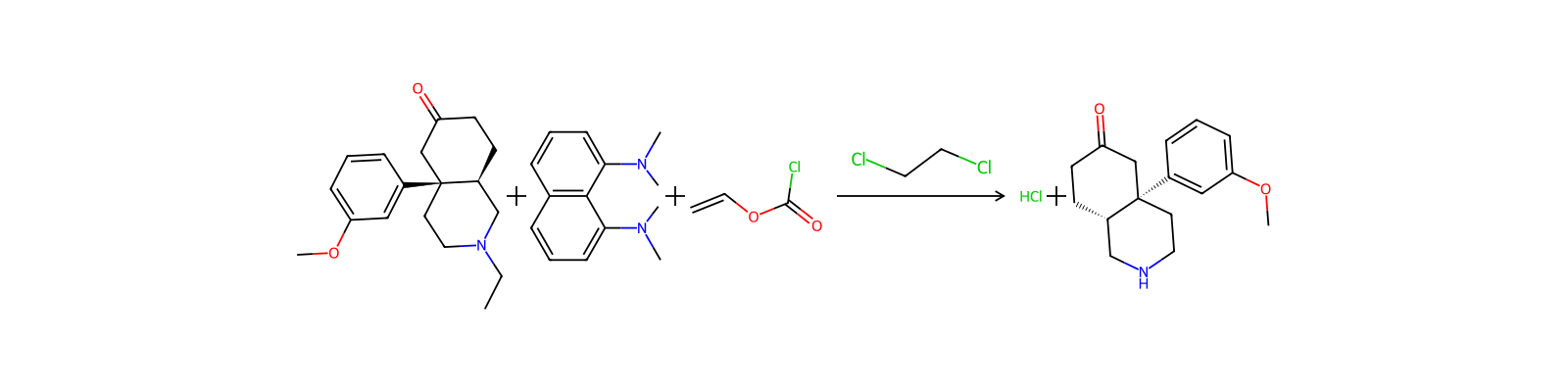
1,8-ビス(ジメチルアミノ)ナフタレン
Proton sponge
データを補完しています。しばらくしてからページを更新すると最新の内容を表示できます

基本情報
- CAS
20734-58-1- 標準SMILES
CN(C)c1cccc2cccc(N(C)C)c12- InChIKey
GJFNRSDCSTVPCJ-UHFFFAOYSA-N- 分子式
- C14H18N2
- 平均分子量
- 214.31 g/mol
- 単同位体質量
- 214.14699858
概要
N1,N1,N8,N8-tetramethylnaphthalene-1,8-diamine is a member of naphthalenes.
名称と識別子
- 優先名称
- Proton sponge
- IUPAC
- 1-N,1-N,8-N,8-N-tetramethylnaphthalene-1,8-diamine
- 現地名
- 1,8-ビス(ジメチルアミノ)ナフタレン
- 英語名
- 1,8-Bis(dimethylamino)naphthalene
- 分子式
- C14H18N2
- 分子量
- 214.31
名称と別名
20734-58-11,8-Bis(dimethylamino)naphthaleneProton spongeDMAN cpd6S79D2P9H8DTXSID10174807RefChem:73727DTXCID5097298244-001-6N1,N1,N8,N8-tetramethylnaphthalene-1,8-diamine1,8-Bis(dimethylamino)naphtaleneN,N,N',N'-Tetramethyl-1,8-naphthalenediamine
名称をさらに表示
1,8-ビス(ジメチルアミノ)ナフタレンプロトンスポンジ4,5-ビス(ジメチルアミノ)ナフタレンN,N,N',N'-テトラメチル-1,8-ナフタレンジアミンN,N,N',N'-テトラメチルナフタレン-1,8-ジアミンN,N,N',N'-テトラメチル-1,8-ジアミノナフタレンN,N,N’,N’-テトラメチルナフタレン-1,8-ジアミン1,8‐ビス(ジメチルアミノ)ナフタレン1,8-ビス(ジメチルアミノ)ナフタレン, 98+%N1,N1,N8,N8-テトラメチルナフタレン-1,8-ジアミンN, N, N ', N ' -テトラメチル-1,8-ナフタレンジアミンN,N,N′,N′-テトラメチル-1,8-ナフタレンジアミンプロトン スポンジN,N,N′,N′-テトラメチルナフタレン-1,8-ジアミンN,N,N',N'-tetramethyl-1,8-diaminonaphthalenePROTON-SPONGE(R)proton-sponge tmLABOTEST-BB LT004539821, 8-dimethylaminonaphthalene
1-N,1-N,8-N,8-N-tetramethylnaphthalene-1,8-diamine1,8-Naphthalenediamine, N,N,N',N'-tetramethyl-Proton-spongeMFCD00003920N,N,N',N'-Tetramethylnaphthalene-1,8-diamine1,8-Naphthalenediamine, N1,N1,N8,N8-tetramethyl-Maybridge1_002116N,N,N',N'-Tetramethyl-1,8-naphthalene diamine
データベース識別子
- CAS
20734-58-1- PubChem CID
- 88675
- DTXSID
DTXSID10174807- ChEMBL
CHEMBL1574733- ChEBI
CHEBI:194986- UNII
- 6S79D2P9H8
- EC Number
- 244-001-6
- Nikkaji
- J83.008I
物性
構造計算による物性補完中
- XLogP
- 3.4
- 極性表面積
- 6.5 Ų
- 水素結合供与体数
- 0
- 水素結合受容体数
- 2
- 回転可能結合数
- 2
- 重原子数
- 16
- 形式電荷
- 0
- 複雑度
- 203
実験および物理化学的性質
PolymersNitrogen Compounds -> Amines, Polyaromatic
SpringerMaterials Properties13C nuclear magnetic resonance spectrum
Solubility31.2 [ug/mL] (The mean of the results at pH 7.4)
Physical DescriptionPale cream crystalline powder; [Alfa Aesar MSDS]
物理化学的性質
- 融点
- 49 · 49-51 °C(lit.)
- 沸点
- 144 · 144-145°C (3.7505 mmHg)
- 比重(密度)
- 1.12 · 1.12
- 闪点
- 230 °F · >230 °F
- 貯蔵温度
- Keep in dark place,Inert atmosphere,Room temperature
- 溶解性
- 有機溶剤に可溶。
- 外見
- 結晶性粉末
- 酸解離定数(Pka)
- 12.1 · 12.1(at 25℃)
- 色
- 淡い茶色がかったピンク
- 水溶解度
- 不溶性
- Merck
- 14 · 14,3388
- BRN
- 396782 · 396782
安全と法規制
安全情報は参考情報です。供給元の安全データシート(SDS)、適用法令、専門家による評価に代わるものではありません。
GHS分類
GHS Classification
Warning
H302 (100%): Harmful if swallowed [Warning Acute toxicity, oral]
P261, P264, P264+P265, P270, P271, P280, P301+P317, P302+P352, P304+P340, P305+P351+P338, P319, P321, P330, P332+P317, P337+P317, P362+P364, P403+P233, P405, and P501 (click each P-code to see the statement)
Aggregated GHS information provided per 95 reports by companies from 8 notifications to the ECHA C&L Inventory. Each notification may be associated with multiple companies.
危険有害性情報
Regulatory Information
Chemical: 1,8-Naphthalenediamine, N,N,N',N'-tetramethyl-
1,8-Bis(dimethylamino)-naphthalene: Does not have an individual approval but may be used under an appropriate group standard
Hazards SummaryCauses burns; [Alfa Aesar MSDS]
Hazard Classes and CategoriesAcute Tox. 4 (100%)
毒性情報
Adverse EffectsDermatotoxin - Skin burns.
安全データ
- F
- 8-10-23
- wgk
- 3
- ridadr
- 3259
- hs_code
- 29215900
- risk_code
- 22-36/37/38-34
- hazard_code
- Xn,C
- safety_code
- 26-45-36/37/39
- hazard_class
- 8
化学と産業
用途と製造
UsesPrototype of a group of very high alkalinity aromatic diamines known as proton sponges; Used in organic synthesis and catalysis; [Merck Index]
応用分野
用途有機合成において、微量のプロトン源によって反応が妨害される場合、プロトンスポンジの添加が効果的な場合がある。
用途有機合成原料。
説明Significant attention in organic chemistry has been given to the so-called proton sponges, which are bi-center nitrogen bases that show spectacularly high basicity and very low nucleophilic character. The first member of this class of compounds 1,8-bis(dimethylamino)naphthalene or DMAN dragged attention due to its unexpectedly high basicity (pKa: DMAN 12.1; 1,8-diaminonaphthalene: 4.6) after its discovery in 1941[1]. It is prepared with an 82% yield from 1,8-diaminonaphthalene, dimethyl sulfate, and sodium hydride.
使用1,8-Bis(dimethylamino)naphthalene, also referred to as protone sponge, is a lipophilic proton trapping agent. 1,8-Bis(dimethylamino)naphthalene is used in the matrix for mass spectroscopy analysis of lipids and fatty acids.
一般的な説明Proton-sponge is also referred as 1,8-dimethylamino naphthalene. It is very strong base with weak nucleophilic character due to steric effects. It also participates in the reactions between arachno-6,9-C2B8H14 and selected acyl chlorides. It has been tested as an effective H+ scavenger.
調製方法
純化方法1,8-Bis(dimethylamino)naphthalene is prepared by methylating 1,8-diaminonaphthalene, and likely impurities are methylated products. The tetramethyl compound is a stronger base than the unmethylated, di and trimethylated derivatives. The pKa values are: 1,8-(NH2)2 = 4.61, 1,8-(NHMe)2 = 5.61, 1-NHMe-8-NHMe2 = 6.43 and 1,8-(NMe2)2 = 12.34. The mixture is then treated with H2O at pH 8 (where all but the required base are protonated) and extracted with Et2O or CHCl3. The dried extract (K2CO3) yields the tetramethyldiamine on evaporation which can be distilled. It is a strong base with weak nucleophilic properties, e.g. it could not be alkylated by refluxing with EtI in MeCN for 4 days; and on treatment with methyl fluorosulfonate only the fluorosulfonate salt of the base is obtained. [NMR: Adler et al. J Chem Soc, Chem Commun 723 1968, Brown & Letang J Am Chem Soc 63 358 1941, Brzezinski et al. J Chem Soc Perkin Trans 2 857 1991.] Alternatively, crystallise proton sponge from EtOH and dry it in a vacuum oven. Store it in the dark in a CO2-free atmosphere. [Benoit et al. Can J Chem 65 996 1987, Beilstein 13 IV 344.]
関連反応
365 件


化合物ノート
読み込み中…