
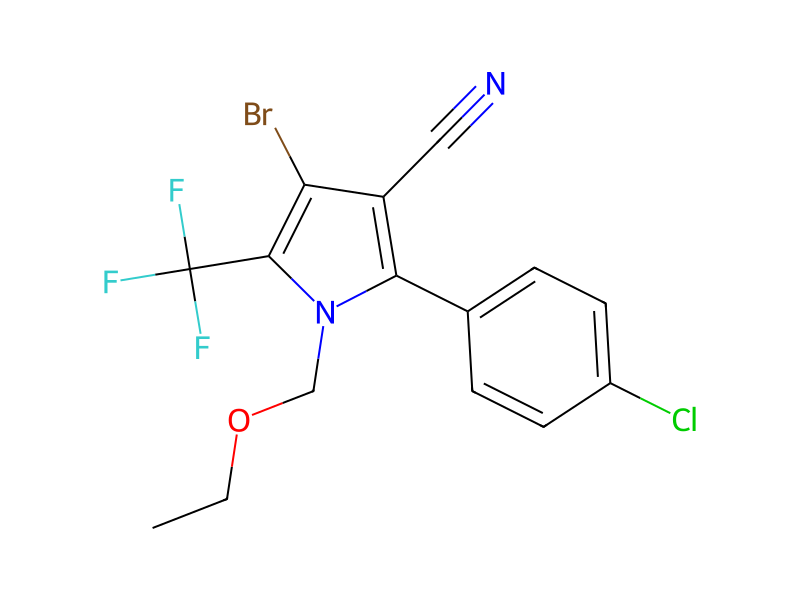
基本情報
- 標準SMILES
CCOCn1c(-c2ccc(Cl)cc2)c(C#N)c(Br)c1C(F)(F)F- InChIKey
CWFOCCVIPCEQCK-UHFFFAOYSA-N- 分子式
- C15H11BrClF3N2O
- 平均分子量
- 407.61 g/mol
- 単同位体質量
- 405.96953741
概要
Chlorfenapyr is a member of the class of pyrroles that is 4-bromo-1H-pyrrole-3-carbonitrile which is substituted at positions 1, 2 and 5 by ethoxymethyl, p-chlorophenyl and trifluoromethyl groups, respectively. A proinsecticide used for termite control and crop protection against several insects and mite pests. It has a role as a proinsecticide and a proacaricide. It is a hemiaminal ether, a nitrile, an organochlorine insecticide, a member of pyrroles, an organochlorine acaricide, an organofluorine insecticide, an organofluorine acaricide and a member of monochlorobenzenes. It is functionally related to a tralopyril.
名称と識別子
- 優先名称
- Chlorfenapyr
- IUPAC
- 4-bromo-2-(4-chlorophenyl)-1-(ethoxymethyl)-5-(trifluoromethyl)pyrrole-3-carbonitrile
- 現地名
- クロルフェナピル
- 英語名
- Chlorfenapyr
- 分子式
- C15H11BrClF3N2O
- 分子量
- 407.61
名称と別名
Chlorfenapyr122453-73-0PirateKotetsuPylon4-Bromo-2-(4-chlorophenyl)-1-(ethoxymethyl)-5-(trifluoromethyl)-1H-pyrrole-3-carbonitrilePirate 3FAC 303630CL 3036301H-Pyrrole-3-carbonitrile, 4-bromo-2-(4-chlorophenyl)-1-(ethoxymethyl)-5-(trifluoromethyl)-DTXSID9032533NWI20P05EB
名称をさらに表示
クロルフェナピル標準品クロルフェナピル4-ブロモ-2-(4-クロロフェニル)-1-エトキシメチル-5-(トリフルオロメチル)ピロール-3-カルボニトリル4-ブロモ-2-(4-クロロフェニル)-1-エトキシメチル-5-トリフルオロメチルピロール-3-カルボニトリルクロルフェナピル STANDARDクロルフェナピル標準物質クロルフェナピル Standard, 100µg/mL in Methanolコテツ4-ブロモ-2-(4-クロロフェニル)-1-エトキシメチル-5-トリフルオロメチル-1H-ピロール-3-カルボニトリル4-ブロモ-2-(4-クロロフェニル)-1-エトキシメチル-5-トリフルオロメチル-3-ピロールカルボニトリル4-ブロモ-2-(4-クロロフェニル)-1-(エトキシメチル)-5-(トリフルオロメチル)-1H-ピロール-3-カルボニトリル1-(エトキシメチル)-2-(4-クロロフェニル)-4-ブロモ-5-(トリフルオロメチル)-1H-ピロール-3-カルボニトリル4-ブロモ-1-(エトキシメチル)-5-(トリフルオロメチル)-2-(4-クロロフェニル)-1H-ピロール-3-カルボニトリルコテツフロアブルピラート1-エトキシメチル-2-(p-クロロフェニル)-4-ブロモ-5-トリフルオロメチル-1H-ピロール-3-カルボニトリル4-BROMO-2-(4-CHLOROPHENYL)-1-(ETHOXYMETHYL)-5-(TRIFLUOROMETHYL)-1H-PYRROL-3-CARBONITRILEAlertSTALKERIntrepidCitrexSunfireKotersu
AC303630AC-303630DTXCID7012533CHEBI:39347AC 303,630RefChem:125308602-782-4chlorfenapyr (ISO); 4-bromo-2-(4-chlorophenyl)-1-ethoxymethyl-5-trifluoromethylpyrrole-3-carbonitrile
データベース識別子
- CAS
122453-73-0- PubChem CID
- 91778
- DTXSID
DTXSID9032533- ChEMBL
CHEMBL1869551- ChEBI
CHEBI:39347- UNII
- NWI20P05EB
- EC Number
- 602-782-4
- Nikkaji
- J582.370F
物性
構造計算による物性
- XLogP
- 4.5
- 極性表面積
- 38 Ų
- 水素結合供与体数
- 0
- 水素結合受容体数
- 5
- 回転可能結合数
- 4
- 重原子数
- 23
- 形式電荷
- 0
- 複雑度
- 448
実験および物理化学的性質
pHpH = 7.16; 1% aqueous slurry at 24 °C
Pesticides
Acaricides, Insecticides
Active substance -> EU Pesticides database: Not approved
Pesticides -> Other Insecticides
Pesticide (Chlorfenapyr) -> USDA PDB
LogPlog Kow = 4.83
OdorCharacteristic of halides and ketones
Density0.543 g/ml tapped bulk density
Color/Form
Light tan or light yellow powdered solid
White solid
Solubility
Soluble in acetone, diethyl ether, DMSO, THF, acetonitrile, alcohols. Insoluble in water
Solubities at 25 °C. [Table#7120]
Solubities in water at 25 °C. [Table#7121]
DecompositionWhen heated to decomposition it emits toxic vapors of /hydrogen chlorid, hydrogen fluoride, and nitrogen oxides/.
Melting Point
100-101 °C
MP: 91-92 °C
Vapor Pressure0.00000007 [mmHg]
Physical DescriptionWhite solid; [Merck Index] Light tan or light yellow solid; [HSDB] White solid; [MSDSonline]
Collision Cross Section
177.74 Ų [M+H]+ [CCS Type: TW; Buffer gas: N2; Ionization: GC-APCI+]
190.4 Ų [M+HCOO]-
物理化学的性質
- 融点
- 91 · 91-92°
- 沸点
- 443.5 · 443.5±45.0 °C(Predicted)
- 比重(密度)
- 1.53 · 1.53±0.1 g/cm3(Predicted)
- 貯蔵温度
- 2 · Sealed in dry,2-8°C
- 水溶解度
- Insoluble in water
- 溶解性
- 250 mg/mL · DMSO: 250 mg/mL (613.33 mM)
- 酸解離定数(Pka)
- -18 · -18.00±0.70(Predicted)
- 外見
- Solid
- 色
- White to Almost white
- BRN
- 6940152 · 6940152
- Henry's Law Constant
- 1.7 · 1.7×103 mol/(m3Pa) at 25℃, HSDB (2015)
- 主な用途
- 農業環境
- InChI
- InChI=1S/C15H11BrClF3N2O/c1-2-23-8-22-13(9-3-5-10(17)6-4-9)11(7-21)12(16)14(22)15(18,19)20/h3-6H,2,8H2,1H3
- InChIKey
- CWFOCCVIPCEQCK-UHFFFAOYSA-N
- SMILES
- N1(COCC)C(C(F)(F)F)=C(Br)C(C#N)=C1C1=CC=C(Cl)C=C1
- CAS データベース
- 122453 · 122453-73-0(CAS DataBase Reference)
- NISTの化学物質情報
- Chlorfenapyr(122453-73-0)
- EPAの化学物質情報
- Chlorfenapyr (122453-73-0)
化学的性質
化学的特性Off-White Solid
安全と法規制
GHS分類
GHS Classification
Danger
H302: Harmful if swallowed [Warning Acute toxicity, oral]
P261, P264, P270, P271, P273, P301+P317, P304+P340, P316, P321, P330, P391, P403+P233, P405, and P501 (click each P-code to see the statement)
Danger
H302 (100%): Harmful if swallowed [Warning Acute toxicity, oral]
P261, P264, P270, P271, P273, P301+P317, P304+P340, P316, P321, P330, P391, P403+P233, P405, and P501 (click each P-code to see the statement)
危険有害性情報
Regulatory Information
Chlorfenapyr is listed in the dataset of EPA Human Health Benchmarks for Pesticides under the Safe Drinking Water Act (40 eCFR 141)
2001/697/EC
Chlorfenapyr: HSNO Approval: HSR006718 Approved with controls
Hazards Summary
A moderate eye irritant; [HSDB] The active metabolite uncouples oxidative phosphorylation in the mitochondria causing cellular death; [Reference #1] In high-dose animal studies, causes liver changes, depressed activity and ataxia; [RTECS] A mild skin and eye irritant based on animal studies; [MSDSonline]
FIFRA Requirements
Tolerances are established for residues of the insecticide chlorfenapyr [4-bromo-2-(4-chlorophenyl)-1-(ethoxymethyl)-5-(trifluoromethyl)-1H-pyrrole-3-carbonitrile] in or on the following raw agricultural commodities: vegetables, fruiting, group 8.
A tolerance is established for residues of chlorfenapyr in or on all food commodities (other than those covered by a higher tolerance as a result of use on growing crops) in food/feed handling areas where food/feed products are prepared, held, processed, or served and in accordance with the following prescribed conditions: (i) Application shall be no greater than a 0.5% active ingredient solution for spot crack and crevice use in food/feed handling establishments, where food and food products are held, processed, prepared and/or served. (ii) Application may only be undertaken when the facility is not in operation, and provided exposed food has been covered, or removed from the area being treated prior to application. (iii) Food contact surfaces and equipment should be throughly washed with an effective cleaning compound, and rinsed with potable water after each use of the product. (iv) Contamination of food or food contact surfaces shall be avoided. Application excludes any direct application to any food, food packaging, or any food contact surfaces. (v) To assure safe use, the label and labeling shall conform to that registered by the U.S. Environmental Protection Agency, and it shall be used in accordance with such label and labeling.
Under the authority of Section 3(c)(5), the Agency has determined that the database supports granting an unconditional registration for Chlorfenapyr Technical, and for Pylon Miticide-Insecticide (21.4% chlorfenapyr), for use on ornamentals grown in commercial greenhouses.
DOT Emergency Guidelines
/GUIDE 154: SUBSTANCES - TOXIC AND/OR CORROSIVE (NON-COMBUSTIBLE)/ Health: TOXIC; inhalation, ingestion, or skin contact with material may cause severe injury or death. Contact with molten substance may cause severe burns to skin and eyes. Avoid any skin contact. Effects of contact or inhalation may be delayed. Fire may produce irritating, corrosive and/or toxic gases. Runoff from fire control or dilution water may be corrosive and/or toxic and cause pollution. /Poisonous solid, organic, NOS; Toxic solid, organic, NOS (Chlorfenapyr)/
/GUIDE 154: SUBSTANCES - TOXIC AND/OR CORROSIVE (NON-COMBUSTIBLE)/ Fire or Explosion: Non-combustible, substance itself does not burn but may decompose upon heating to produce corrosive and/or toxic fumes. Some are oxidizers and may ignite combustibles (wood, paper, oil, clothing, etc.). Contact with metals may evolve flammable hydrogen gas. Containers may explode when heated. /Poisonous solid, organic, NOS; Toxic solid, organic, NOS (Chlorfenapyr)/
/GUIDE 154: SUBSTANCES - TOXIC AND/OR CORROSIVE (NON-COMBUSTIBLE)/ Public Safety: CALL Emergency Response Telephone Number ... . As an immediate precautionary measure, isolate spill or leak area in all directions for at least 50 meters (150 feet) for liquids and at least 25 meters (75 feet) for solids. Keep unauthorized personnel away. Stay upwind. Keep out of low areas. Ventilate enclosed areas. /Poisonous solid, organic, NOS; Toxic solid, organic, NOS (Chlorfenapyr)/
/GUIDE 154: SUBSTANCES - TOXIC AND/OR CORROSIVE (NON-COMBUSTIBLE)/ Protective Clothing: Wear positive pressure self-contained breathing apparatus (SCBA). Wear chemical protective clothing that is specifically recommended by the manufacturer. It may provide little or no thermal protection. Structural firefighters' protective clothing provides limited protection in fire situations ONLY; it is not effective in spill situations where direct contact with the substance is possible. /Poisonous solid, organic, NOS; Toxic solid, organic, NOS (Chlorfenapyr)/
For more DOT Emergency Guidelines (Complete) data for CHLORFENAPYR (8 total), please visit the HSDB record page.
Hazard Classes and Categories
Acute Tox. 4 (100%)
Acute toxicity - category 3
Acute toxicity (Oral) - Category 4
Acute Tox. 3 *
Explosive Limits and PotentialNot explosive
Skin, Eye, and Respiratory IrritationsChlorfenapyr is a moderate but reversible eye irritant, but not a skin irritant.
安全と保護具
Fire Fighting ProceduresUse water, alcohol foam, dry chemical, or carbon dioxide to extinguish fires.
Storage Conditions
Do not store below 32 °F. ... Store in a secure, dry, ventilated area away from children, livestock, and food. Do not store in direct sunlight or heat.
Safe Storage of Pesticides. Always store pesticides in their original containers, complete with labels that list ingredients, directions for use, and first aid steps in case of accidental poisoning. Never store pesticides in cabinets with or near food, animal feed, or medical supplies. Do not store pesticides in places where flooding is possible or in places where they might spill or leak into wells, drains, ground water, or surface water.
Cleanup Methods
If a spill occurs, clean it up promptly. Don't wash it away. Instead, sprinkle the spill with sawdust, vermiculite, or kitty litter. Sweep it into a plastic garbage bag, and dispose of it as directed on the pesticide product label.
After Applying a Pesticide, Indoors or Outdoors. To remove pesticide residues, use a bucket to rinse tools or equipment three times, including any containers or utensils that you used when mixing the pesticide. Then pour the rinsewater into the pesticide sprayer and reuse the solution by applying it according to the pesticide product label directions. After applying any pesticide wash your hands and any other parts of your body that may have come in contact with the pesticide..To prevent tracking pesticides inside, remove or rinse your boots or shoes before entering your home. Wash any clothes that have been exposed to a lot of pesticide separately from your regular wash.
Disposal Methods
SRP: The most favorable course of action is to use an alternative chemical product with less inherent propensity for occupational exposure or environmental contamination. Recycle any unused portion of the material for its approved use or return it to the manufacturer or supplier. Ultimate disposal of the chemical must consider: the material's impact on air quality; potential migration in soil or water; effects on animal, aquatic, and plant life; and conformance with environmental and public health regulations.
Do not contaminate water, food, or feed by disposal.
Safe Disposal of Pesticides. The best way to dispose of small amounts of excess pesticides is to use them - apply them - according to the directions on the label. If you cannot use them, ask your neighbors whether they have a similar pest control problem and can use them. If all of the remaining pesticide cannot be properly used, check with your local solid waste management authority, environmental agency, or health department to find out whether your community has a household hazardous waste collection program or a similar program for getting rid of unwanted, leftover pesticides. These authorities can also inform you of any local requirements for pesticide waste disposal.
Safe Disposal of Pesticides. An empty pesticide container can be as hazardous as a full one because of residues left inside. Never reuse such a container. When empty, a pesticide container should be rinsed carefully three times and the rinsewater thoroughly drained back onto the sprayer or the container previously used to mix the pesticide. Use the rinsewater as a pesticide, following label directions. Replace the cap or closure securely. Dispose of the container according to label instructions. Do not puncture or burn a pressurized container like an aerosol - it could explode. Do cut or puncture other empty pesticide containers made of metal or plastic to prevent someone from reusing them. Wrap the empty container and put it in the trash after you have rinsed it.
Preventive Measures
Do not get in eyes, on skin, or clothing. Avoid breathing vapor or mist. Harmful if inhaled. Wash thoroughly after handling with soap and water.
Wear the items of protective clothing the label requires: for example, non-absorbent gloves (not leather or fabric), rubber footwear (not canvas or leather), a hat, goggles, or a dust-mist filter. If no specific clothing is listed, gloves, long-sleeved shirts and long pants, and closed shoes are recommended. You can buy protective clothing and equipment at hardware stores or building supply stores.
Indoor Applications. If the label directions permit, leave all windows open and fans operating after the application is completed. If the pesticide product is only effective in an unventilated (sealed) room or house, do not stay there. Put all pets outdoors, and take yourself any your family away from treated areas for at least the length of time prescribed on the label. Apply most surface sprays only to limited areas such as cracks; don't treat entire floors, walls, or ceilings. Don't let pesticides get on any surfaces that are used for food preparation. Wash any surfaces that may have pesticide residue before placing food on them.
Outdoor Applications. Never apply pesticides outdoors on a windy day (winds higher than 10 mph). Position yourself so that a light breeze does not blow pesticide spray or dust into your face.
SRP: The scientific literature for the use of contact lenses in industry is conflicting. The benefit or detrimental effects of wearing contact lenses depend not only upon the substance, but also on factors including the form of the substance, characteristics and duration of the exposure, the uses of other eye protection equipment, and the hygiene of the lenses. However, there may be individual substances whose irritating or corrosive properties are such that the wearing of contact lenses would be harmful to the eye. In those specific cases, contact lenses should not be worn. In any event, the usual eye protection equipment should be worn even when contact lenses are in place.
Allowable Tolerances
Tolerances are established for residues of the insecticide chlorfenapyr [4-bromo-2-(4-chlorophenyl)-1-(ethoxymethyl)-5-(trifluoromethyl)-1H-pyrrole-3-carbonitrile] in or on the following raw agricultural commodities: vegetables, fruiting, group 8, 1.0 ppm.
A tolerance of 0.01 parts per million is established for residues of chlorfenapyr in or on all food commodities (other than those covered by a higher tolerance as a result of use on growing crops) in food/feed handling areas where food/feed products are prepared, held, processed, or served and in accordance with the following prescribed conditions: (i) Application shall be no greater than a 0.5% active ingredient solution for spot crack and crevice use in food/feed handling establishments, where food and food products are held, processed, prepared and/or served. (ii) Application may only be undertaken when the facility is not in operation, and provided exposed food has been covered, or removed from the area being treated prior to application. (iii) Food contact surfaces and equipment should be throughly washed with an effective cleaning compound, and rinsed with potable water after each use of the product. (iv) Contamination of food or food contact surfaces shall be avoided. Application excludes any direct application to any food, food packaging, or any food contact surfaces. (v) To assure safe use, the label and labeling shall conform to that registered by the U.S. Environmental Protection Agency, and it shall be used in accordance with such label and labeling.
Personal Protective Equipment (PPE)Chemical-resistant apron when cleaning equipment, mixing, or loading. Chemical resistant gloves.
毒性情報
Treatment
Antidotes to cyanide poisoning include hydroxocobalamin and sodium nitrite, which release the cyanide from the cytochrome system, and rhodanase, which is an enzyme occurring naturally in mammals that combines serum cyanide with thiosulfate, producing comparatively harmless thiocyanate. Oxygen therapy can also be administered. (L97)
InteractionsInhibition of /microsomal/ oxidative activation /of chlorfenapyr/ ... in insects in vivo with piperonyl butoxide antagonizes the toxicity of chlorfenapyr.
Health Effects
Exposure to high levels of cyanide for a short time harms the brain and heart and can even cause coma, seizures, apnea, cardiac arrest and death. Chronic inhalation of cyanide causes breathing difficulties, chest pain, vomiting, blood changes, headaches, and enlargement of the thyroid gland. Skin contact with cyanide salts can irritate and produce sores. (L96, L97)
Ecotoxicity Values
LC50; Species: Daphnia spp; Concentration: 6.1 ppb/24 to 96 hr; Conditions: not specified /From table/
LD50 /Colinus virginianus/ (Northern bobwhite) oral 34 mg/kg (95% confidence interval 24-49 mg/kg) /from table/
LD50 /Anas platyrhynchos/ (Mallard duck) oral 10.3 mg/kg (95% confidence interval 7.0-15.1 mg/kg) /from table/
LD50 /Agelaius phoeniceus/ (Red-winged blackbird) oral 2.2 mg/kg (95% confidence interval 1.5-4.0 mg/kg) /from table/
For more Ecotoxicity Values (Complete) data for CHLORFENAPYR (7 total), please visit the HSDB record page.
Environmental Fate
TERRESTRIAL FATE: Based on a classification scheme(1), an estimated Koc value of 10,000(SRC), determined from a log Kow of 4.83(2) and a regression-derived equation(3), indicates that chlorfenapyr is expected to be immobile in soil(SRC). Volatilization of chlorfenapyr from moist soil surfaces is not expected to be an important fate process(SRC) given an estimated Henry's Law constant of 5.7X10⁻⁹ atm-cu m/mole(SRC), using a fragment constant estimation method(4). Chlorfenapyr is not expected to volatilize from dry soil surfaces(SRC) based upon an estimated vapor pressure of 7.4X10⁻⁸ mm Hg(SRC), determined from a fragment constant method(5). A biodegradation half-life range of 230-250 days in soil(6) suggest that biodegradation is not an important environmental fate process in soil(SRC).
AQUATIC FATE: Based on a classification scheme(1), an estimated Koc value of 10,000(SRC), determined from a log Kow of 4.83(2) and a regression-derived equation(3), indicates that chlorfenapyr is expected to adsorb to suspended solids and sediment(SRC). Volatilization from water surfaces is not expected(3) based upon an estimated Henry's Law constant of 5.7X10⁻⁹ atm-cu m/mole(SRC), developed using a fragment constant estimation method(4). BCFs of 83-114 given for bluegill sunfish(5), suggest the potential for bioconcentration in aquatic organisms is moderate to high(SRC). Photolysis is expected to be the principal fate of chlorfenapyr in water(5). A biodegradation half-life of 250 days in sediment(5) suggest that biodegradation is not an important environmental fate process in water(SRC).
ATMOSPHERIC FATE: According to a model of gas/particle partitioning of semivolatile organic compounds in the atmosphere(1), chlorfenapyr, which has an estimated vapor pressure of 7.4X10⁻⁸ mm Hg at 25 °C(SRC), determined from a fragment constant method(2), will exist in both the vapor and particulate phases in the ambient atmosphere. Vapor-phase chlorfenapyr is degraded in the atmosphere by reaction with photochemically-produced hydroxyl radicals(SRC); the half-life for this reaction in air is estimated to be 1.2 days(SRC), calculated from its rate constant of 1.4X10⁻¹¹ cu cm/molecule-sec at 25 °C(SRC) that was derived using a structure estimation method(3). Particulate-phase chlorfenapyr may be removed from the air by wet or dry deposition(SRC). Chlorfenapyr photodegrades in sterile fresh water with a half-life of 5-7 days(4), suggesting that photolysis in air may be important(SRC).
Food Survey ValuesChlorfenapyr was detected in 10 of 129 sweet peppers tested, at concentrations of <0.5 ug/g, sampled from Hyogo Prefecture, Japan(1).
Adverse EffectsOccupational hepatotoxin - Secondary hepatotoxins: the potential for toxic effect in the occupational setting is based on cases of poisoning by human ingestion or animal experimentation.
Exposure RoutesOral (L96) ; inhalation (L96) ; dermal (L96)
Toxicity Summary
Organic nitriles decompose into cyanide ions both in vivo and in vitro. Consequently the primary mechanism of toxicity for organic nitriles is their production of toxic cyanide ions or hydrogen cyanide. Cyanide is an inhibitor of cytochrome c oxidase in the fourth complex of the electron transport chain (found in the membrane of the mitochondria of eukaryotic cells). It complexes with the ferric iron atom in this enzyme. The binding of cyanide to this cytochrome prevents transport of electrons from cytochrome c oxidase to oxygen. As a result, the electron transport chain is disrupted and the cell can no longer aerobically produce ATP for energy. Tissues that mainly depend on aerobic respiration, such as the central nervous system and the heart, are particularly affected. Cyanide is also known produce some of its toxic effects by binding to catalase, glutathione peroxidase, methemoglobin, hydroxocobalamin, phosphatase, tyrosinase, ascorbic acid oxidase, xanthine oxidase, succinic dehydrogenase, and Cu/Zn superoxide dismutase. Cyanide binds to the ferric ion of methemoglobin to form inactive cyanmethemoglobin. (L97)
Ecotoxicity Excerpts
/BIRDS and MAMMALS/ The acute toxicity of chlorfenapyr to birds is high to very high. The subchronic toxicity to birds is also very high (eg, in mallard ducks, chlorfenapyr at 2.5 ppm in the diet reduced adult body weights and decr egg-laying and hatch rates by about 40 to 60%) ... Although /lab/ results suggest that there is a considerable potential for the use of chlorfenapyr to cause acute and reproductive toxicity in wild birds, there appear to be no reports of detectable impacts on birds or other wildlife when these have been closely monitored in areas where chlorfenapyr has been used.
/AQUATIC SPECIES/ Chlorfenapyr is also very highly toxic to fish and aquatic invertebrates /with LC50 for fish ranged 7.4 to 500 ppb/24 to 96 hr/ ...
/BIRDS and MAMMALS/ Clinical signs of intoxication /in acute studies/ common to all three species included whole body and wing beat convulsions, lethargy and loose green or chalky excreta. In addition, dyspnea (labored breathing) and opisthotonos (head stretched over back) were reported for the mallard. Lethargy was reported in the highest red-winged blackbird dose group. Post-mortem exam showed no treatment related abnormalities other than firm pectoral muscles. A reduction in body weight, as compared to the control animals, occurred in the northern bobwhite at dose levels above 32 mg/kg during the first 3 days of the study. No body weight reduction was noted in the mallards or red-winged blackbirds. A reduction in food consumption, as compared to the control animals, occurred in the northern bobwhite at dose levels above 16 mg/kg during the first 3 days of the study. A similar response was observed in the mallard at treatments higher than 4 mg/kg. These results indicate that chlorfenapyr is very highly toxic to waterfowl and passerine species and highly toxic to upland gamebirds on an acute oral basis.
/BIRDS and MAMMALS/ AC 303,268, a soil photolytic degradate, was shown to kill nearly as quickly as the parent compound and was more toxic to northern bobwhite. Deaths prior to day 4 accounted for 88% of the total mortality observed in mallards and northern bobwhite. Weight loss coincided with decreased food consumption at day 3 at treatment groups 40 mg/kg and higher in the mallard and at 25 mg/kg and higher in the northern bobwhite. Signs of intoxication common to both species included shallow rapid breathing, reduced reaction time, and loss of coordination. Necropsy showed small pale yellow spleens and stained vents. /AC 303,268; soil degradate/
For more Ecotoxicity Excerpts (Complete) data for CHLORFENAPYR (9 total), please visit the HSDB record page.
Signs and SymptomsCyanide poisoning is identified by rapid, deep breathing and shortness of breath, general weakness, giddiness, headaches, vertigo, confusion, convulsions/seizures and eventually loss of consciousness. (L96, L97)
Soil Adsorption/Mobility
The Koc of chlorfenapyr is estimated as 10,000(SRC), using a log Kow of 4.83(1) and a regression-derived equation(2). According to a classification scheme(3), this estimated Koc value suggests that chlorfenapyr is expected to be immobile in soil.
法規制情報
FIFRA Requirements
Tolerances are established for residues of the insecticide chlorfenapyr [4-bromo-2-(4-chlorophenyl)-1-(ethoxymethyl)-5-(trifluoromethyl)-1H-pyrrole-3-carbonitrile] in or on the following raw agricultural commodities: vegetables, fruiting, group 8.
A tolerance is established for residues of chlorfenapyr in or on all food commodities (other than those covered by a higher tolerance as a result of use on growing crops) in food/feed handling areas where food/feed products are prepared, held, processed, or served and in accordance with the following prescribed conditions: (i) Application shall be no greater than a 0.5% active ingredient solution for spot crack and crevice use in food/feed handling establishments, where food and food products are held, processed, prepared and/or served. (ii) Application may only be undertaken when the facility is not in operation, and provided exposed food has been covered, or removed from the area being treated prior to application. (iii) Food contact surfaces and equipment should be throughly washed with an effective cleaning compound, and rinsed with potable water after each use of the product. (iv) Contamination of food or food contact surfaces shall be avoided. Application excludes any direct application to any food, food packaging, or any food contact surfaces. (v) To assure safe use, the label and labeling shall conform to that registered by the U.S. Environmental Protection Agency, and it shall be used in accordance with such label and labeling.
Under the authority of Section 3(c)(5), the Agency has determined that the database supports granting an unconditional registration for Chlorfenapyr Technical, and for Pylon Miticide-Insecticide (21.4% chlorfenapyr), for use on ornamentals grown in commercial greenhouses.
安全データ
- wgk
- 3
- ridadr
- UN 2811
- 毒性
- LD50 (single dose) in male, female rats (mg/kg): 223, 459 orally; in rabbits: >2000 dermally (Lovell); LC50 in Japanese carp: 0.5 ppm (Lovell)
- hs_code
- 2933.99.1701
- risk_code
- 22-23-50/53
- 化審法
- 一般化学物質
- hazard_code
- T;N,N,T
- safety_code
- 13-36/37-45-60-61
- 毒劇物取締法
- III
- Hazard Classifications
- Acute Tox. 3 InhalationAcute Tox. 4 OralAquatic Acute 1Aquatic Chronic 1
- ストレージクラス
- 6.1C - Combustible acute toxic Cat.3toxic compounds or compounds which causing chronic effects
- 有毒物質データの
- 122453-73-0(Hazardous Substances Data)
化学と産業
薬理情報
Mechanism of Action
Chlorfenapyr shows virtually no uncoupling activity but removal of the N-ethoxymethyl group through microsomal oxidation releases the corresponding free pyrrole (AC 303,268) which is a lipophilic weak acid with very strong uncoupling activity ...
Chlorfenapyr is a member of a new class of chemicals- the pyrroles. The compound is a pro-insecticide, i.e. the biological activity depends on its activation to another chemical. Oxidative removal of the N-ethoxymethyl group of chlorfenapyr by mixed function oxidases forms the compound CL 303268. CL 303268 uncouples oxidative phosphorylation at the mitochondria, resulting in disruption of production of ATP, cellular death, and ultimately organism mortality.
Metabolism/Metabolites
Chlorfenapyr shows virtually no uncoupling activity but removal of the N-ethoxymethyl group through microsomal oxidation releases the corresponding free pyrrole (AC 303,268) which is a lipophilic weak acid with very strong uncoupling activity ... AC 302,268 has an acute toxicity higher than that of chlorfenapyr in both vertebrates and insects (eg, the acute oral LD50 for the rat is 29 mg/kg). Upon injection into insects it cause an almost immediate and massive stimulation of respiration whereas the parent chlorfenapyr does so only after a significant delay. All these observations support the idea that chlorfenapyr is a proinsecticide and requires metabolic conversion to the active uncoupler, AC 303,268, before it exert a toxic action.
[2-Pyrrole-14C]CL 303,630 or [Phenyl-(U)-14C]CL 303,630 (radiochemical,purity: 99-100%, S.A. 134.7 uCi/mg and 411.4 uCi/mg, respectively) and nonlabeled CL 303,630 (...98.8% purity) were suspended in 0.5% (w/w) CMC solution and administered via gavage to 5 rats/sex as single doses of 20.7 or 206.7 mg/kg and as multiple oral doses: pretreat 5 rats/sex daily with nonlabeled CL 303,630 for 14 days prior to pulsing with 20.5 mg/kg [2-Pyrrole-14C]CL 303,630 or [Phenyl-(U)-14C]CL 303,630. Regardless of treatment regimen, 14C CL 303,630 was eliminated mainly by the fecal route. By 48 hours, 70.4-91.4% and 3.9-9.7% of the administered radioactivity was detected in feces and urine, respectively. Blood and tissue concentrations were higher in females than in males indicating that there are substantial sex-related differences. The excreted fecal residue was mainly unchanged parent compound plus minor N-dealkylated, debrominated, and hydroxylated oxidation products. Absorbed CL 303,630 was extensively metabolized in tissues and urine by N-dealkylation, debromination, ring hydroxylation, and conjugation.
AC 303,268, and its further degradation products, is a common metabolites of chlorfenapyr found in studies with vertebrates ... Urinary metabolites /from an oral dose admin in rats/ included products of N-alkoxy side chain oxidation and removal (eg, AC 303,268) and ring hydroxylation products and their conjugates. Similar results were obtained with goats and hens. In fish and soil, debromination is observed as an additional metabolic route.
Organic nitriles are converted into cyanide ions through the action of cytochrome P450 enzymes in the liver. Cyanide is rapidly absorbed and distributed throughout the body. Cyanide is mainly metabolized into thiocyanate by either rhodanese or 3-mercaptopyruvate sulfur transferase. Cyanide metabolites are excreted in the urine. (L96)
Absorption, Distribution and Excretion
An oral dose of chlorfenapyr was poorly absorbed in rats and over 80% was eliminated in the feces ...
Radioactive chlorfenapyr was administered to rats by oral gavage at dose levels of 20 mg/kg/day as a single dose or following a 14-day pre-treatment with non-radioactive chlorfenapyr, or at 200 mg/kg as a single dose. Based on the metabolites identified, the major deposition route of orally administered chlorfenapyr is fecal excretion of unaltered parent compound. The two rings of the molecule are not cleaved. Metabolites are excreted primarily in urine; accumulation in tissues is minimal.
用途と製造
Uses
Used as insecticide and acaricide as a foliar spray to ornamental crops in greenhouses; [HSDB] One of a new class of pro-insecticides, the pyrroles, that depend on activation to another chemical; [Reference #1]
Farming (Pesticides) [Category: Industry]
Insecticide, acaricide
For chlorfenapyr (USEPA/OPP Pesticide Code: 129093) ACTIVE products with label matches. /SRP: Registered for use in the U.S. but approved pesticide uses may change periodically and so federal, state and local authorities must be consulted for currently approved uses./
For manufacturing use and as a foliar spray to ornamental crops in greenhouses. For greenhouse ornamentals /target pests include/ mites, caterpillar pests, thrips, and fungus gnats.
Acaricide, insecticide; For cotton, vegetables, citrus, and ornamentals. /Non-US/
Formulations/Preparations
Trade names include Alert, Citrex, Intrepid, Phantom, Pirate, Stalker, and Sunfire.
Trade Name: Pylon Miticide-Insecticide 21.4% chlorfenapyr
Suspension concentrate.
General Manufacturing Information
The WHO Recommended Classification of Pesticides by Hazard identifies Chlorfenapyr (technical grade) as Class II: moderately hazardous; Main Use: insecticide, miticide.
Chlorfenapyr ... was developed by structural modification of a microbial natural product, dioxapyrrolomycin ...
応用分野
用途ダニ駆除剤、殺虫剤
説明Chlorfenapyr is a pyrrole pro-insecticide that is metabolized in vivo into CL 303268 by mixed function oxidases. Chlorfenapyr increases respiratory activity in German cockroaches when used at concentrations ranging from 1 to 10 μg per insect but has no effect on respiration in Sf9 cells when used at concentrations ranging from 1 to 100 μM and does not affect respiration in isolated rat liver mitochondria up to a concentration of 10 μM. Chlorfenapyr is active against a variety of insects including those susceptible and resistant to pyrethroid and organophosphate insecticides, including horn flies (H. irritans) as well as A. culicifacies and A. stephensi mosquitos that carry malaria (LC50s = 2-2.39% suspension impregnated on paper). Chlorfenapyr is lethal to rats with LD50 values of 441 and 1,152 mg/kg for male and female rats, respectively. Formulations containing chlorfenapyr have been used to control termites and in agriculture to control various insects.
使用Chlorfenapyr is a halogenated pyrrole based pro-insecticide. Chlorfenapyr functions by metabolizing into an active insecticide after entering the host. Chlorfenapyr is used primarily as a means of pes t control on cotton.
上流・下流製品情報
上流原料
サプライヤー50 社
Shandong chuangyingchemical Co., Ltd.18853181302 · [email protected]
江苏瑞点药业有限公司15896106238 · [email protected]
合肥翰刚医药科技有限公司+8618062405514 · [email protected]
河北创海生物科技有限公司+86-86-13131129325 · [email protected]
Baoji Guokang Healthchem co.,ltd+8615604608665 15604608665 · [email protected]
Dayang Chem (Hangzhou) Co.,Ltd.+86-0571-88938639 17705817739 · [email protected]
Hebei Yanxi Chemical Co., Ltd.+86-17531190177 · [email protected]
Pure Chemistry Scientific Inc.001-857-928-2050 or 1-888-588-9418 · [email protected]
武汉丰泰威远科技有限公司+86-27-8746-5837 +86-18627785180 · [email protected]
上海瀚香生物科技有限公司177-54423994 17754423994 · [email protected]
武汉赛沃尔化工有限公司027-85613400 18707177243 · [email protected]
武汉丰泰威远科技有限公司027-87465837 19945049750 · [email protected]
HONG KONG IPURE BIOLOGY CO.,LIMITED86 18062405514 18062405514 · [email protected]
四川库利南科技有限公司400-1166-196 18981987031 · [email protected]
上海遐瑞医药科技有限公司+86 21 61551611
TCI AMERICA800-4238616 · [email protected]
TOKYO CHEMICAL INDUSTRY CO., LTD.03-36680489 · [email protected]
TCI Europe320-37350700 · [email protected]
深圳振强药物研发有限公司0755-66853366 13670046396 · [email protected]
广州爱纯医药科技有限公司020-39119399 18927568969 · [email protected]
南京生利德生物科技有限公司025-57798810 18652991625 · [email protected]
湖北威德利化学试剂有限公司186-02735115 18602735115 · [email protected]
上海将来实业股份有限公司400-0066400 13621662912 · [email protected]
天津阿尔塔科技有限公司022-65378550-8551 · [email protected]
杭州杰恒化工有限公司0571-87396432 · [email protected]
上海寰川实业有限公司021-61478794 · [email protected]
凯试(上海)科技有限公司021-50135380 · [email protected]
湖北巨胜科技有限公司027-59599241 18871490274 · [email protected]
池州凯隆进出口贸易有限公司[email protected]
桦特昇生物科技(武汉)有限公司027-59207879 1972026995 18140587686 · [email protected]
江苏倍达医药科技有限公司0512-63009836 18994340901 · [email protected]
TargetMol中国(陶术生物)021-021-33632979 15002134094 · [email protected]
上海陶术生物科技股份有限公司+1-781-999-5354; +1-00000000000 · [email protected]
潍坊原野生物科技有限公司0536-5316600 15684478666 · [email protected]
Henan Alfa Chemical Co., Ltd+8618339805032 · [email protected]
湖北威德利化学试剂有限公司18327179646 · [email protected]
武汉鑫儒化工有限公司15927387915 15337108568
厦门志信化学有限公司+86-5922680277 +86-13806087780 · [email protected]
南京艾比克斯生化科技有限公司025-87193546 18652950785 · [email protected]
南京熙朗化工产品有限公司18936048580 · [email protected]
南京择优新材料科技有限公司173-40521416 17340521416 · [email protected]
上海西陇生化科技有限公司021-52907766-8042
上海前衍生物科技有限公司02781293128 · [email protected]
上海源叶生物科技有限公司13636370518 · [email protected]
山东西亚化学有限公司4009903999 13395398332 · [email protected]
湖北威德利化学试剂有限公司13429867250 13429867250
南京罗迈美生物科技有限公司[email protected]
广东翁江化学试剂有限公司0751-2886750 13927877953 · [email protected]
西氟试剂+86-531-85906692 · [email protected]
深圳市森迪生物科技有限公司18124570582 TEL:0755-23574479 2355327139 · [email protected]
関連反応
4 件


関連ノート
読み込み中…