ホームMCPワークベンチSkills
ホームワークベンチ通知マイページ
llms.txt · MCPガイドプライバシーポリシー · 利用規約 · サポートv1.8.0
  1. ホーム
  2. /化合物

1,1,1-トリクロロ-2,2,2-トリフルオロエタン

1,1,1-Trichloro-2,2,2-trifluoroethane

HCID 9635
ノートを作成反応を作成見積依頼を出す
印刷プレビュー
基本情報名称と識別子物性安全と法規制化学と産業関連反応化合物ノート
部分構造検索類似構造を探す

基本情報

CAS
26523-64-8
標準SMILES
FC(F)(F)C(Cl)(Cl)Cl
InChIKey
BOSAWIQFTJIYIS-UHFFFAOYSA-N
分子式
C2Cl3F3
平均分子量
187.37 g/mol
単同位体質量
185.9017677

名称と識別子

優先名称
1,1,1-Trichloro-2,2,2-trifluoroethane
IUPAC
1,1,1-trichloro-2,2,2-trifluoroethane
現地名
1,1,1-トリクロロ-2,2,2-トリフルオロエタン
英語名
1,1,1-Trichlorotrifluoroethane
分子式
C2Cl3F3
分子量
187.38

名称と別名

1,1,1-Trichlorotrifluoroethane354-58-51,1,1-TRICHLORO-2,2,2-TRIFLUOROETHANEFreon FTPrecision cleaning agentCFC-113aEthane, 1,1,1-trichloro-2,2,2-trifluoro-CFC 113aFC 113a1,1,1-TrifluorotrichloroethaneFreon-FTF 113a
名称をさらに表示
1,1,1-トリクロロ-2,2,2-トリフルオロエタン1,1,1-トリクロロトリフルオロエタンプレシジョンクリーニングエージェントフレオンFT1,1,1-トリフルオロ-2,2,2-トリクロロエタン2,2,2-トリクロロ-1,1,1-トリフルオロエタンフロン113aフレオン113aトリクロロトリフルオロエタントリクロロトリフルオロエタン(CFC 113)TFf113aR113a2-CHLORO-1,1,1-TRIFLUOROETHANEHCFC-133ACF3CCl3TRFE1-CHLORO-2,2,2-TRIFLUOROETHANE
T-WD602DTXSID502714807H0R79HO0R-113AFREON 113ADTXCID307148RefChem:70844206-564-6

データベース識別子

CAS
26523-64-8、354-58-5
PubChem CID
9635
DTXSID
DTXSID5027148
UNII
07H0R79HO0
EC Number
206-564-6、247-758-0
Nikkaji
J37J

物性

構造計算による物性

XLogP
3.2
極性表面積
0 Ų
水素結合供与体数
0
水素結合受容体数
3
回転可能結合数
0
重原子数
8
形式電荷
0
複雑度
79.5

実験および物理化学的性質

PFASPFAS -> PFAS identified in REACH Regulation EC No. 1272/2008
SolventsSolvents -> Chlorofluorocarbons
SpringerMaterials Properties19F nuclear magnetic resonance spectrum
OdorExpected to be nearly odorless
Density · 3 件

1.5790 g/cu cm at 20 °C

Density: 1.579 g/mL at 20 °C (liquid)

1.579 @25 °C

Color/FormColorless gas
SolubilitySoluble in ethanol, chloroform, ethyl ether; insoluble in water
Boiling Point · 3 件

45.5 °C

BP: 45.8 °C at 101.3 kP

45.8 °C @760 [mm Hg]

Decomposition · 3 件

When heated to decomposition it emits toxic vapors of /hydrogen fluoride and hydrogen chloride/.

Under certain conditions, /chlorofluorocarbon/ vapors may decompose on contact with flames or hot surfaces, creating the potential hazard of inhalation of toxic decomposition products. /Chlorofluorocarbon/

The appearance of toxic decomposition products serves as warning of the occurrence of thermal decompositon and detection of a sharp acrid odor warns of the presence of these products. /Fluorocarbons/

安全と法規制

安全情報は参考情報です。供給元の安全データシート(SDS)、適用法令、専門家による評価に代わるものではありません。

GHS分類

GHS Classification · 4 件

Warning

H420 (40.8%): Harms public health and the environment by destroying ozone in the upper atmosphere [Warning Hazardous to the ozone layer]

P502</a, and a href="https://pubchem.ncbi.nlm.nih.gov/ghs/#P502">P502 (click each P-code to see the statement)

Aggregated GHS information provided per 71 reports by companies from 4 notifications to the ECHA C&L Inventory.

危険有害性情報

Regulatory Information · 3 件

Chemical: Ethane, 1,1,1-trichloro-2,2,2-trifluoro-

Ethane, 1,1,1-trichloro-2,2,2-trifluoro- is listed on the EPA's Chemical Data Reporting (CDR) system. Manufacturers and importers of Ethane, 1,1,1-trichloro-2,2,2-trifluoro- are required to report information about their production and use of this chemical to the EPA under the Toxic Substances Control Act (TSCA). (40 eCFR Part 711)

REACH registered substance: Trichlorotrifluoroethane (EC: 206-564-6)

Hazards Summary · 1 件

Low acute and chronic toxicity; Inhalation of high concentrations after a spill or abuse may cause CNS depression and cardiac arrhythmias; [HSDB] An irritant; Inhalation may induce narcosis and incoordination; [MSDSonline] See CHLOROFLUOROCARBONS.

FDA Requirements · 2 件

The Food and Drug Administration (FDA), after consultation with the Environmental Protection Agency (EPA), is amending FDA's regulation on the use of ozone-depleting substances (ODSs) in selfpressurized containers to remove the essential-use designations for flunisolide, triamcinolone, metaproterenol, pirbuterol, albuterol and ipratropium in combination, cromolyn, and nedocromil used in oral pressurized metered-dose inhalers (MDIs). The Clean Air Act requires FDA, in consultation with the EPA, to determine whether an FDA-regulated product that releases an ODS is an essential use of the ODS. FDA has concluded that there are no substantial technical barriers to formulating flunisolide, triamcinolone, metaproterenol, pirbuterol, albuterol and ipratropium in combination, cromolyn, and nedocromil as products that do not release ODSs, and therefore they will no longer be essential uses of ODSs as of the effective dates of this rule. MDIs for these active moieties containing an ODS may not be marketed after the relevant effective date. DATES: Removal of Part 2.125(e)(2)(iii) and 2.125(e)(4)(vii) is effective June 14, 2010. Removal of Part 2.125(e)(1)(v) and 2.125(e)(4)(iv) is effective December 31, 2010. Removal of Part 2.125(e)(1)(iii) is effective June 30, 2011. Removal of 2.125(e)(2)(iv) and Part 2.125(e)(4)(viii) is effective December 31, 2013. /Ozone-Depleting Substances/

化学と産業

薬理情報

Absorption, Distribution and ExcretionRegardless of the route of entry, chlorofluorocarbons appear to be eliminated almost exclusively through the respiratory tract. Little, if any, chlorofluorocarbon or metabolite has ever been reported in urine or feces. /Chlorofluorocarbons/

用途と製造

Uses · 5 件

Used as a solvent for cleaning electronic equipment, degreasing machinery, and cleaning garments; Also used as an intermediate in the production of 2,3-dichloro-5-trifluoromethylpyridine; [HSDB]

Metal Degreasing [Category: Clean]

Used as a solvent for cleaning electronic equipment and degreasing of machinery. /Former use/

Used for cleaning of garments and soft furnishing. /Former use/

Used as an intermediate in the production of 2,3-dichloro-5-trifluoromethylpyridine, a precursor to several crop protection chemicals

Impurities · 1 件

Chlorofluoroalkanes (and also the alternative HCFCs and HFCs) produced on an industrial scale are subject to stringent standards. Impurities must not exceed the following limits (vol %): acids, 0; moisture, <0.001; higher-boiling fractions, <0.05; and other gases, 2. /Chlorofluoroalkanes/

U.S. Production · 4 件

2023: 100,000,000 - <500,000,000 lb

Ethane, 1,1,1-trichloro-2,2,2-trifluoro- is listed as a High Production Volume (HPV) chemical (65FR81686). Chemicals listed as HPV were produced in or imported into the U.S. in >1 million pounds in 1990 and/or 1994. The HPV list is based on the 1990 Inventory Update Rule. (IUR) (40 CFR part 710 subpart B; 51FR21438).

Production volume for non-confidential chemicals reported under the 2006 Inventory Update Rule. Chemical: Ethane, 1,1,1-trichloro-2,2,2-trifluoro-. Aggregated National Production Volume: 100 to < 500 million lbs.

Non-confidential 2012 Chemical Data Reporting (CDR) information on the production and use of chemicals manufactured or imported into the United States. Chemical: Ethane, 1,1,1-trichloro-2,2,2-trifluoro-. National Production Volume: withheld.

関連反応

28 件
反応記録を作成
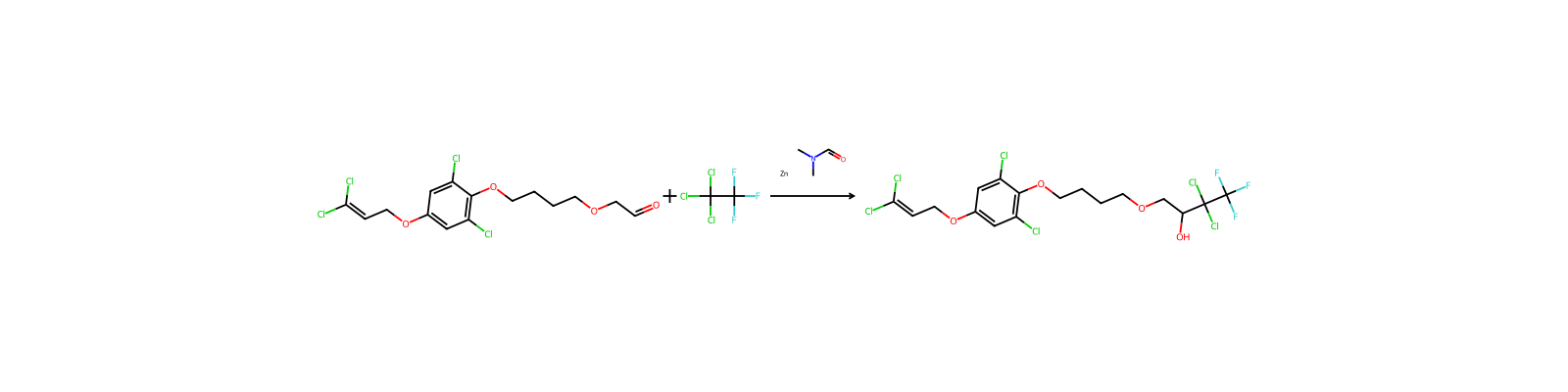
HRID 120813 の反応式
HRID 120813反応物としてTraining data from https://doi.org/10.1039/C8SC04228D (2/10)
HRID 153686 の反応式
HRID 153686反応物としてTraining data from https://doi.org/10.1039/C8SC04228D (9/10)
HRID 194572 の反応式
HRID 194572反応物としてTraining data from https://doi.org/10.1039/C8SC04228D (6/10)
HRID 369660 の反応式
HRID 369660反応物としてuspto-grants-2000_10
HRID 369667 の反応式
HRID 369667反応物としてuspto-grants-2000_10
HRID 369669 の反応式
HRID 369669反応物としてuspto-grants-2000_10
HRID 369689 の反応式
HRID 369689反応物としてuspto-grants-2000_10
HRID 678256 の反応式
HRID 678256反応物としてTraining data from https://doi.org/10.1039/C8SC04228D (3/10)
1 / 4 ページ

化合物ノート

読み込み中…

このページの内容基本情報名称と識別子物性安全と法規制化学と産業関連反応化合物ノート
その他の操作
ノートを作成反応を作成見積依頼を出す
Melting Point · 2 件

14.37 °C

14.2 °C

Vapor Pressure · 3 件

360.0 [mmHg]

360 mm Hg at 25 °C

360 [mm Hg] @25 °C

Refractive IndexIndex of refraction = 1.3610 at 25 °C/D

物理化学的性質

融点
14 °C · 14°C
沸点
45 · 45,7°C
比重(密度)
1.579 g/mL · 1.579 g/mL at 25 °C(lit.)
蒸気圧
47.87 kPa · 47.87kPa at 25℃
屈折率
1.36 · 1.36
闪点
None
水溶解度
8.7 mg/L · 8.7mg/L at 25℃
Henry's Law Constant
3.7 · 3.7×10-5 mol/(m3Pa) at 25℃, HSDB (2015)
Dielectric constant
2.44 · 2.4399999999999999
InChI
InChI=1S/C2Cl3F3/c3-1(4,5)2(6,7)8
InChIKey
BOSAWIQFTJIYIS-UHFFFAOYSA-N
SMILES
C(Cl)(Cl)(Cl)C(F)(F)F
LogP
4.6 at · 4.6 at 25℃
CAS データベース
354 · 354-58-5(CAS DataBase Reference)
EPAの化学物質情報
-113 a · CFC-113a (354-58-5)

化学的性質

化学的特性clear colourless liquid

Use of ozone-depleting substances in foods, drugs, devices, or cosmetics. (a) As used in this section, ozone-depleting substance (ODS) means any class I substance as defined in 40 CFR part 82, appendix A to subpart A, or class II substance as defined in 40 CFR part 82, appendix B to subpart A. (b) Except as provided in paragraph (c) of this section, any food, drug, device, or cosmetic that is, consists in part of, or is contained in an aerosol product or other pressurized dispenser that releases an ODS is not an essential use of the ODS under the Clean Air Act. (c) A food, drug, device, or cosmetic that is, consists in part of, or is contained in an aerosol product or other pressurized dispenser that releases an ODS is an essential use of the ODS under the Clean Air Act if paragraph (e) of this section specifies the use of that product as essential. For drugs, including biologics and animal drugs, and for devices, an investigational application or an approved marketing application must be in effect, as applicable. ... (e) The use of ODSs in the following products is essential: ... (2) Metered-dose short-acting adrenergic bronchodilator human drugs for oral inhalation. Oral pressurized metered-dose inhalers containing the following active moieties: ... (iv) Pirbuterol. ... (4) Other essential uses. (iii) Anesthetic drugs for topical use on accessible mucous membranes of humans where a cannula is used for application. ... (vi) Metered-dose atropine sulfate aerosol human drugs administered by oral inhalation. ... (viii) Metered-dose ipratropium bromide and albuterol sulfate, in combination, administered by oral inhalation for human use. (ix) Sterile aerosol talc administered intrapleurally by thoracoscopy for human use. /Ozone-Depleting Substances/

Special Reports · 5 件

Production and Consumption of Ozone Depleting Substances under the Montreal Protocol 1986 - 2004[UNEP; Ozone Secretariat UNEP November 2005, Available from, as of march 11, 2013: http://ozone.unep.org/Publications/Production_and_consumption2005.pdf]

The Montreal Protocol on Substances that Deplete the Ozone Layer[UNEP; Ozone Secretariat United Nations Environment Programme, The Montreal Protocol on Substances that Deplete the Ozone Layer, Available from, as of March 11, 2013: http://ozone.unep.org/pdfs/Montreal-Protocol2000.pdf]

Achievements in Stratospheric Ozone Protection Progress Report: This report covers the important and substantial achievements of the people, programs, and organizations that are working to protect the Earth's ozone layer. As impressive as these accomplishments are, our work is not done. Even though we have reduced or eliminated the use of many ozone-depleting substances, some still remain. Additionally, since ozone-depleting substances persist in the air for long periods of time, the past use of these substances continues to affect the ozone layer today. We must also continue to ensure that the alternatives being brought to the market support the country's long-term environmental goals in a cost-effective manner.[EPA; Achievements in Stratospheric Ozone Protection Progress Report, Available from, as of March 11, 2013: http://www.epa.gov/ozone/downloads/spd-annual-report_final.pdf]

UNEP; Ozone Secretariat. Twenty Questions and Answers about the Ozone Layer: 2010 Update. The questions address the nature of atmospheric ozone, the chemicals that cause ozone depletion, how global and polar ozone depletion occur, the success of the Montreal Protocol, and what could lie ahead for the ozone layer.[Available from, as of May 21, 2013: http://ozone.unep.org/Assessment_Panels/SAP/Scientific_Assessment_2010/]

USEPA; Ozone Layer Protection - Alternatives/SNAP Program. List of Substitutes. Substitutes are reviewed on the basis of ozone depletion potential, global warming potential, toxicity, flammability, and exposure potential as described in the final SNAP rule (59 FR 13044). Lists of acceptable and unacceptable substitutes are updated several times each year.[Available from, as of May 21, 2013: www.epa.gov/ozone/snap/lists/index.html]

Hazard Classes and CategoriesOzone 1 (40.8%)

安全と保護具

Firefighting HazardsVery slight, when exposed to heat or flame.
Disposal Methods · 1 件

SRP: The most favorable course of action is to use an alternative chemical product with less inherent propensity for occupational harm/injury/toxicity or environmental contamination. Recycle any unused portion of the material for its approved use or return it to the manufacturer or supplier. Ultimate disposal of the chemical must consider: the material's impact on air quality; potential migration in soil or water; effects on animal and plant life; and conformance with environmental and public health regulations.

Preventive Measures · 5 件

Inhalation of vapors should be avoided. /Chlorofluorocarbon/

Forced air ventilation at the level of vapor concentration together with the use of individual breathing devices with independent air supply will minimize the risk of inhalation. Lifelines should be worn when entering tanks or other confined spaces. /Chlorofluorocarbon/

Enclosure of process materials and isolation of reaction vessels and proper design and operation of filling heads for packaging and shipping ... /are administrative controls that may be instituted to limit occupational exposure to chlorofluorocarbons during manufacture, packaging, and use/. /Chlorofluorocarbon/

Filling areas should be monitored to ensure that the ambient CFC, /and/ HCFC ... /concentration does/ not exceed prevailing work standards. /Chlorofluorocarbon/

SRP: Local exhaust ventilation should be applied wherever there is an incidence of point source emissions or dispersion of regulated contaminants in the work area. Ventilation control of the contaminant as close to its point of generation is both the most economical and safest method to minimize personnel exposure to airborne contaminants. Ensure that the local ventilation moves the contaminant away from the worker.

Protective Action Criteria (PAC) · 3 件

14 [ppm]

150 [ppm]

900 [ppm]

Personal Protective Equipment (PPE) · 2 件

Forced air ventilation and level of vapor concentration together with the use of individual breathing devices with independent air supply will minimize risk of inhalation. Lifelines should be worn when entering tanks or other confined spaces. /Chlorofluorocarbon/

Neoprene gloves, protective clothing, and eye protection minimize risk of topical contact. /Chlorofluorocarbon or Hydrochlorofluorocarbon/

Other Standards Regulations and Guidelines · 1 件

The Montreal Protocol on Substances that Deplete the Ozone Layer was designed to reduce the production and consumption of ozone depleting substances in order to reduce their abundance in the atmosphere, and thereby protect the earth's fragile ozone Layer. The original Montreal Protocol was agreed on 16 September 1987 and entered into force on 1 January 1989. The Montreal Protocol includes a unique adjustment provision that enables the Parties to the Protocol to respond quickly to new scientific information and agree to accelerate the reductions required on chemicals already covered by the Protocol. These adjustments are then automatically applicable to all countries that ratified the Protocol. Since its initial adoption, the Montreal Protocol has been adjusted five times. Specifically, the Second, Fourth, Seventh, Ninth, Eleventh and Nineteenth Meetings of the Parties to the Montreal Protocol adopted, in accordance with the procedure laid down in paragraph 9 of Article 2 of the Montreal Protocol, certain adjustments and reductions of production and consumption of the controlled substances listed in the Annexes of the Protocol. These adjustments entered into force, for all the Parties, on 7 March 1991, 23 September 1993, 5 August 1996, 4 June 1998, 28 July 2000 and 14 May 2008, respectively. In addition to adjusting the Protocol, the Parties to the Montreal Protocol have amended the Protocol to enable, among other things, the control of new chemicals and the creation of a financial mechanism to enable developing countries to comply. Specifically, the Second, Fourth, Ninth and Eleventh Meetings of the Parties to the Montreal Protocol adopted, in accordance with the procedure laid down in paragraph 4 of Article 9 of the Vienna Convention, four Amendments to the Protocol - the London Amendment (1990), the Copenhagen Amendment (1992), the Montreal Amendment (1997) and the Beijing Amendment (1999). Unlike adjustments to the Protocol, amendments must be ratified by countries before their requirements are applicable to those countries. The London, Copenhagen, Montreal and Beijing Amendments entered into force on 10 August 1992, 14 June 1994, 10 November 1999 and 25 February 2002, respectively, only for those Parties which ratified the particular amendments. In addition to adjustments and amendments to the Montreal Protocol, the Parties to the Protocol meet annually and take a variety of decisions aimed at enabling effective implementation of this important legal instrument. Through the 22nd Meeting of the Parties to the Montreal Protocol, the Parties have taken over 720 decisions.

毒性情報

Body Burden1,1,1-Trichloro-2,2,2-trifluoroethane was detected in the expired air of 6 out of 10 air samples taken from 8 smoking and non-smoking male volunteers from Texas, at expiration rates from 2.6-63.0 and 11.0-580 ug/kg, respectively(1).
Environmental Fate · 3 件

TERRESTRIAL FATE: Based on a classification scheme(1), an estimated Koc value of 200(SRC), determined from a structure estimation method(2), indicates that 1,1,1-trichloro-2,2,2-trifluoroethane is expected to have moderate mobility in soil(SRC). Volatilization of 1,1,1-trichloro-2,2,2-trifluoroethane from moist soil surfaces is expected to be an important fate process(SRC) given an estimated Henry's Law constant of 0.27 atm-cu m/mole(SRC), using a fragment constant estimation method(3). 1,1,1-Trichloro-2,2,2-trifluoroethane is expected to volatilize from dry soil surfaces(SRC) based upon an measured vapor pressure of 360 mm Hg at 25 °C(4). Biodegradation data in soil were not available(SRC, 2012).

AQUATIC FATE: Based on a classification scheme(1), an estimated Koc value of 200(SRC), determined from a structure estimation method(2), indicates that 1,1,1-trichloro-2,2,2-trifluoroethane is expected to adsorb to suspended solids and sediment(SRC). Volatilization from water surfaces is expected(3) based upon an estimated Henry's Law constant of 0.27 atm-cu m/mole(SRC), developed using a fragment constant estimation method(4). Using this Henry's Law constant and an estimation method(3), volatilization half-lives for a model river and model lake are 4 hours and 5 days, respectively(SRC). According to a classification scheme(5), an estimated BCF of 51(SRC), from an estimated log Kow of 3.09(6) and a regression-derived equation(7), suggests the potential for bioconcentration in aquatic organisms is moderate(SRC). Biodegradation data in water were not available(SRC, 2012).

ATMOSPHERIC FATE: According to a model of gas/particle partitioning of semivolatile organic compounds in the atmosphere(1), 1,1,1-trichloro-2,2,2-trifluoroethane, which has a measured vapor pressure of 360 mm Hg at 25 °C(2), is expected to exist solely as a vapor in the ambient atmosphere. 1,1,1-Trichloro-2,2,2-trifluoroethane is essentially inert to reaction with photochemically generated radicals and ozone molecules(3,4). 1,1,1-Trichloro-2,2,2-trifluoroethane does not contain chromophores that absorb at wavelengths >290 nm(5) and, therefore, is not expected to undergo direct photolysis by sunlight in the troposphere(SRC). 1,1,1-Trichloro-2,2,2-trifluoroethane will gradually diffuse into the stratosphere above the ozone layer where it will slowly degrade due to direct photolysis from UV-C radiation and contribute to the catalytic removal of stratospheric ozone(6).

Adverse EffectsNeurotoxin - Acute solvent syndrome
Ongoing Test Status · 1 件

The following link will take the user to the National Toxicology Program (NTP) Test Agent Search Results page, which tabulates all of the "Standard Toxicology & Carcinogenesis Studies", "Developmental Studies", and "Genetic Toxicity Studies" performed with this chemical. Clicking on the "Testing Status" link will take the user to the status (i.e., in review, in progress, in preparation, on test, completed, etc.) and results of all the studies that the NTP has done on this chemical.[Available from: http://ntp-apps.niehs.nih.gov/ntp_tox/index.cfm?fuseaction=ntpsearch.searchresults&searchterm=354-58-5]

Effluent Concentrations · 1 件

1,1,1-Trichloro-2,2,2-trifluoroethane was detected as a component of landfill gases from sites in the UK at a measured concentration of 70 mg/cu-m in underground probes(1). 1,1,1-Trichloro-2,2,2-trifluoroethane was detected, not quantified at hazardous waste sites and a sanitary landfill in New Jersey(2).

Soil Adsorption/Mobility · 1 件

Using a structure estimation method based on molecular connectivity indices(1), the Koc of 1,1,1-trichloro-2,2,2-trifluoroethane can be estimated to be 200(SRC). According to a classification scheme(2), this estimated Koc value suggests that 1,1,1-trichloro-2,2,2-trifluoroethane is expected to have moderate mobility in soil.

Atmospheric Concentrations · 1 件

RURAL/REMOTE: 1,1,1-Trichloro-2,2,2-trifluoroethane was qualitatively detected in rural air samples, date and location not provided(1). The concentration of 1,1,1-trichloro-2,2,2-trifluoroethane in air samples collected at the South Pole, January 1985, was 11 ppb(2).

Human Toxicity Excerpts · 5 件

/SIGNS AND SYMPTOMS/ Aerosol sprays containing fluorocarbon propellants are another source of solvent intoxication. Prolonged exposure or daily use may result in damage to several organ systems. Clinical problems include cardiac arrhythmias, bone marrow depression, cerebral degeneration, and damage to liver, kidney, & peripheral nerves. Death occasionally has been attributed to inhalant abuse, probably via the mechanism of cardiac arrhythmias, especially accompanying exercise or upper airway obstruction. /Fluorocarbon propellants/

/CASE REPORTS/ During the course of dockside ship maintenance, a compartment was partially flooded with Trichlorotrifluoroethane gas. One sailor entered the compartment, collapsed, and was then rescued by two other men. All three victims then climbed a 11-m (36-ft) ladder and collapsed. They all experienced a rapid development of cardiac arrest. /Investigators/ report on the pathologic, toxicologic, and pathophysiologic aspects of the incident.

/CASE REPORTS/ A case is presented of a 16-year-old male who died as a result of exposure to Trichlorotrifluoroethane while working in an open pit. Chromatographic results and tissue concentrations are presented.

/OTHER TOXICITY INFORMATION/ The available toxicological data on the fully halogenated chlorofluorocarbons reviewed in this monograph show a low acute and chronic toxicity and indicate no mutagenic or carcinogenic potential. The human health risks are mainly confined to occasional high exposures that may occur during the handling of these substances. In contrast, indirect effects from the accumulation of these substances in the stratosphere may lead to substantial effects on human health, mainly due to the depletion of stratospheric ozone resulting in an increase in effects from UV-B radiation. The projected increase in the incidence of non-melanoma skin cancers, a possible increase in melanoma skin cancers, and immunotoxic and ocular effects suggest that immediate action is required to reduce further stratospheric ozone depletion. /Halogenated chlorofluorocarbons/

/OTHER TOXICITY INFORMATION/ The toxicity of Chlorofluorocarbons (CFCs) had been considered to be low; it is absorbed via the lungs and undergoes little subsequent biotransformation. In the United States when sudden unexplained deaths of aerosol "sniffers" were reported they were considered to be possibly due to cardiac arrhythmias induced by the CFC propellants. /CFCs/

Artificial Pollution Sources · 1 件

1,1,1-Trichloro-2,2,2-trifluoroethane's production and use as a solvent(1) and as an intermediate in the production of 2,3-dichloro-5-trifluoromethylpyridine(2) may result in its release to the environment through various waste streams(SRC). The compound is often present in low levels in CFC113(2). Fully halogenated chlorofluorocarbons (CFCs), such as 1,1,1-trichloro-2,2,2-trifluoroethane, were scheduled for production phase-out in 1987 by the Montreal Protocol(2). Although originally scheduled for 50% production phase-out by the year 2000 in developed countries, the worsening ozone depletion has forced acceleration of the CFC phase-out(2,3).

Environmental BiodegradationBiodegradation data on 1,1,1-trichloro-2,2,2-trifluoroethanec in soil or water were not available.(SRC, 2012)
Sediment/Soil ConcentrationsSEDIMENT: Trichlorotrifluoroethanes were detected in sediment samples at the site of an illegal dump site, The Valley of the Drums, KY, 1979 at a concentration of 5.4 mg/L(1). /Trichlorofluoroethanes/
Environmental Bioconcentration · 1 件

An estimated BCF of 51 was calculated in fish for 1,1,1-trichloro-2,2,2-trifluoroethane(SRC), using an estimated log Kow of 3.09(1) and a regression-derived equation(2). According to a classification scheme(3), this BCF suggests the potential for bioconcentration in aquatic organisms is moderate(SRC).

法規制情報

FDA Requirements · 2 件

The Food and Drug Administration (FDA), after consultation with the Environmental Protection Agency (EPA), is amending FDA's regulation on the use of ozone-depleting substances (ODSs) in selfpressurized containers to remove the essential-use designations for flunisolide, triamcinolone, metaproterenol, pirbuterol, albuterol and ipratropium in combination, cromolyn, and nedocromil used in oral pressurized metered-dose inhalers (MDIs). The Clean Air Act requires FDA, in consultation with the EPA, to determine whether an FDA-regulated product that releases an ODS is an essential use of the ODS. FDA has concluded that there are no substantial technical barriers to formulating flunisolide, triamcinolone, metaproterenol, pirbuterol, albuterol and ipratropium in combination, cromolyn, and nedocromil as products that do not release ODSs, and therefore they will no longer be essential uses of ODSs as of the effective dates of this rule. MDIs for these active moieties containing an ODS may not be marketed after the relevant effective date. DATES: Removal of Part 2.125(e)(2)(iii) and 2.125(e)(4)(vii) is effective June 14, 2010. Removal of Part 2.125(e)(1)(v) and 2.125(e)(4)(iv) is effective December 31, 2010. Removal of Part 2.125(e)(1)(iii) is effective June 30, 2011. Removal of 2.125(e)(2)(iv) and Part 2.125(e)(4)(viii) is effective December 31, 2013. /Ozone-Depleting Substances/

Use of ozone-depleting substances in foods, drugs, devices, or cosmetics. (a) As used in this section, ozone-depleting substance (ODS) means any class I substance as defined in 40 CFR part 82, appendix A to subpart A, or class II substance as defined in 40 CFR part 82, appendix B to subpart A. (b) Except as provided in paragraph (c) of this section, any food, drug, device, or cosmetic that is, consists in part of, or is contained in an aerosol product or other pressurized dispenser that releases an ODS is not an essential use of the ODS under the Clean Air Act. (c) A food, drug, device, or cosmetic that is, consists in part of, or is contained in an aerosol product or other pressurized dispenser that releases an ODS is an essential use of the ODS under the Clean Air Act if paragraph (e) of this section specifies the use of that product as essential. For drugs, including biologics and animal drugs, and for devices, an investigational application or an approved marketing application must be in effect, as applicable. ... (e) The use of ODSs in the following products is essential: ... (2) Metered-dose short-acting adrenergic bronchodilator human drugs for oral inhalation. Oral pressurized metered-dose inhalers containing the following active moieties: ... (iv) Pirbuterol. ... (4) Other essential uses. (iii) Anesthetic drugs for topical use on accessible mucous membranes of humans where a cannula is used for application. ... (vi) Metered-dose atropine sulfate aerosol human drugs administered by oral inhalation. ... (viii) Metered-dose ipratropium bromide and albuterol sulfate, in combination, administered by oral inhalation for human use. (ix) Sterile aerosol talc administered intrapleurally by thoracoscopy for human use. /Ozone-Depleting Substances/

安全データ

tsca
TSCA listed
rtecs
KJ3975000
ridadr
3082
毒性
LC50 ihl-rat: 13 pph/15M HUTODJ 1,239,82
PRTR法
第一種指定化学物質
hs_code
29037720
risk_code
59-36/37/38
化審法
(2)-95
hazard_code
Xi,N
hazard_note
Irritant
safety_code
23-24/25-61-59-36/37/39-26
hazard_class
IRRITANT, OZONE DEPLETER
有毒物質データの
354-58-5(Hazardous Substances Data)
Industry Uses
Intermediate
Methods of Manufacturing · 2 件

Production: perchloroethylene + hydrogen fluoride (halogen exchange by-product of 1,1-dichloro-2,2,2-trifluoroethane production)

The most important commercial method for manufacturing CFCs and HCFCs is the successive replacement of chlorine by fluorine using hydrogen fluoride. The traditional, liquid-phase process uses antimony pentafluoride or a mixture of antimony trifluoride and chlorine as catalysts. Continuous vapor-phase processes that employ gaseous hydrogen fluoride in the presence of heterogenous chromium, iron, or fluorinated alumina catalysts also are widely used. Carbon tetrachloride, chloroform, and hexachloroethane (or tetrachloroethylene plus chlorine) are commonly used starting materials for one- and two-carbon chlorofluorocarbons. The extent of chlorine exchange can be controlled by varying the hydrogen fluoride concentration, the contact time, or the reaction temperature. /CFCs and HCFCs/

General Manufacturing Information · 6 件

Industrial Gas Manufacturing

Ethane, 1,1,1-trichloro-2,2,2-trifluoro-: ACTIVE

SRP: The EPA has organized groups of chemicals into two classes according to their ozone-depletion potential. Class I controlled substances are those with an ozone-depletion potential of 0.2 or higher. Class II controlled substances are those with an ozone-potential of less than 0.2. Class II controlled substances are all hydrochlorofluorocarbons (HCFCs).

In the United States, "Class I" substances were subject to the first round of phaseout targets. Class I substances have an ozone depletion potential (ODP) of 0.2 or higher, and include halons, chlorofluorocarbons (CFCs), methyl chloroform, carbon tetrachloride, and methyl bromide. Section 604 of the Clean Air Act sets the phaseout targets for Class I substances. The ban on production and import of halons took effect on January 1, 1994. The ban on production and import of other Class I ODS /ozone-depleting substance/ - excluding methyl bromide - took effect on January 1, 1996.

Class I Controlled Substance: C2F3Cl3 - Trichlorotrifluoroethane (CFC-113) /and all isomers/: Ozone-depletion potential: 0.8.

Not offered as a commercial product ... often present in low levels in CFC113 ... being phased out since it is an ozone-depleting substance ... covered under the Montreal Protocol

応用分野

使用CFC 113a has not been offered as a commercial product. It is, however, often present in low levels in CFC 113. It, like CFC 113, is being phased out since it is an ozone-depleting substance.

上流・下流製品情報

上流原料

1,1,1-trichloroethane1,1,1-トリフルオロ-2-クロロエタントリクロロエチレンフッ化水素酸1,1,1-トリフルオロエタン1,1-ジクロロ-1-フルオロエタン1-クロロ-1,1-ジフルオロエタン1,1-ジクロロエテン1,1,2-トリフルオロトリクロロエタン

下流製品

N,N-ジエチル-2,2,2-トリフルオロアセトアミド2,2,4-Trichloro-1,1,1-trifluorobutaneN,N-Diallyl-2,2,2-trifluoroacetamide