

基本情報
- 標準SMILES
CC(C)(C)OC(=O)N=NC(=O)OC(C)(C)C- InChIKey
QKSQWQOAUQFORH-UHFFFAOYSA-N- 分子式
- C10H18N2O4
- 平均分子量
- 230.26 g/mol
- 単同位体質量
- 230.12665706
名称と識別子
- 優先名称
- Di-tert-butyl azodicarboxylate
- IUPAC
- tert-butyl N-[(2-methylpropan-2-yl)oxycarbonylimino]carbamate
- 現地名
- ジアゼンジカルボン酸ジ-tert-ブチル
- 英語名
- Di-tert-Butyl azodicarboxylate
- 分子式
- C10H18N2O4
- 分子量
- 230.26
名称と別名
Di-tert-butyl azodicarboxylate870-50-8DTXSID201306310RefChem:586103DTXCID201736276212-796-9Di-tert-butyl diazene-1,2-dicarboxylateAzodicarboxylic Acid Di-tert-butyl EsterDi-tert-butylazodicarboxylateMFCD00015001di-t-butyl azodicarboxylate(E)-di-tert-butyl diazene-1,2-dicarboxylate
名称をさらに表示
ジアゼンジカルボン酸ビス-tert-ブチル1,2-ビス(tert-ブトキシカルボニル)ジアゼンビス(tert-ブトキシカルボニル)ジアゼンジアゼン-1,2-ジカルボン酸ジ-tert-ブチル2,3-ジアザ-2-ブテン二酸ジ-tert-ブチルアゾビスぎ酸ジ-tert-ブチルジアゼン-1,2-ビス(ぎ酸tert-ブチル)アゾビス(ぎ酸tert-ブチル)ジアゼンジカルボン酸ジ-tert-ブチルジアゼンジカルボン酸ジtert-ブチルΔN,N'-ビ[カルバミド酸tert-ブチル]アゾジカルボン酸ジ-tert-ブチル (20%トルエン溶液)アゾジカルボン酸ジ‐TERT‐ブチルアゾジカルボン酸ジ-TERT-ブチルアゾジカルボン酸ジ-tert-ブチル, 98%1,2-ジアゼンジカルボン酸ジ-tert-ブチル1,2-ビス(tert-ブチルオキシカルボニル)-1,2-ジアザエテンN-{[(tert-ブトキシ)カルボニル]イミノ}(tert-ブトキシ)ホルムアミド1,1′-アゾビス(ぎ酸tert-ブチル)ΔN,N′-ビ[カルバミド酸tert-ブチル]di-tert-butyl (E)-diazene-1,2-dicarboxylateDi-tert-Butyl azodicDi-tert-butyl azodiformateSKL270NSC 109889DI-TERT-BUTYL AZODICARBOXYALTEBis(tert-butoxycarbonyl)diazene
Di-(tert-butyl) diazene-1,2-dicarboxylate1,2-Diazenedicarboxylic acid, 1,2-bis(1,1-dimethylethyl) esterDTADdi-tert-butylazocarboxylatetert-butyl {[(tert-butyl)oxycarbonyl]diazenyl}formatetert-butyl N-tert-butoxycarbonyliminocarbamatedi t-butyl azodicarboxylateDitertbutyl azodicarboxylate
データベース識別子
- CAS
870-50-8- PubChem CID
- 97268
- DTXSID
DTXSID201306310- EC Number
- 212-796-9
物性
構造計算による物性
- XLogP
- 2.9
- 極性表面積
- 77.3 Ų
- 水素結合供与体数
- 0
- 水素結合受容体数
- 4
- 回転可能結合数
- 4
- 重原子数
- 16
- 形式電荷
- 0
- 複雑度
- 267
物理化学的性質
- 融点
- 89 · 89-92 °C(lit.)
- 沸点
- 287.1 · 287.1±9.0 °C(Predicted)
- 比重(密度)
- 1.06 · 1.06±0.1 g/cm3(Predicted)
- 貯蔵温度
- 2 · 2-8°C
- 溶解性
- クロロホルム(少量)、メタノール(少量)
- 外見
- 結晶または結晶性粉末
- 色
- 黄色
- 水溶解度
- 不溶性
- BRN
- 1911434 · 1911434
- InChI
- InChI=1S/C10H18N2O4/c1-9(2,3)15-7(13)11-12-8(14)16-10(4,5)6/h1-6H3
- InChIKey
- QKSQWQOAUQFORH-VAWYXSNFSA-N
- SMILES
- N(C(OC(C)(C)C)=O)=NC(OC(C)(C)C)=O
- CAS データベース
- 870 · 870-50-8(CAS DataBase Reference)
化学的性質
化学的特性yellow crystals or crystalline powder
安全と法規制
GHS分類
GHS Classification
This chemical does not meet GHS hazard criteria for 10.7% (6 of 56) of reports.
Warning
H315 (89.3%): Causes skin irritation [Warning Skin corrosion/irritation];H319 (89.3%): Causes serious eye irritation [Warning Serious eye damage/eye irritation];H335 (87.5%): May cause respiratory irritation [Warning Specific target organ toxicity, single exposure; Respiratory tract irritation]
P261, P264, P264+P265, P271, P280, P302+P352, P304+P340, P305+P351+P338, P319, P321, P332+P317, P337+P317, P362+P364, P403+P233, P405, and P501 (click each P-code to see the statement)
Aggregated GHS information provided per 56 reports by companies from 8 notifications to the ECHA C&L Inventory. Each notification may be associated with multiple companies.;Reported as not meeting GHS hazard criteria per 6 of 56 reports by companies.;There are 7 notifications provided by 50 of 56 reports by companies with hazard statement code(s).;Information may vary between notifications depending on impurities, additives, and other factors. The percentage value in parenthesis indicates the notified classification ratio from companies that provide hazard codes. Only hazard codes with percentage values above 10% are shown. For more detailed information, please visit ECHA C&L website.
危険有害性情報
Hazard Classes and CategoriesSkin Irrit. 2 (89.3%);Eye Irrit. 2 (89.3%);STOT SE 3 (87.5%)
安全データ
- wgk
- 3
- ridadr
- 1325
- PRTR法
- 第一種指定化学物質
- hs_code
- 29270000
- risk_code
- 36/37/38-11
- 安衛法
- 有機則 第二種有機溶剤等
- 消防法
- 危-4-1-II
- hazard_code
- Xi,F
- hazard_note
- Irritant
- safety_code
- 26-36-37/39-16
- hazard_class
- 3
- packing_group
- II
- ストレージクラス
- 11 - Combustible Solids
化学と産業
応用分野
使用Di-tert-butyl azodicarboxylate is a reagent used in the preparation of acyl hydrazinedicarboxylates. It is also used in the electrophilic amination of beta-keto esters catalyzed by an axially chiral guanidine. It serves as a precursor in an enantioselective synthesis of 3,6-dihyropyridazines employing organocatalysts such as L-proline or (S)-2-pyrrolidinyl tetrazole. It is also utilized in the asymmetric Friedel-Crafts amination through a chiral organocatalyst. Further, it acts as a reactant for preparation of hexapeptide key fragments through stereo selective selenocyclization/oxidative deselenylation reactions. In addition to this, it is employed as a starting material in the synthesis of pyrroloisoquinoline template through stereoselective N-acyliminium-mediated cyclization and enolate amination for preparation of peptidomimetic compounds and Barbier-type propargylation reactions.
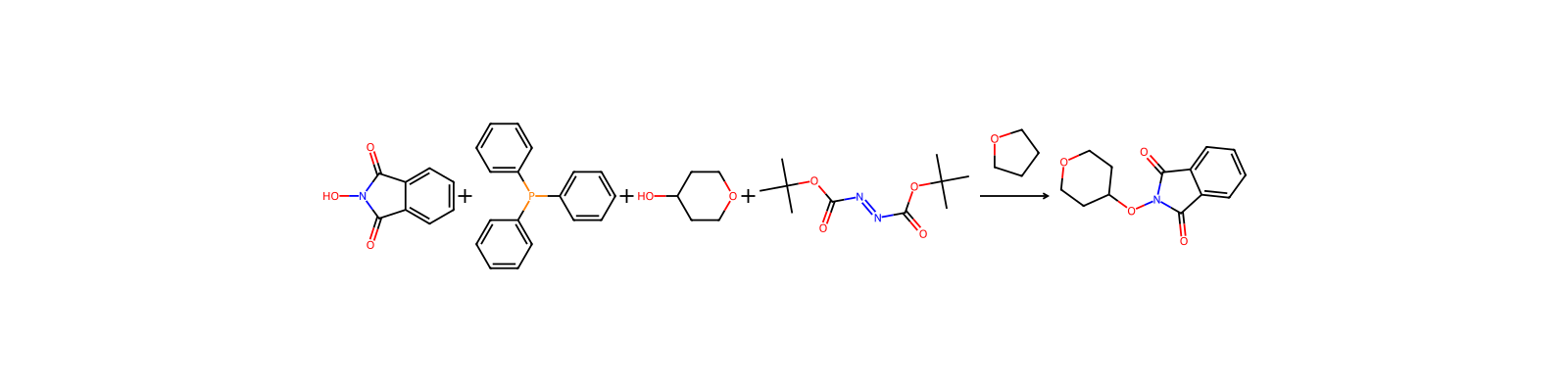
一般的な説明Di-tert-butyl azodicarboxylate is a an acid labile reagent for Mitsunobu reactions allowing facile isolation of products and for the electrophilic amination and hydrazination of enolates and lithium alkyls.
調製方法
純化方法The tert-butyl ester has the advantage over the ethyl ester (below) in being a solid and more acid labile. It crystallises from ligroin and is best purified by covering the dry solid (22g) with pet ether (b 30-60o, 35-40 mL) heating to boiling and adding ligroin (b 60-90o) until the solid dissolves. On cooling, large lemon yellow crystals of the ester separate (~ 20g), m 90.7-92o. Evaporation of the filtrate gives a further crop of crystals [Carpino & Crowley Org Synth 44 18 1964]. This reagent is useful in the Mitsunobu reaction [Mitsunobu Synthesis 1 1981, Gennari et al. J Am Chem Soc 108 6394 1986, Evans et al. J Am Chem Soc 108 6394 1986, Hughes Org React 42 335 1992, Dodge et al. Org Synth 73 110 1996, Hughes Org Prep Proc Int 28 127 1996, Ferguson & Marcelle J Am Chem Soc 128 4576 2006, see also DEAD and DIAD below].
上流・下流製品情報
下流製品
サプライヤー50 社
国药集团化学试剂有限公司86-21-63210123 · [email protected]
北京华美互利生物化工010-56205725 · [email protected]
梯希爱(上海)化成工业发展有限公司021-67121386 · [email protected]
上海阿拉丁生化科技股份有限公司400-6206333 13167063860 · [email protected]
INTATRADE GmbH+49 3493/605464 · [email protected]
北京安司莫森技术有限公司010-82954736 13391601435 · [email protected]
韶远科技(上海)有限公司021-50795510 4000665055 · [email protected]
科瑞迪化学400-821-5857 021-64326257 · [email protected]
上海将来实业股份有限公司400-0066400 13621662912 · [email protected]
Syntechem Co.,Ltd[email protected]
上海迈瑞尔生化科技有限公司4006356688 18621169109 · [email protected]
北京华威锐科化工有限公司0757-86329057 18934348241 · [email protected]
武汉易泰科技有限公司上海分公司18930552037 · [email protected]
阿法埃莎(中国)化学有限公司400-6106006 · [email protected]
安耐吉化学&3A(安徽泽升科技股份有限公司)400-0056266 · [email protected]
石家庄斯迪亚诺精细化工有限公司0311-89250318 13582355795 · [email protected]
上海恩诺生物科技有限公司+86 (21) 6435-5022
上海瀚鸿科技股份有限公司021-54306202 13764082696 · [email protected]
上海相辉医药科技有限公司13761987713 · [email protected]
上海景颜化工科技有限公司13817811078 · [email protected]
武汉泰易成生化药业有限公司027-88320699 · [email protected]
嘉兴市艾森化工有限公司0573-85285100 18627885956 · [email protected]
上海隆盛化工有限公司58099637 13585536065 · [email protected]
南京爱珂医药科技有限公司025-58395930 · [email protected]
山东西亚化学有限公司13355009207 13355009207 · [email protected]
唐山默内德贸易有限公司0315-8309571 15633399667 · [email protected]
四川库利南科技有限公司400-1166-196 18981987031 · [email protected]
天津希恩思生化科技有限公司400 638 7771 · [email protected]
湖南汇百侍生物科技有限公司0731-85526065 13308475853 · [email protected]
南京维奥化工有限公司Please Send Email 18652950785 · [email protected]
河南多贝化工有限公司0370-2785118 17550508557 · [email protected]
北京泰亚杰科技有限公司021-33690831-8001 13552411790;18616022633 · [email protected]
武汉海正工贸发展有限公司027-8866 0053/88660577/88660578
艾科试剂4008-755-333 18080918076 · [email protected]
上海思域化工科技有限公司86-21-34053660 · [email protected]
苏州思变化学技术有限公司0512-65617459 18915409046 · [email protected]
赛默飞世尔科技(中国)有限公司800-810-5118 · [email protected]
北京伊诺凯科技有限公司400-810-7969 010-59572699 · [email protected]
上海特伯化学科技有限公司+86-21-60341587 · [email protected]
江苏艾康生物医药研发有限公司025-66113011 13913916777 · [email protected]
上海健超生物科技有限公司150-2103-5486 18017383231 · [email protected]
TCI AMERICA800-4238616 · [email protected]
TOKYO CHEMICAL INDUSTRY CO., LTD.03-36680489 · [email protected]
TCI Europe320-37350700 · [email protected]
随州市红旗化工有限公司0722-3257376 13026100080;13235518175 · [email protected]
深圳康特腾科技有限公司86-0755-86635001 · [email protected]
越林试剂021-62960152 · [email protected]
无锡中坤生化科技有限公司+86 0510-85629785
上海乐晨国际贸易有限公司021-67256163 · [email protected]
北京环宇世纪化学科技有限公司hysj_bj.com
関連反応
744 件


関連ノート
読み込み中…