
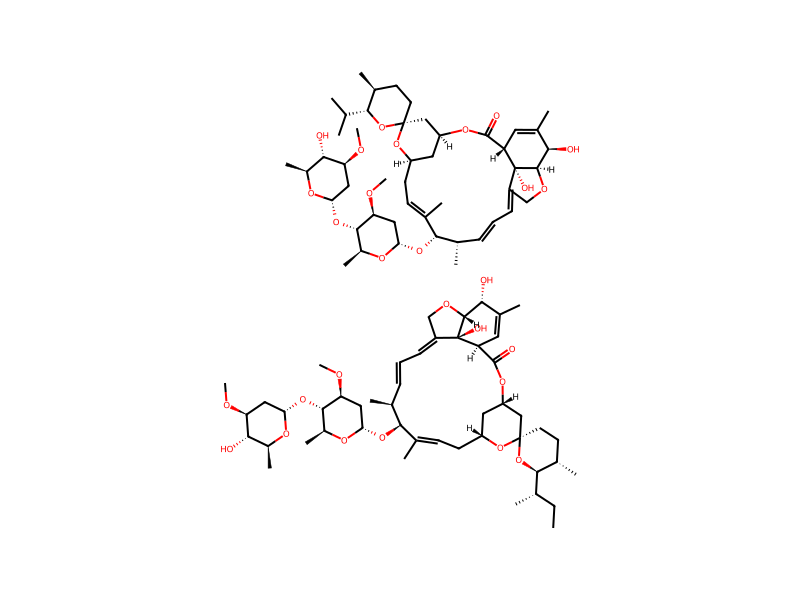
基本情報
- CAS
70288-86-7- 標準SMILES
CC[C@H](C)[C@H]1O[C@]2(CC[C@@H]1C)C[C@@H]1C[C@@H](C/C=C(\C)[C@@H](O[C@H]3C[C@H](OC)[C@@H](O[C@H]4C[C@H](OC)[C@@H](O)[C@H](C)O4)[C@H](C)O3)[C@@H](C)/C=C/C=C3\CO[C@@H]4[C@H](O)C(C)=C[C@@H](C(=O)O1)[C@]34O)O2.CO[C@H]1C[C@H](O[C@H]2[C@H](C)O[C@@H](O[C@@H]3/C(C)=C/C[C@@H]4C[C@@H](C[C@]5(CC[C@H](C)[C@@H](C(C)C)O5)O4)OC(=O)[C@@H]4C=C(C)[C@@H](O)[C@H]5OC/C(=C\C=C\[C@@H]3C)[C@]54O)C[C@@H]2OC)O[C@@H](C)[C@@H]1O- InChIKey
SPBDXSGPUHCETR-JFUDTMANSA-N- 分子式
- C95H146O28
- 平均分子量
- 1,736.2 g/mol
概要
Ivermectin is a semi-synthetic antiparasitic medication derived from avermectins, a class of highly-active broad-spectrum antiparasitic agents isolated from the fermentation products of Streptomyces avermitilis. Ivermectin itself is a mixture of two avermectins, comprising roughly 90% 5-O-demethyl-22,23-dihydroavermectin A1a (22,23-dihydroavermectin B1a) and 10% 5-O-demethyl-25-de(1-methylpropyl)-22,23-dihydro-25-(1-methylethyl)avermectin A1a (22,23-dihydroavermectin B1b). Ivermectin is mainly used in humans in the treatment of onchocerciasis, but may also be effective against other worm infestations (such as strongyloidiasis, ascariasis, trichuriasis and enterobiasis). Applied topically, it may be used in the treatment of head lice infestation. With the advent of 2020 and the COVID-19 pandemic, ivermectin began garnering notoriety due to its off-label use for the prophylaxis and treatment of COVID-19. While studies are still ongoing, much of the evidence for ivermectin in COVID-19 relies on pre-print in vitro data, and the clinical utility of this data remains unclear. Due to a number of factors - for example, the relatively low number of patients per trial and the speed at which these trials were conducted - studies on the use of ivermectin in COVID-19 have been fraught with statistical errors and accusations of plagiarism. In addition, the use of aggregate patient data in large-scale meta-analyses (as opposed to individual patient data (IPD)) has been shown to disguise otherwise blatant data errors, such as extreme terminal digit bias and the duplication of blocks of patient records. Until high-quality, peer-reviewed data regarding both the safety and efficacy of ivermectin for COVID-19 in humans becomes available, the use of ivermectin for these purposes should be avoided in favour of thoroughly-vetted therapies (e.g. COVID-19 vaccines like [Comirnaty](https://go.drugbank.com/drugs/DB15696)).
名称と識別子
- 優先名称
- Ivermectin CRS
- IUPAC
- (1R,4S,5'S,6R,6'R,8R,10E,12S,13S,14E,16E,20R,21R,24S)-6'-[(2S)-butan-2-yl]-21,24-dihydroxy-12-[(2R,4S,5S,6S)-5-[(2S,4S,5S,6S)-5-hydroxy-4-methoxy-6-methyloxan-2-yl]oxy-4-methoxy-6-methyloxan-2-yl]oxy-5',11,13,22-tetramethylspiro[3,7,19-trioxatetracyclo[15.6.1.14,8.020,24]pentacosa-10,14,16,22-tetraene-6,2'-oxane]-2-one;(1R,4S,5'S,6R,6'R,8R,10E,12S,13S,14E,16E,20R,21R,24S)-21,24-dihydroxy-12-[(2R,4S,5S,6S)-5-[(2S,4S,5S,6S)-5-hydroxy-4-methoxy-6-methyloxan-2-yl]oxy-4-methoxy-6-methyloxan-2-yl]oxy-5',11,13,22-tetramethyl-6'-propan-2-ylspiro[3,7,19-trioxatetracyclo[15.6.1.14,8.020,24]pentacosa-10,14,16,22-tetraene-6,2'-oxane]-2-one
- 現地名
- イベルメクチン
- 英語名
- Ivermectin
- 分子式
- C48H74O14
- 分子量
- 875.09
名称と別名
Ivermectin RSIvermectin CRSIvermectin (Standard)SCHEMBL44294SPBDXSGPUHCETR-JFUDTMANSA-NHMS6018O13HY-15310RIvermectine 100 microg/mL in AcetonitrileF556517イボメックイベルメクチンストロメクトール
名称をさらに表示
5-O-デメチル-22,23-ジヒドロアベルメクチンA1a/5-O-デメチル-25-デ(1-メチルプロピル)-22,23-ジヒドロ-25-(1-メチルエチル)アベルメクチンA1aイベルメクチン標準品イベルメクチン (JAN)5-O-デメチル-22,23-ジヒドロエバーメクチンA1a/5-O-デメチル-25-デ(1-メチルプロピル)-22,23-ジヒドロ-25-(1-メチルエチル)エバーメクチンA1aIVERMECTINElvermectinIVOMECVERMECTINIVERMECTIN HCLStromectolIvermectin EP2000Avermectin B1a Dihydro Analogmk933Uvemec
物性
構造計算による物性
- 極性表面積
- 340 Ų
- 水素結合供与体数
- 6
- 水素結合受容体数
- 28
- 回転可能結合数
- 15
- 重原子数
- 123
- 形式電荷
- 0
- 複雑度
- 3,340
実験および物理化学的性質
SolubilityInsoluble
物理化学的性質
- 比旋光度
- 71.5 · D +71.5 ± 3° (c = 0.755 in chloroform)
- 貯蔵温度
- 2 · 2-8°C
- 溶解性
- 2 O: · H2O: ≤1.0% KF
- 外見
- 粉
- 色
- 白い
- 水溶解度
- 4 mg/L · 4mg/L(温度表記無し)
- BCS Class
- 4 · 4/3
- 安定性
- -20 °Cで最大3か月保存できます。 · DMSO溶液またはエタノール溶液で-20°Cで最大3か月保存できます。
- 主な用途
- 医薬品(低分子化合物)
- InChIKey
- AZSNMRSAGSSBNP-XPNPUAGNSA-N
- CAS データベース
- 70288 · 70288-86-7(CAS DataBase Reference)
- EPAの化学物質情報
- Ivermectin (70288-86-7)
化学的性質
化学的特性Crystalline Solid
安全と法規制
安全データ
- wgk
- 3
- ridadr
- UN 2811 6.1/PG 2
- 毒性
- LD50 in dogs, rhesus monkeys (mg/kg): about 80, more than 24 orally. (MSDS Merck & Co. Inc., 2003)
- hs_code
- 29322090
- risk_code
- 61-25-36-36/38-22-28
- hazard_code
- T,Xn,T+
- safety_code
- 53-26-45-36-36/37-28
- hazard_class
- 6.1(a)
- packing_group
- II
- Hazard Classifications
- Acute Tox. 1 OralAcute Tox. 3 DermalAquatic Acute 1Aquatic Chronic 1
- ストレージクラス
- 6.1A - Combustible acute toxic Cat. 1 and 2very toxic hazardous materials
化学と産業
薬理情報
Protein Binding93%
Pharmacodynamics
Ivermectin is a semisynthetic, anthelminitic agent. It is an avermectin, a group of pentacyclic sixteen-membered lactones (i.e. a macrocyclic lactone disaccharide) derived from the soil bacterium _Streptomyces avermitilis_. Avermectins are potent and broad-spectrum anti-parasitic agents.
Mechanism of Action
Ivermectin binds selectively and with high affinity to glutamate-gated chloride ion channels in invertebrate muscle and nerve cells of the microfilaria. This binding causes an increase in the permeability of the cell membrane to chloride ions and results in hyperpolarization of the cell, leading to paralysis and death of the parasite. Ivermectin also is believed to act as an agonist of the neurotransmitter gamma-aminobutyric acid (GABA), thereby disrupting GABA-mediated central nervous system (CNS) neurosynaptic transmission. Ivermectin may also impair normal intrauterine development of _O. volvulus_ microfilariae and may inhibit their release from the uteri of gravid female worms.
Biological Half-LifeFollowing oral administration, the half-life of ivermectin is approximately 18 hours.
Metabolism/MetabolitesPrimarily hepatic. Ivermectin and/or its metabolites are excreted almost exclusively in the feces over an estimated 12 days, with less than 1 % of the administered dose excreted in the urine.
Absorption, Distribution and Excretion
Moderately well absorbed. Improved absorption with high fat meal.
Ivermectin is metabolized in the liver, and ivermectin and/or its metabolites are excreted almost exclusively in the feces over an estimated 12 days, with less than 1% of the administered dose excreted in the urine.
The volume of distribution is 3 to 3.5 L/kg and it does not cross the blood-brain barrier.
応用分野
関連反応
2 件

化合物ノート
読み込み中…