
HRID 720781反応物として
Ammonium fluoroborate
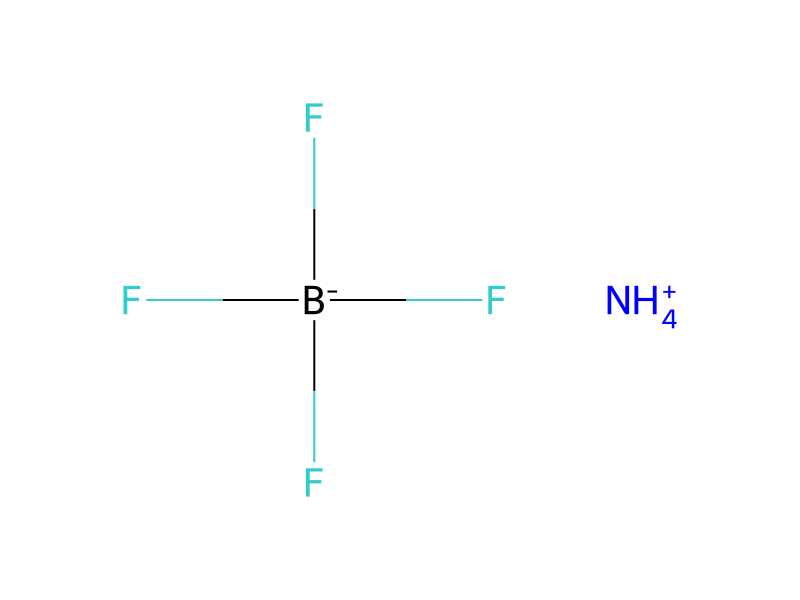
13826-83-0F[B-](F)(F)F.[NH4+]PDTKOBRZPAIMRD-UHFFFAOYSA-OAmmonium fluoborate appears as odorless white crystals. Sinks and mixes with water. (USCG, 1999)
13826-83-0DTXSID80656601.871 at 59 °F 1.85 at 17.5 °C (USCG, 1999) - Denser than water; will sink
1.871 g/cu cm at 15 °C
1.85 @25 °C
Water solubility (g/100 mL water): 3.09 at -1.0 °C; 5.26 at -1.5 °C; 10.85 at -2.7 °C; 12.20 at 0 °C; 25 at 16 °C; 25.83 at 25 °C; 44.09 at 50 °C; 67.50 at 75 °C; 98.93 at 100 °C; 113.7 at 108.5 °C
Solubility in HF at 0 °C: 19.89%
Soluble in ammonium hydroxide
When heated to decomposition it emits very toxic fumes of /hydrogen fluoride and nitrogen oxides and ammonia./
The toxic action of the halogenated borons is considerably influenced by their decomposition products (hydrofluoric acid-, fluoboric acid-, hydrochloric acid-). /Halogenated borons/
446 °F (USCG, 1999)
487 °C (decomposes)
Sublimes at melting point
230 °C
安全情報は参考情報です。供給元の安全データシート(SDS)、適用法令、専門家による評価に代わるものではありません。
Danger
H290 (50%): May be corrosive to metals [Warning Corrosive to Metals]
P234, P260, P261, P264, P264+P265, P271, P280, P301+P330+P331, P302+P352, P302+P361+P354, P304+P340, P305+P351+P338, P305+P354+P338, P316, P319, P321, P332+P317, P337+P317, P362+P364, P363, P390, P403+P233, P405, P406, and P501 (click each P-code to see the statement)
Aggregated GHS information provided per 78 reports by companies from 6 notifications to the ECHA C&L Inventory. Each notification may be associated with multiple companies.
Danger
H319: Causes serious eye irritation [Warning Serious eye damage/eye irritation]
Chemical: Borate(1-), tetrafluoro-, ammonium
REACH registered substance: Ammonium tetrafluoroborate (EC: 237-531-4)
Restricted substance: Ammonium tetrafluoroborate
Borate(1-), tetrafluoro-, ammonium: Does not have an individual approval but may be used under an appropriate group standard
The New Jersey Worker and Community Right to Know Act requires public and private employers to provide information about hazardous substances at their workplaces. (N.J.S.A. 34:5A-1 et. seq.)
Following daily oral intake of 6.4 mg sodium tetrafluoroborate by a volunteer for a period of 14 days, a daily average of 100% was excreted in the urine and 1.6% in the feces. The fluoride content of the volunteer's food was not determined. Sodium fluoroborate is therefore well absorbed, but the fluoride which enters the body is not stored. The authors attributed this to slow hydrolysis of the tetrafluoroborate ion. In another study with 3 volunteers and a study duration of 7 to 38 weeks, there were indications that fluoride which was absorbed in the form of sodium tetrafluoroborate was stored in the body. The amount was <10% of that absorbed into the bloodstream. /Sodium tetrafluoroborate/
In a further study... on the distribution of potassium tetrafluoroborate in various tissues, male albino rats (weighing 110 to 150 g; aged 11-13 weeks) were each iv injected with 1 umol 18F-labelled potassium tetrafluoroborate... . At 120 min after injection, the following relative specific activities (activity per gram of tissue/activity in serum) were determined: liver 0.29, spleen 0.37, kidney 0.60, lung 0.60, muscle 0.14, brain 0.03, femoral diaphysis 0.26, femoral epiphysis 0.29, incisors 0.27, cranial bone 0.27, cartilage 0.30. Further relative specific activities at 30, 120, and 240 min after injection were reported for serum/total injected dose as 1.75, 0.28, and 0.07, respectively, for muscle/serum as 0.14, 0.15, and 0.35, respectively, as well as for femoral epiphysis/serum as 0.35, 0.85, and 1.35, respectively, and for femoral epiphysis/femoral diaphysis as 1.0, 2.3, and 2.4, respectively. /Potassium tetrafluoroborate/
Rats (approx 200 g; 4 animals/group) were given a single ip injection of 5 ug 18F-labelled potassium tetrafluoroborate (it was not specified whether per kg bw or per rat). After 40, 60, 100, and 120 minutes, various organs were assessed for relative specific tetrafluoroborate activity (tissue/blood specific activity ratio). ...The highest activity was found in the thyroid gland, where it was 26 to 42 fold higher than in the other organs after 2 hours. Increases in dose to 50, 500, and 1000 ug potassium tetrafluoroborate did not increase the specific activity in the thyroid gland, but reduced it relative to the values found after administration of 5 ug, e.g. by about a factor of 20, 210 minutes after 1000 ug. /Potassium tetrafluoroborate/


Ammonium fluoborate appears as odorless white crystals. Sinks and mixes with water. (USCG, 1999)
White odorless solid; [HSDB] Soluble in water; [MSDSonline]
化学的特性white crystalline powder
Acidic inorganic salts are generally soluble in water. The resulting solutions contain moderate concentrations of hydrogen ions and have pH's of less than 7.0. They react as acids to neutralize bases. These neutralizations generate heat, but less or far less than is generated by neutralization of inorganic acids, inorganic oxoacids, and carboxylic acid. They usually do not react as either oxidizing agents or reducing agents but such behavior is not impossible. Many of these compounds catalyze organic reactions.
Persons in charge of vessels or facilities are required to notify the National Response Center (NRC) immediately, when there is a release of this designated hazardous substance, in an amount equal to or greater than its reportable quantity of 5000 lb or 2270 kg. The toll free number of the NRC is (800) 424-8802. The rule for determining when notification is required is stated in 40 CFR 302.4 (section IV. D.3.b).
Ammonium fluoroborate is designated as a hazardous substance under section 311(b)(2)(A) of the Federal Water Pollution Control Act and further regulated by the Clean Water Act Amendments of 1977 and 1978. These regulations apply to discharges of this substance. This designation includes any isomers and hydrates, as well as any solutions and mixtures containing this substance.
Extinguish fire using agent suitable for type of surrounding fire.
Water spray will probably reduce fume and irritant gases.
Environmental considerations - land spill: Dig a pit, pond, lagoon, holding area to contain liquid or solid material. /SRP: If time permits, pits, ponds, lagoons, soak holes, or holding areas should be sealed with an impermeable flexible membrane liner./ Cover solids with a plastic sheet to prevent dissolving in rain or fire fighting water.
SRP: The most favorable course of action is to use an alternative chemical product with less inherent propensity for occupational exposure or environmental contamination. Recycle any unused portion of the material for its approved use or return it to the manufacturer or supplier. Ultimate disposal of the chemical must consider: the material's impact on air quality; potential migration in soil or water; effects on animal, aquatic, and plant life; and conformance with environmental and public health regulations.
If material not involved in fire: Keep material out of water sources and sewers. Build dikes to contain flow as necessary.
Keep upwind. ... Avoid breathing vapors or dusts. Wash away any material which may have contacted the body with copious amounts of water or soap and water.
SRP: The scientific literature for the use of contact lenses in industry is conflicting. The benefit or detrimental effects of wearing contact lenses depend not only upon the substance, but also on factors including the form of the substance, characteristics and duration of the exposure, the uses of other eye protection equipment, and the hygiene of the lenses. However, there may be individual substances whose irritating or corrosive properties are such that the wearing of contact lenses would be harmful to the eye. In those specific cases, contact lenses should not be worn. In any event, the usual eye protection equipment should be worn even when contact lenses are in place.
8 hr Time Weighted Avg (TWA): 2.5 mg/cu m. /Fluorides, as F/
Excursion Limit Recommendation: Excursions in worker exposure levels may exceed 3 times the TLV-TWA for no more than a total of 30 minutes during a work day, and under no circumstances should they exceed 5 times the TLV-TWA, provided that the TLV-TWA is not exceeded. /Fluorides, as F/
A4; Not classifiable as a human carcinogen. /Fluorides, as F/
Biological Exposure Index (BEI): Determinant: Fluorides in urine; Sampling Time: prior to shift; BEI: 3 mg/g creatinine; Sampling Time: end of shift; BEI: 10 mg/g creatinine. The determinant may be present in biological specimens collected from subjects who have not been occupationally exposed, at a concentration which could affect interpretation of the result. Such background concentrations are incorporated in the BEI value. The determinant is nonspecific, since it is also observed after exposure to other chemicals. /Fluorides/
10 [mg/m3]
110 [mg/m3]
690 [mg/m3]
Mechanical filter respirator if dusty or misty; self-contained breathing apparatus if fuming. Rubber gloves; safety glasses (dust) or chemical goggles (mist); full, clean work clothing. (USCG, 1999)
Wear appropriate chemical protective gloves, boots and goggles.
/Use/ mechanical filter respirator if dusty or misty, self-contained breathing apparatus if fuming.
Physical examinations of exposed personnel every six months including fluoride determinations in urine, studies of liver and kidney function; chest X-ray, annually. Protect from exposure those individuals with diseases of kidneys, liver, and lung. /Hydrofluoric acid/
No specific considerations are needed for boric acid or borates except for general health and liver and kidney function. /Boric acid and borates/
/SIGNS AND SYMPTOMS/ Chronic effects: (from inhalation or ingestion), may cause fluorosis. Symptoms- weight loss, malaise, anemia, leukopenia, discoloration of teeth, osteosclerosis. /Hydrofluoric acid/
/SIGNS AND SYMPTOMS/ Contact of skin with anhydrous liquid produces severe burns that are felt immediately. Concentrated aqueous solution also cause early sensation of pain, but dilute solution may give no warning of injury. /Hydrofluoric acid/
/SIGNS AND SYMPTOMS/ All forms-dilute or concentrated solution or vapor of hydrofluoric acid (HF) ... cause severe burns. Inhalation of anhydrous HF or HF mists or vapors can cause severe respiratory tract irritation that may be fatal. /Hydrofluoric acid/
/SIGNS AND SYMPTOMS/ Acute effects: ...Inhalation, extreme irritation of respiratory tract... Ingestion, necrosis of esophagus and stomach with nausea, vomiting, diarrhea, circulatory collapse, death. /Hydrofluoric acid/
For more Human Toxicity Excerpts (Complete) data for AMMONIUM FLUOBORATE (6 total), please visit the HSDB record page.
/LABORATORY ANIMALS: Acute Exposure/ The danger of hydrofluoric acid solutions depends upon the concentration. Experimental splash burns in rabbits... have shown 20% solution to cause immediate damage with total corneal opacification with conjunctival eschemia, and with corneal stromal edema within an hour, followed by necrosis of anterior ocular structures. An 8% solution produced ischemia and corneal stromal edema persisting for 40-65 days, accompanied by corneal vascularization. Even a 2% solution caused mild persistent stromal edema and vascularization, but after 0.5% solution there was recovery in 10 days. /Hydrofluoric acid/
/LABORATORY ANIMALS: Chronic Exposure or Carcinogenicity/ Chronic exposure of guinea pigs and rabbits has caused injury of the cornea as well as of mucous membranes. /Hydrofluoric acid/
Maintain an open airway and assist ventilation if nescessary. treat coma, seizures, hypotension, and renal failure if they occur. There is no specific antidote. Administer activated charcoal (although boric acid is not well absorbed). Consider gastric lavage for large ingestions. /Boric acid, Borates, and Boron/
Hemodialysis is effective and is indicated after massive ingestions and for supportive care of renal failure. Peritoneal dialysishas not proved effective in enhancing elimination in infants. /Boric acid, Borates, and Boron/
In acute poisonings, if a large amount has been ingested and the patient is seen within one hour of exposure, gastrointestinal decontamination should be considered ... .It is important to keep in mind that vomiting and diarrhea are common, and severe poisoning may be associated with seizures. Therefore induction of emesis by syrup of ipecac is probably contraindicated in these exposures. Catharsis is not indicated if diarrhea is present. /Boric acid and Borates/
If ingestion of borate has been massive (several grams), or has extended over several days, administer intravenous glucose and electrolyte solutions to sustain urinary excretion of borate. Monitor fluid balance and serum electrolytes (including bicarbonate capacity ) regularly. Monitor cardiac status by ECG. Test the urine for proteins and cells to detect renal injury, and monitor serum concentration of borate. Metabolic acidosis may be treated with sodium bicarbonate. If shock develops, it may be necessary to infuse plasma or whole blood. Administer oxygen continuously. If oliguria (less than 25 to 30 mL urine per hour) occurs, intravenous fluids must be slowed or stopped to avoid overloading the circulation. Such patients should be referred to a center capable of providing intensive care for critically ill patients. /Boric acid and Borates/
For more Antidote and Emergency Treatment (Complete) data for AMMONIUM FLUOBORATE (7 total), please visit the HSDB record page.
Persons in charge of vessels or facilities are required to notify the National Response Center (NRC) immediately, when there is a release of this designated hazardous substance, in an amount equal to or greater than its reportable quantity of 5000 lb or 2270 kg. The toll free number of the NRC is (800) 424-8802. The rule for determining when notification is required is stated in 40 CFR 302.4 (section IV. D.3.b).
Ammonium fluoroborate is designated as a hazardous substance under section 311(b)(2)(A) of the Federal Water Pollution Control Act and further regulated by the Clean Water Act Amendments of 1977 and 1978. These regulations apply to discharges of this substance. This designation includes any isomers and hydrates, as well as any solutions and mixtures containing this substance.
(CA) CALIFORNIA 1000 ug/L /Boron/
(NH) NEW HAMPSHIRE 630 ug/L /Boron/
(ME) MAINE 1,400 ug/L /Boron/
(MN) MINNESOTA 1,000 ug/L /Boron/
(WI) WISCONSIN 960 ug/L /Boron/
Used in metal industry as high-temperature flux; Also used as a catalyst, flame retardant, and lubricant in aluminum cutting-oils; [HSDB]
Metal Preparation and Pouring [Category: Foundry]
Mainly used for the high temperature fluxing action required by the metals industry; catalyst; in flame retardants; acts as a solid lubricant in cutting-oil emulsions for aluminum rolling and forming
使用Ammonium fluoroborate is used as an analytical reagent. It is also applied in the textile printing and dyeing industry and used as a catalyst for resin finishing. It is mainly used for the high temperature fluxing action required by the metals industry; catalyst; in flame retardants and acts as a solid lubricant in cutting-oil emulsions for aluminum rolling and forming.
一般的な説明Odorless white crystals. Sinks and mixes with water.
純化方法Crystallise it from conductivity water (1mL/g) between 100o and 0o. 450 Purification of Inorganic Compounds