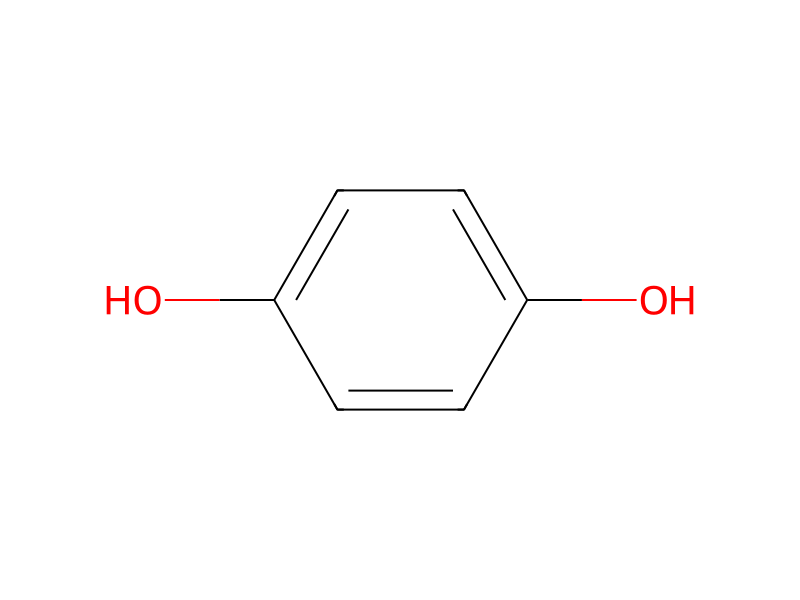
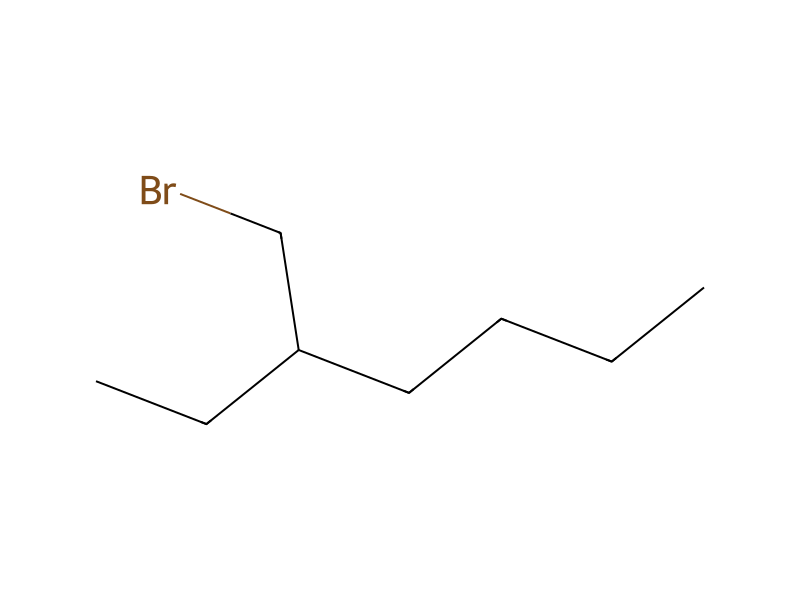
Hydroquinone (37.9 g, 0.344 mol) is suspended in IMS (310 ml) and 1-bromo-2-ethylhexane (132.7 g, 0.687 mol) is added. A solution of KOH (49.9 g, 0.89 mol) in IMS (250 ml) is added slowly over 1 minute. The mixture is heated at reflux whilst monitoring reaction progress by HPLC. After 16 hours, further 1-bromo-2-ethylhexane (53.1 g, 0.27 mol) and solid KOH (20.0 g, 0.36 mol) are added then heated for 2 hours at reflux. The reaction mixture is allowed to cool, is poured into water (1.5 L) and extracted with toluene (500 ml). The organic layer is dried over MgSO4 then evaporated to yield a pale yellow oil. The oil is flashed through silica gel, eluting with 50/50 dichloromethane/hexane to give two product fractions. The initial fraction (35.3 g) co-eluted with 2-ethylhexan-1-ol by-product. The second fraction is evaporated to give pure 1,4-bis(2-ethylhexyloxy)benzene as a pale yellow oil (48.4 g, 42%). The initial fraction is further purified by bulb to bulb distillation to give further pure 1,4-bis(2-ethylhexyloxy)benzene as a pale yellow oil (25.3 g, 22%).