1-Butanol → Bis(dibutylchlorotin) Phosphate
反応式

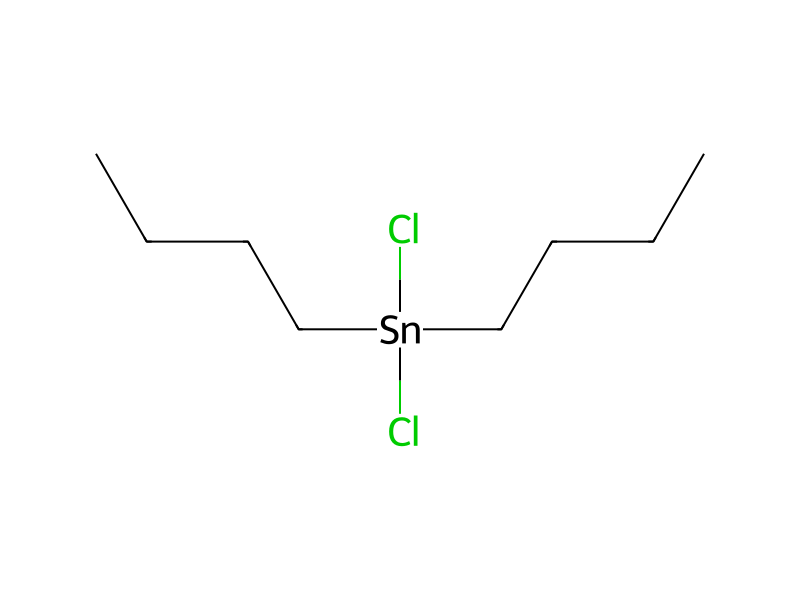
[CH2:1]([Sn:5](Cl)([Cl:10])[CH2:6][CH2:7][CH2:8][CH3:9])[CH2:2][CH2:3][CH3:4].C(O)CCC.O.O.[P:19]([O-:23])([O-:22])([O-:21])=[O:20].[Na+].[Na+].[Na+]>O>[P:19]([OH:23])([O-:22])([O-:21])=[O:20].[CH2:1]([Sn+:5]([CH2:6][CH2:7][CH2:8][CH3:9])[Cl:10])[CH2:2][CH2:3][CH3:4].[CH2:1]([Sn+:5]([CH2:6][CH2:7][CH2:8][CH3:9])[Cl:10])[CH2:2][CH2:3][CH3:4]参加物
5




実験手順
A glass reactor was charged with 91.1 g (0.3 mole) dibutyltin dichloride, 200 cc n-butanol, 50 cc water and 27.3 g (0.15 mole) dibasic sodium phosphate dihydrate. The resultant mixture was heated under a nitrogen atmosphere and the water removed by azeotropic distillation until the vapor temperature reached 117° C. The reaction mixture was then filtered and the liquid phase was concentrated under reduced pressure. The liquid residue solidified upon standing and weighed 83 g. The product was found to contain 34.60% tin, 11.18% chlorine and 4.42% phosphorus. The calculated values for these elements in the expected product are 37.53% tin, 11.21% chlorine and 4.90% phosphorus.
後処理
- customthe water removed by azeotropic distillation until the vapor temperature
- customreached 117° C
- filtrationThe reaction mixture was then filtered
- concentrationthe liquid phase was concentrated under reduced pressure
出典と根拠
- ORDレコード
- ord-7624373b99824b889b3cf0d978fd40db
- 出典データセット
- uspto-grants-1982_01
- 特許番号
- US04312959
反応ノート
読み込み中…