5-(4-Bromo-2,6-dimethylphenyl)-4-hydroxycyclopent-2-enone → 2-(4-Bromo-2,6-dimethylphenyl)cyclopent-4-ene-1,3-dione
HRID 1193027
反応式

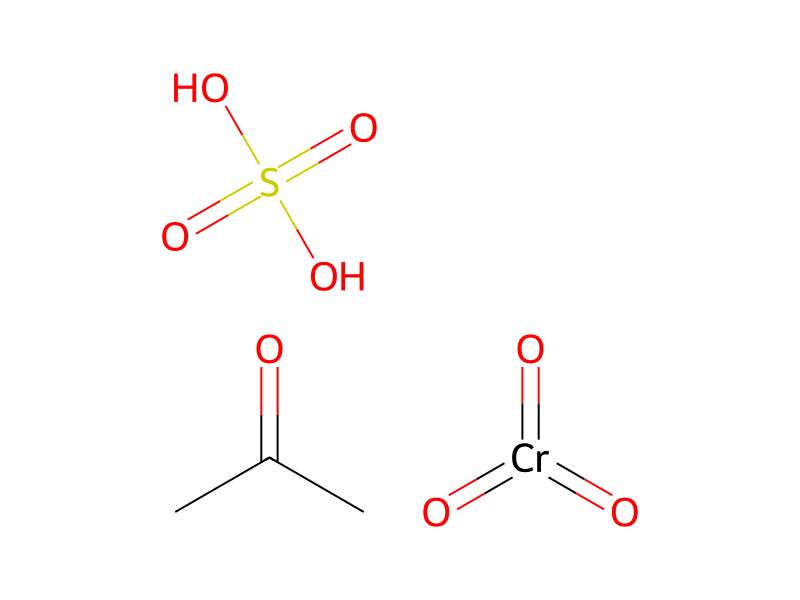
[Br:1][C:2]1[CH:7]=[C:6]([CH3:8])[C:5]([CH:9]2[C:13](=[O:14])[CH:12]=[CH:11][CH:10]2[OH:15])=[C:4]([CH3:16])[CH:3]=1.CC(C)=O.OS(O)(=O)=O.O=[Cr](=O)=O>CC(C)=O>[Br:1][C:2]1[CH:3]=[C:4]([CH3:16])[C:5]([CH:9]2[C:13](=[O:14])[CH:12]=[CH:11][C:10]2=[O:15])=[C:6]([CH3:8])[CH:7]=1参加物
4



実験手順
To a solution of 5-(4-bromo-2,6-dimethylphenyl)-4-hydroxycyclopent-2-enone (18.33 g. 65 mmol) in acetone (200 ml) at 0° C. is added, dropwise, a solution of Jones reagent (1.67 M, 39 ml, 65 mmol) and the resulting yellow solution is stirred at 0° C. for 90 minutes. The reaction is quenched by the addition of propan-2-ol (1 ml) and stirred for a further 2 hours. Brine (300 ml) is added and the reaction is extracted with ethyl acetate (3×250 ml). The organic extracts are combined, washed with brine, dried over anhydrous magnesium sulfate, filtered and the filtrate is concentrated under reduced pressure. The residue is purified by column chromatography on silica gel to give 2-(4-bromo-2,6-dimethylphenyl)cyclopent-4-ene-1,3-dione (17.2 g).