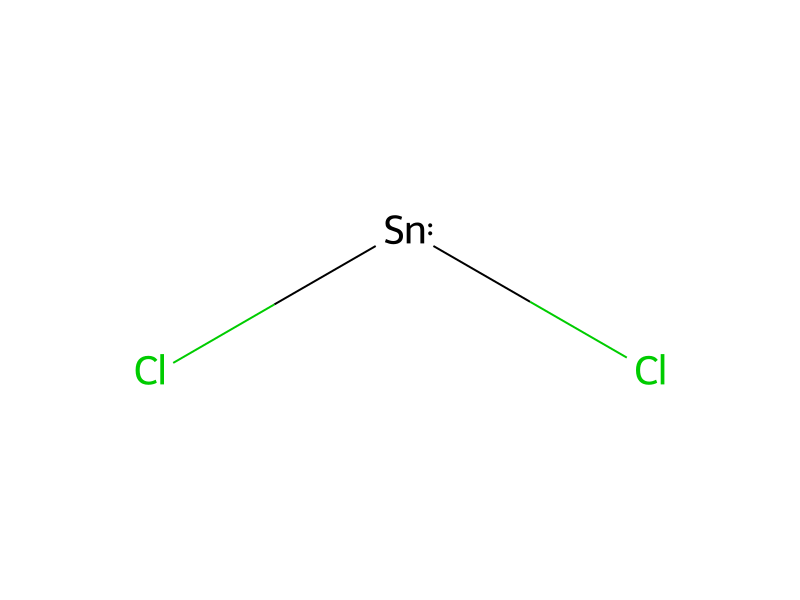
[Cl:1][C:2]1[CH:7]=[CH:6][CH:5]=[C:4]([Cl:8])[C:3]=1[C:9]1[N:13]=[C:12]([C:14]2[CH:19]=[CH:18][CH:17]=[C:16]([N+:20]([O-])=O)[CH:15]=2)[O:11][N:10]=1.O.O.[Sn](Cl)Cl.[Sn](Cl)Cl>C(OCC)(=O)C>[Cl:8][C:4]1[CH:5]=[CH:6][CH:7]=[C:2]([Cl:1])[C:3]=1[C:9]1[N:13]=[C:12]([C:14]2[CH:19]=[CH:18][CH:17]=[C:16]([NH2:20])[CH:15]=2)[O:11][N:10]=1The nitro oxadiazole prepared in Step 1 (200 mg) was dissolved in ethyl acetate (20 mL) and tin (II) chloride dihydrate (162 mg, 1.2 molar equivalent) was added. The mixture was stirred at room temperature for 1 h. An additional 1.2 molar equivalents of tin (II) chloride was added. After a further 4 h at room temperature, the reaction mixture was diluted with ethyl acetate and washed three times with water. The organic layer was dried over anhydrous sodium sulfate, filtered and concentrated under reduced pressure to give the desired 3-(2,6-dichlorophenyl)-5-(3-aminophenyl)-1,2,4-oxadiazole as a white solid in quantitative yield. NMR (300 MHz, DMSO-d6): 7.70 (m, 3H), 7.36 (s, 1H), 7.24 (d, 2H), 6.91 (m, 1H), 5.57 ppm (broad s, 2H). LC-MS tr=33.1 min (Method W) MH+=307