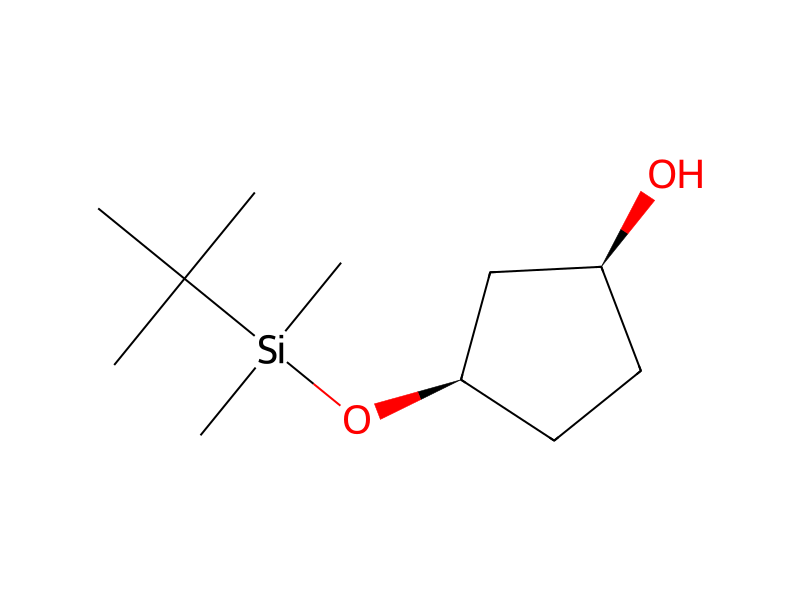
(1R,4S)-4-((tert-Butyldimethylsilyl)oxy)cyclopent-2-en-1-ol → (1S,3R)-3-((tert-Butyldimethylsilyl)oxy)cyclopentan-1-ol
反応式

[C:1]([Si:5]([CH3:14])([CH3:13])[O:6][C@H:7]1[CH2:11][C@@H:10]([OH:12])[CH:9]=[CH:8]1)([CH3:4])([CH3:3])[CH3:2]>C1C=CC(P(C2C=CC=CC=2)C2C=CC=CC=2)=CC=1.C1C=CC(P(C2C=CC=CC=2)C2C=CC=CC=2)=CC=1.C1C=CC(P(C2C=CC=CC=2)C2C=CC=CC=2)=CC=1.[Cl-].[Rh].C1(C)C=CC=CC=1>[C:1]([Si:5]([CH3:14])([CH3:13])[O:6][C@@H:7]1[CH2:8][CH2:9][C@H:10]([OH:12])[CH2:11]1)([CH3:4])([CH3:3])[CH3:2]参加物
4


実験手順
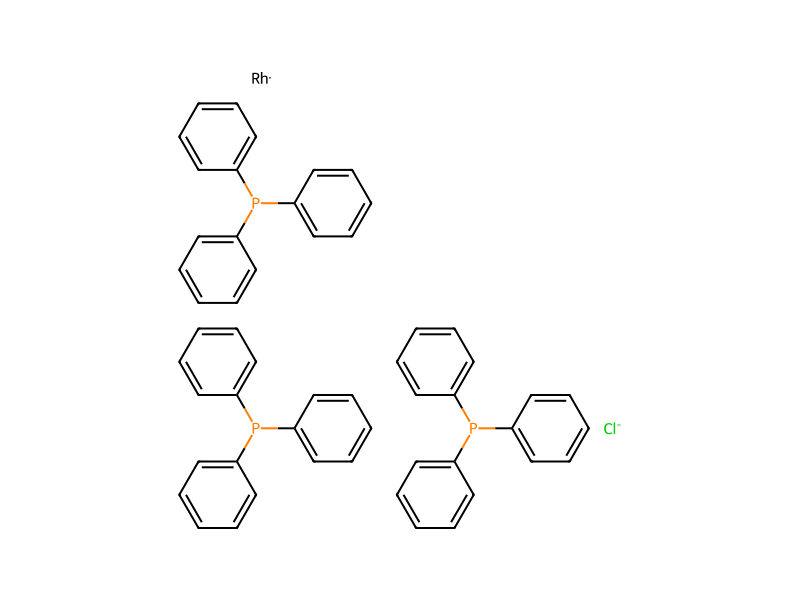
A solution of (−)-(1R,4S)-4-(tert-butyl-dimethyl-silanyloxy)-cyclopent-2-enol (1.2 g, 5.6 mmol) (from Example 27a supra) and Wilkinson's catalyst (520 mg, 0.56 mmol) (Aldrich) in toluene (50 mL) was subjected to hydrogenation at atmospheric pressure for 16 hours. The reaction mixture was filtered and partitioned between ethyl acetate and water. The organic layer was collected, dried over sodium sulfate, filtered and concentrated. The resulting residue was purified by chromatography on a silica gel column using a 0–30% diethyl ether in hexanes gradient to give (−)-(1S,3R)-3-(tert-butyl-dimethyl-silanyloxy)-cyclopentanol as a colorless oil. (Yield 790 mg, 65%).