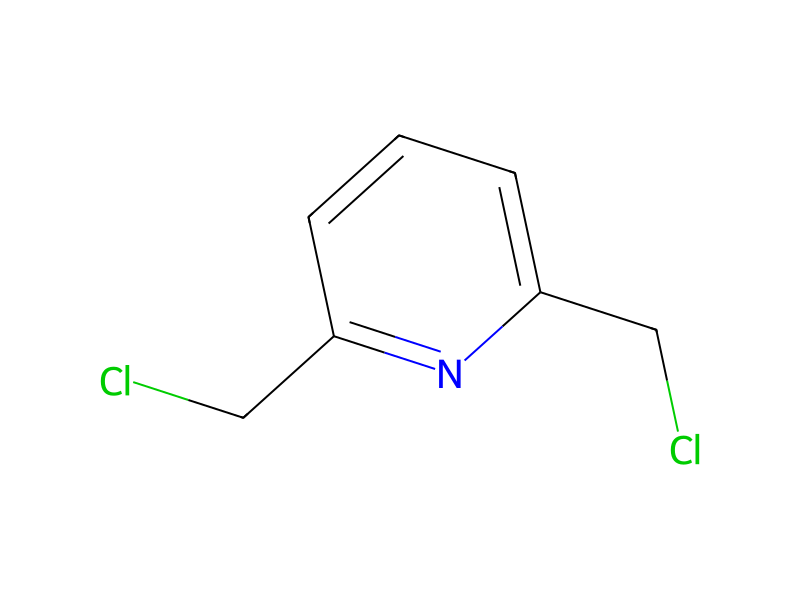
2,6-Bis(chloromethyl)pyridine → 1H-Isoindole-1,3(2H)-dione, 2-[[6-(chloromethyl)-2-pyridinyl]methyl]-
HRID 1258576
反応式

Cl[CH2:2][C:3]1[CH:8]=[CH:7][CH:6]=[C:5]([CH2:9][Cl:10])[N:4]=1.[C:11]1(=[O:21])[NH:15][C:14](=[O:16])[C:13]2=[CH:17][CH:18]=[CH:19][CH:20]=[C:12]12.[K]>CN(C=O)C>[Cl:10][CH2:9][C:5]1[N:4]=[C:3]([CH2:2][N:15]2[C:11](=[O:21])[C:12]3[C:13](=[CH:17][CH:18]=[CH:19][CH:20]=3)[C:14]2=[O:16])[CH:8]=[CH:7][CH:6]=1参加物
4



実験手順
To a solution of 2,6-bis(chloromethyl)pyridine (20 g, 113.6 mmol, 1 eq.) in 250 ml of DMF was added potassium phthalimide (21.04 g, 113.6 mmol, 1 eq.). The reaction was stirred at r.t. overnight then the solvent was evaporated and the residue taken in EtOAc. The insolubles were removed by filtration and the filtrate washed with H2O. The organic layer was separated, dried over MgSO4 and concentrated. The resulting white solid was recrystallised from IPE/EtOAc (1/1) to give 2-{[6-(chloromethyl)pyridin-2-yl]methyl}-1H-isoindole-1,3(2H)-dione (22.34 g, 68% yield) as a white solid.