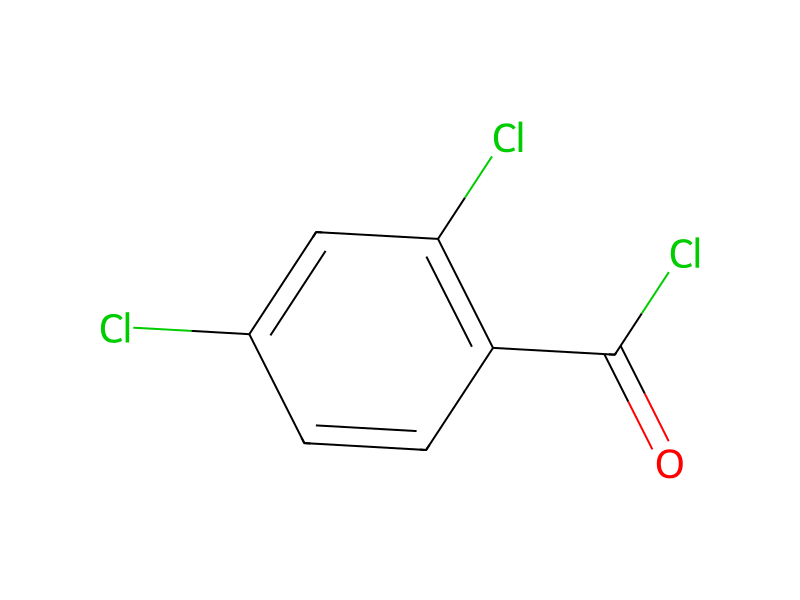
[Cl:1][C:2]1[CH:7]=[CH:6][C:5](/[CH:8]=[CH:9]/[S:10]([NH2:13])(=[O:12])=[O:11])=[CH:4][CH:3]=1.C(=O)([O-])[O-].[K+].[K+].[Cl:20][C:21]1[CH:29]=[C:28]([Cl:30])[CH:27]=[CH:26][C:22]=1[C:23](Cl)=[O:24].Cl>O1CCOCC1>[Cl:20][C:21]1[CH:29]=[C:28]([Cl:30])[CH:27]=[CH:26][C:22]=1[C:23]([NH:13][S:10](/[CH:9]=[CH:8]/[C:5]1[CH:4]=[CH:3][C:2]([Cl:1])=[CH:7][CH:6]=1)(=[O:11])=[O:12])=[O:24]To a solution of (E)-2-(4-chloro-phenyl)-ethenesulfonic acid amide (65 mg, 0.3 mmol) in 1,4-dioxane (1.5 ml) was added potassium carbonate (83 mg, 0.6 mmol) followed by 2,4-dichlorobenzoyl chloride (63 μL, 0.45 mmol). The reaction was heated at 80° C. for 16 hours then allowed to cool to room temperature whereupon 1N HCl (2 ml) was added. The mixture was extracted with ethyl acetate (2 ml), the organics were dried with MgSO4 and washed with ethyl acetate (0.4 ml). The mixture was concentrated in vacuo and the resultant residue was purified by preparative HPLC to afford (E)-2-(4-chloro-phenyl)-ethenesulfonic acid 2,4-dichloro-benzoylamide (33.6 mg, 29%).