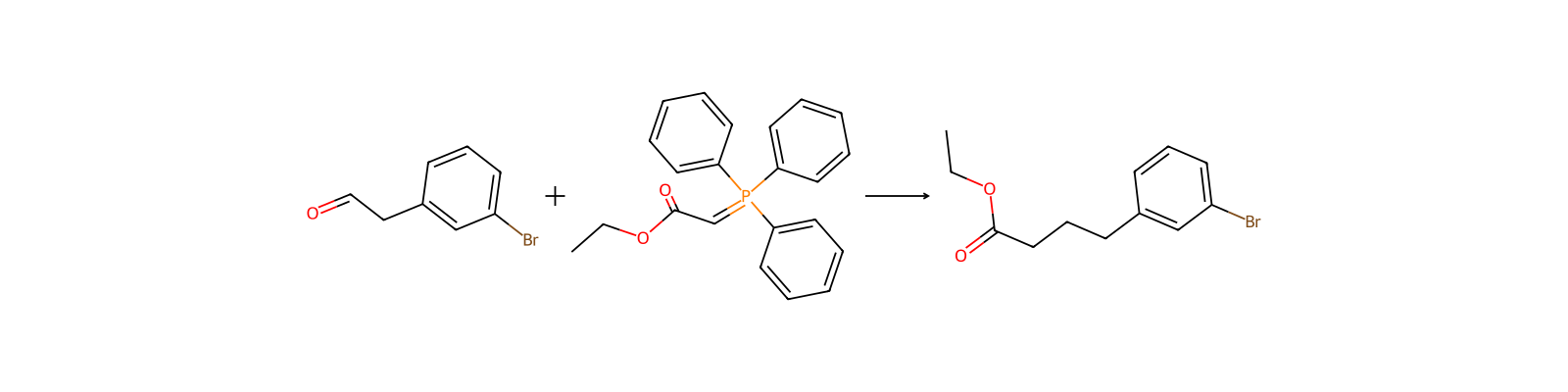
関与物質
| 役割 | 名称 | HCID | 仕込み量 |
|---|
| 反応物 | Acetic acid, 2-(triphenylphosphoranylidene)-, ethyl ester | HCID 70670 | — |
| 反応物 | (3-Bromophenyl)acetaldehyde | HCID 20387554 | — |
| 生成物 | Ethyl 4-(3-bromophenyl)butanoate | HCID 11492759 | — |
反応手順
Compound G can be obtained as described in J. Med. Chem. 1995, 38, 4764-4767, and as shown in Reaction Scheme 1. Thus, referring now specifically to Reaction Scheme 1, ethyl 3-bromophenylacetate (Compound B, made by esterification of 3-bromophenylacetic acid) is reduced with diisobutylaluminum hydride (DIBAL H) to yield (3-bromophenyl)acetaldehyde. (3-Bromophenyl)acetaldehyde is reacted in a Wittig reaction with (carbethoxymethylene)triphenylphosphorane to provide a mixture of E and Z ethyl 4-(3-bromophenyl)but-2-enoates. The latter compounds are hydrogenated to yield ethyl 4-(3-bromophenyl)butanoate (Compound D). Compound D is reacted with the Grignard reagent derived from methylbromide to give the tertiary alcohol 5-(3-bromophenyl)-2-methylpentan-2-ol (Compound E) (It should be apparent to those skilled in the art, that the choice of the Grignard reagent used in this reaction step determines the nature of the R1 substituent in the resulting compounds of the invention.) Compound E is then treated with acid to cyclize it and to form 6-bromo-1,2,3,4-tetrahydro-1,1-dimethylnaphthalene (Compound F). Compound F is oxidized with chromium trioxide to yield 7-bromo-3,4-dihydro-4,4-dimethylnaphthalen-1(2H)-one (Compound G). The isomeric compound, 6-bromo-3,4-dihydro-4,4-dimethylnaphthalen-1(2H)-one (Compound H) can be obtained, starting with ethyl (4-bromophenyl)acetate, in accordance with the sequence of reactions illustrated in Reaction Scheme 1 for Compound G.
情報源と証拠
| DOI | 10.6084/m9.figshare.5104873.v1 |
|---|
| 特許番号 | US05723666 |
|---|
| 出典データセット | uspto-grants-1998_03 |
|---|
| ORD ID | ord-b3dbd0407beb47cbade768f03604d785 |
|---|
| 出典メモ | uspto-grants-1998_03 |
|---|