反応式

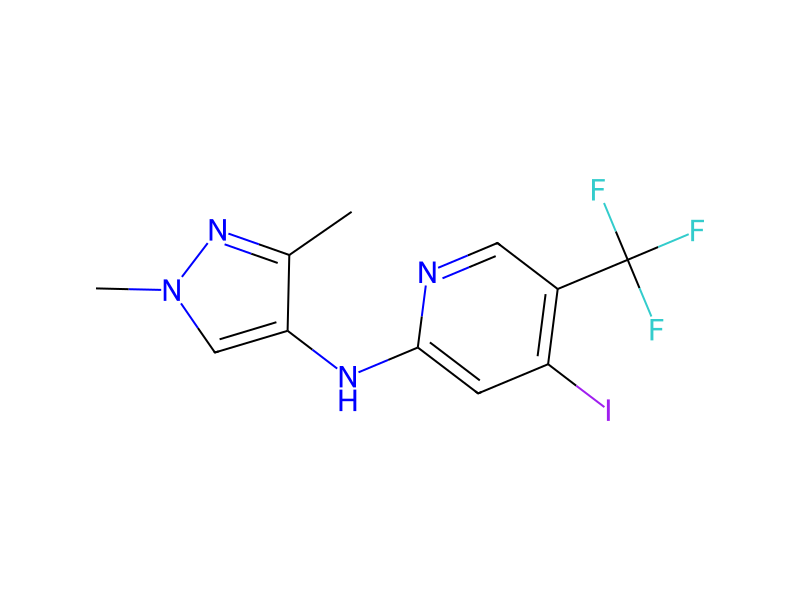
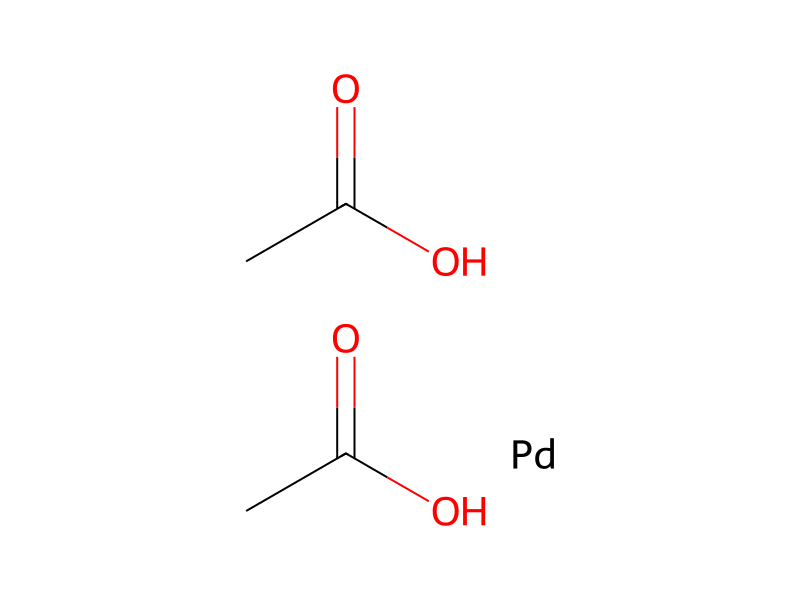
CN1CCc2cccc(N)c2C1=O.Cc1nn(C)cc1Nc1cc(I)c(C(F)(F)F)cn1>C1COCCO1.CC(=O)O.CC(=O)O.CC1(C)c2cccc(P(c3ccccc3)c3ccccc3)c2Oc2c(P(c3ccccc3)c3ccccc3)cccc21.O=C([O-])[O-].[Cs+].[Cs+].[Pd]>Cc1nn(C)cc1Nc1cc(Nc2cccc3c2C(=O)N(C)CC3)c(C(F)(F)F)cn1参加物
反応物 2

生成物 1

試薬・触媒・溶媒 4



反応条件
- 温度
- 80 °C
実験手順
A suspension of 8-amino-2-methyl-3,4-dihydroisoquinolin-1(2H)-one (23.06 mg, 0.13 mmol), N-(1,3-dimethyl-1H-pyrazol-4-yl)-4-iodo-5-(trifluoromethyl)pyridin-2-amine (50 mg, 0.13 mmol), diacetoxypalladium (1.469 mg, 6.54 µmol), (9,9-dimethyl-9H-xanthene-4,5-diyl)bis(diphenylphosphine) (7.57 mg, 0.01 mmol) and cesium carbonate (85 mg, 0.26 mmol) was stirred at 80 °C overnight under nitrogen. LCMS showed formation of more bis-arylation by-product than in _EN01775-08_ (DMA under micorwaves conditions). The crude was combined with EN01775-08-01 and poured onto a silicagel column. The crude product was purified by flash chromatography eluting with 0 to 5% methanol in ethyl acetate/DCM (1/1). The solvent was evaporated to dryness to afford a gummy film in the flask **(37mg: not that bad)**. it was scratched in diethyl ether (soluble) then after Et2O evaporation in a few drops of MeCN. A solid crashed out. The resulting solid was taken up into diethyl ether, collected by filtration and dried to afford 8-(2-(1,3-dimethyl-1H-pyrazol-4-ylamino)-5-(trifluoromethyl)pyridin-4-ylamino)-2-methyl-3,4-dihydroisoquinolin-1(2H)-one (19.00 mg, 33.7 %) as a white solid (a bit soluble in Et2O because some P1 remained in the Et2O filtrate). **not the real yield**
出典と根拠
- ORDレコード
- ord-ff15f562a6534424848273f847da5684
- 出典データセット
- 750 AstraZeneca ELN dataset
- 元リンク
- 出典を表示
関連ノート
読み込み中…