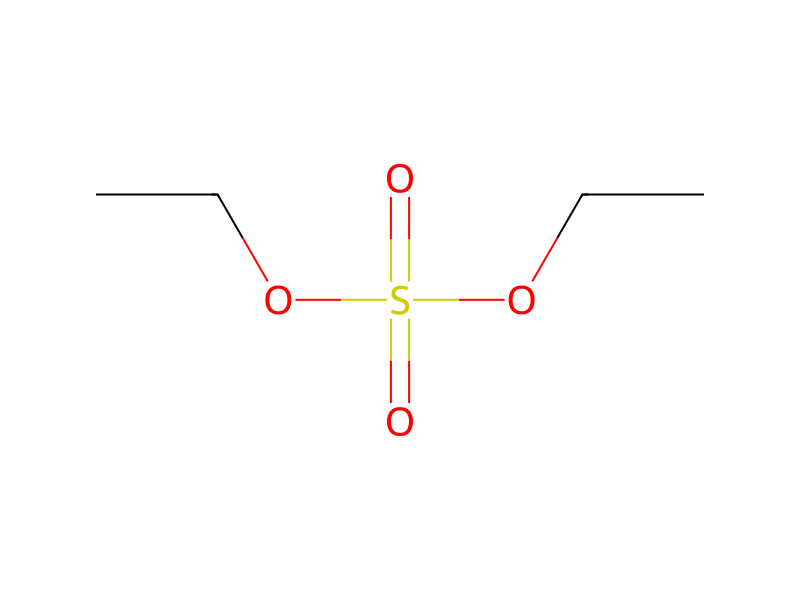
Diethyl Sulfate → 6-Ethoxy-4-chloromethyl-2-methyl-pyrimidine
HRID 1380828
反応式

[Cl:1][CH2:2][C:3]1[N:8]=[C:7]([CH3:9])[N:6]=[C:5]([OH:10])[CH:4]=1.S(OCC)(O[CH2:15][CH3:16])(=O)=O.C(=O)([O-])[O-].[K+].[K+]>CC(C)=O>[CH2:15]([O:10][C:5]1[N:6]=[C:7]([CH3:9])[N:8]=[C:3]([CH2:2][Cl:1])[CH:4]=1)[CH3:16]参加物
5




実験手順
15.8 g (0.1 mol) of 6-chloromethyl-4-hydroxy-2-methyl-pyrimidine, 13 ml (0.1 mol) of diethyl sulphate and 27.6 g (0.2 mol) of potassium carbonate are heated at reflux in 500 ml of acetone for 6 hours. The mixture is then filtered and the filtrate is concentrated to dryness. The residue is taken up in 200 ml of methylene chloride and the methylene chloride solution is washed once with 50 ml of 2N sodium hydroxide and twice with 50 ml of semi-saturated sodium chloride solution, dried over anhydrous sodium sulphate and evaporated under reduced pressure. The residual oil is distilled at 47° C./0.07 mmHg, whereupon the distillate becomes solid. There is obtained 6-ethoxy-4-chloromethyl-2-methyl-pyrimidine, m.p. 29° C.