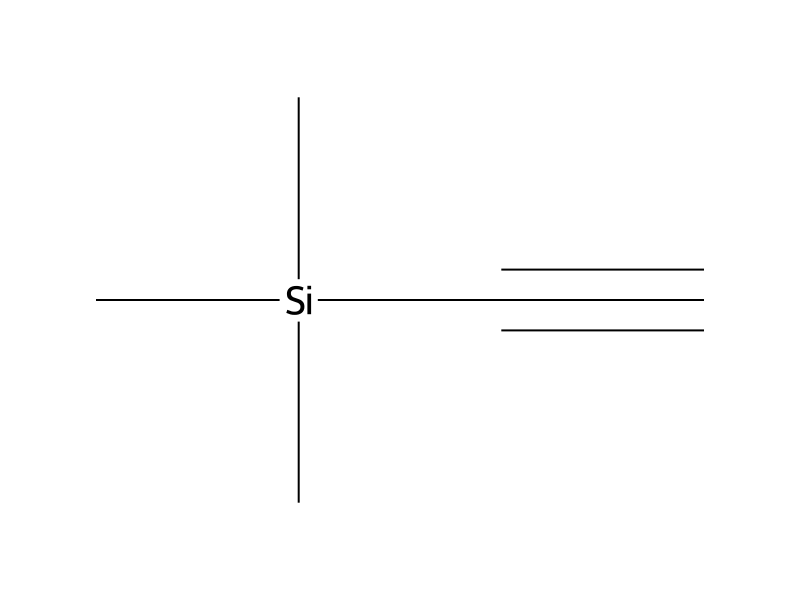
Br[C:2]1[CH:3]=[CH:4][C:5]2[N:9]=[C:8]([O:10][CH2:11][CH2:12][F:13])[N:7]([C:14]3[CH:19]=[CH:18][N:17]=[C:16]([NH2:20])[N:15]=3)[C:6]=2[CH:21]=1.[C:22]([Si:24]([CH3:27])([CH3:26])[CH3:25])#[CH:23].C(N(CC)CC)C>CS(C)=O.ClCCl.[Pd](Cl)Cl.C1(P(C2C=CC=CC=2)C2C=CC=CC=2)C=CC=CC=1.C1(P(C2C=CC=CC=2)C2C=CC=CC=2)C=CC=CC=1>[F:13][CH2:12][CH2:11][O:10][C:8]1[N:7]([C:14]2[CH:19]=[CH:18][N:17]=[C:16]([NH2:20])[N:15]=2)[C:6]2[CH:21]=[C:2]([C:23]#[C:22][Si:24]([CH3:27])([CH3:26])[CH3:25])[CH:3]=[CH:4][C:5]=2[N:9]=1A solution of 4-[6-bromo-2-(2-fluoroethoxy)-1H-1,3-benzodiazol-1-yl]pyrimidin-2-amine (150 mg, 0.43 mmol), ethynyltrimethylsilane (126 mg, 1.28 mmol), bis(triphenylphosphine) palladium(II) dichloride (120 mg, 0.17 mmol) and triethylamine (0.5 mL) in dimethylsulfoxide (1 mL) was irradiated with microwave radiation under nitrogen in a sealed tube at 80° C. for 40 min. The reaction mixture was diluted with 10 mL of dichloromethane and the solid material was removed by filtration. The filtrate was concentrated under vacuum and the residue was purified on a silica gel column (ethyl acetate/petroleum ether, 3:1) to give 60 mg (38%) of 4-[2-(2-fluoroethoxy)-6-[2-(trimethylsilyl)ethynyl]-1H-1,3-benzodiazol-1-yl]pyrimidin-2-amine as a yellow solid: LC-MS: m/z=+370 (M+H)+.