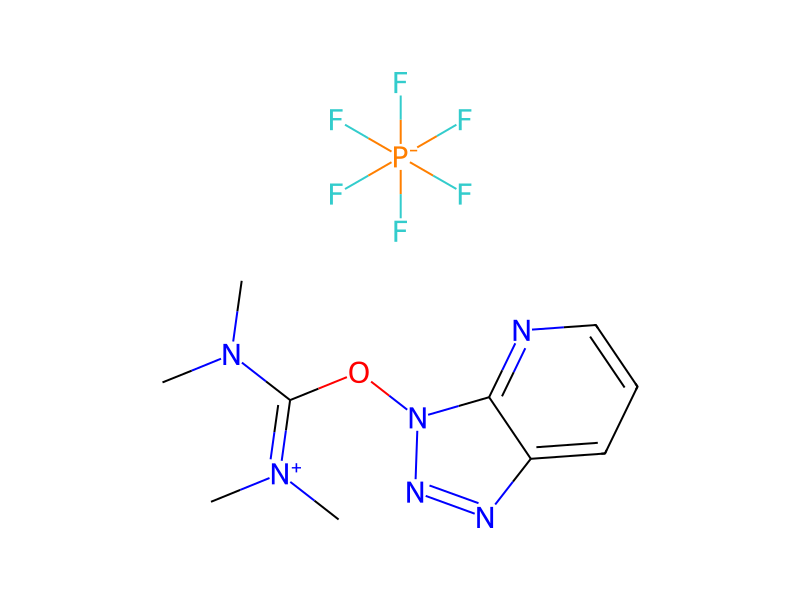
[F:1][C:2]([F:11])([F:10])[C:3]1[N:8]=[CH:7][C:6]([NH2:9])=[CH:5][CH:4]=1.[NH2:12][C:13]1[CH:21]=[CH:20][C:16]([C:17](O)=[O:18])=[CH:15][C:14]=1[N+:22]([O-:24])=[O:23].CN(C(ON1N=NC2C=CC=NC1=2)=[N+](C)C)C.F[P-](F)(F)(F)(F)F.CCN(CC)CC>CN(C=O)C>[NH2:12][C:13]1[CH:21]=[CH:20][C:16]([C:17]([NH:9][C:6]2[CH:7]=[N:8][C:3]([C:2]([F:1])([F:10])[F:11])=[CH:4][CH:5]=2)=[O:18])=[CH:15][C:14]=1[N+:22]([O-:24])=[O:23]To a solution of 6-trifluoromethylpyridin-3-ylamine (1.0 g, 6.17 mmol) and 4-amino-3-nitrobenzoic acid (1.12 g, 6.17 mmol) in DMF (25 mL) was added HATU (3.5 g, 9.23 mmol) followed by NEt3 (1.77 ml, 9.23 mmol). The reaction mixture was stirred at ambient temperature overnight. The reaction was quenched with water and extracted with EtOAc. The organic layer was washed with water, brine, dried with MgSO4, and filtered. The solvent was removed under reduced pressure and the residue was purified by flash chromatography using a heptane/EtOAc (1:1 then followed by 100% EtOAc) to give 4-amino-3-nitro-N-(6-trifluoromethylpyridin-3-yl)-benzamide as a red solid.