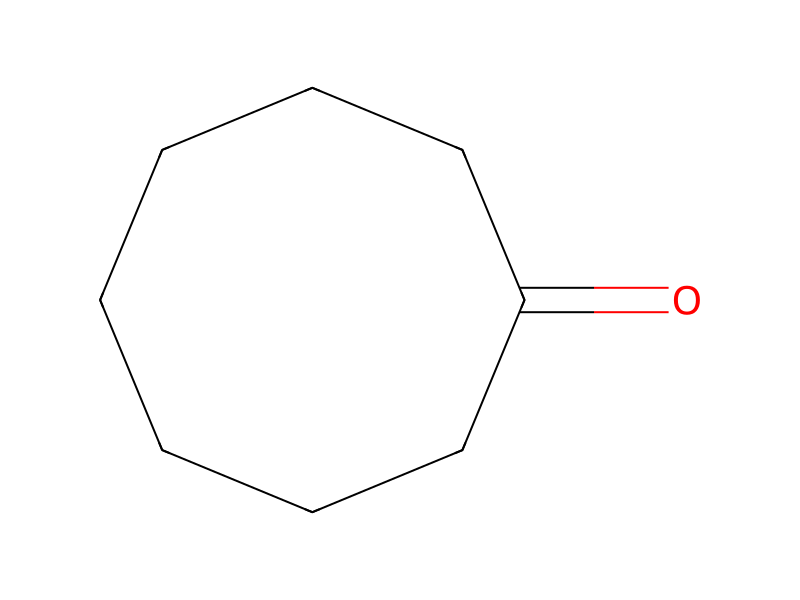
2,8-Dibenzylcyclooctanone is prepared by stirring 25 grams of cyclooctanone, 54 grams of benzaldehyde, 30 grams of potassium hydroxide and 500 milliliters of methanol at reflux temperatures for 4 hours. The mixture is then cooled to room temperature and 200 milliliters of water are added followed by 300 milliliters of ether. The ether layer is separated and the ether and methanol are then removed by distillation. The residue is taken up in 200 milliliters of ethanol and hydrogenated at 1,000 p.s.i.g. and ambient temperature using a 10 percent palladium on carbon catalyst. The catalyst is removed by filtration and the solvent is removed by distillation. Recrystallization of the crude product is effected by dissolving in 150 milliliters of methanol and seeding with crystalline 2,8-dibenzylcyclooctanone (m.p. 75°-77° C.). Cooling of the seeded methanolic solution gives 16 grams of crystals with melting point 60°-67° C. A second recrystallization of this material from methanol gives one isomer of 2,8-dibenzylcyclooctanone, melting point 75°-77° C., as a first crop and a second isomer of 2,8-dibenzylcyclooctanone, melting point 66°-68° C., as a second crop.