Potassium Carbonate → 1-[p-(N',N'-dimethylureido)-phenoxy]-2-hydroxy-3-isopropylaminopropane
反応式
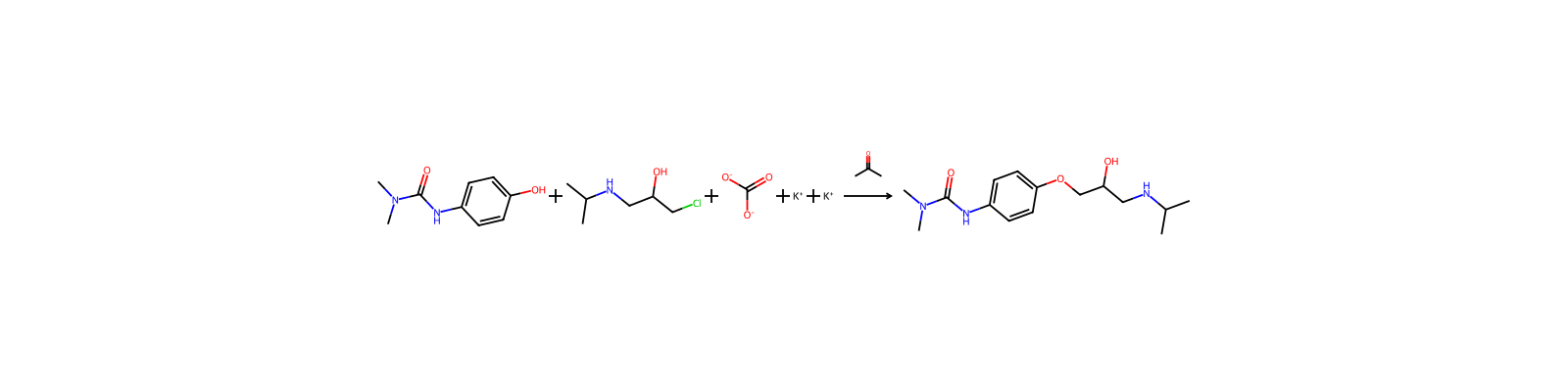
[CH3:1][N:2]([CH3:13])[C:3](=[O:12])[NH:4][C:5]1[CH:10]=[CH:9][C:8]([OH:11])=[CH:7][CH:6]=1.[CH:14]([NH:17][CH2:18][CH:19]([OH:22])[CH2:20]Cl)([CH3:16])[CH3:15].C(=O)([O-])[O-].[K+].[K+]>CC(C)=O>[CH3:1][N:2]([CH3:13])[C:3](=[O:12])[NH:4][C:5]1[CH:10]=[CH:9][C:8]([O:11][CH2:20][CH:19]([OH:22])[CH2:18][NH:17][CH:14]([CH3:16])[CH3:15])=[CH:7][CH:6]=1参加物
5




実験手順
A mixture of 20 g of p-(N',N'-dimethylureido)-phenol, 15 g of 3-isopropylamino-2-hydroxy-1-chloropropane, and 20 g of finely ground potassium carbonate in 250 ml of acetone is stirred at 50° for 5 hours. The solid part of the mixture is filtered off and the acetone solution is evaporated in a vacuum. The residue is dissolved in 100 ml of 2N hydrochloric acid, the undissolved part is filtered off and the remaining mixture is extracted with methylene chloride. The aqueous phase is rendered alkaline by adding 2N sodium hydroxide solution and is extracted with methylene chloride. After the evaporation of the solvent, 1-[p-(N',N'-dimethylureido)-phenoxy]-2-hydroxy-3-isopropylaminopropane is isolated which melts at 138°-139° after recrystallisation from benzene and has the formula ##SPC6##