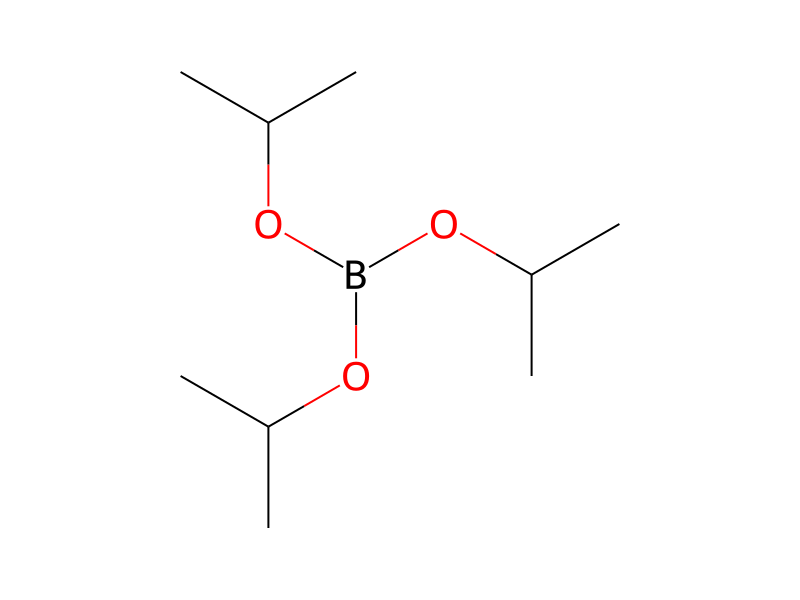
Under an argon gas atmosphere, a mixture of 9.80 g (25.6 mmol) of 6-bromo-2-(9-phenanthrenyl)naphthalene, 100 mL of dehydrated toluene and 100 mL of dehydrated diethylether was cooled down to −10 degrees C., and added with 19.7 mL (30.7 mmol) of hexane solution of 1.56M n-butyllithium in drops while being stirred. Then, the reaction mixture was stirred for four hours at −10 degree C. The reaction mixture was further cooled down to −60 degrees C., and added with 14.4 g (76.7 mmol) of triisopropyl borate in drops. The reaction mixture was subsequently warmed up to room temperature, and stirred for 16 hours at room temperature. The reaction mixture was further added with solution of hydrochloric acid to be stirred for one night at room temperature. After the reaction, the reaction mixture experienced liquid separation, organic phase thereof was cleansed with water, and the solvent was distilled away under reduced pressure until the reaction mixture became slurry. By adding residue thereof with hexane, filtering the solid and recrystallizing the residue by THF and hexane, 5.20 g of 2-(9-phenanthrenyl)naphthalene-6-boronic acid was obtained at an yield of 58%.