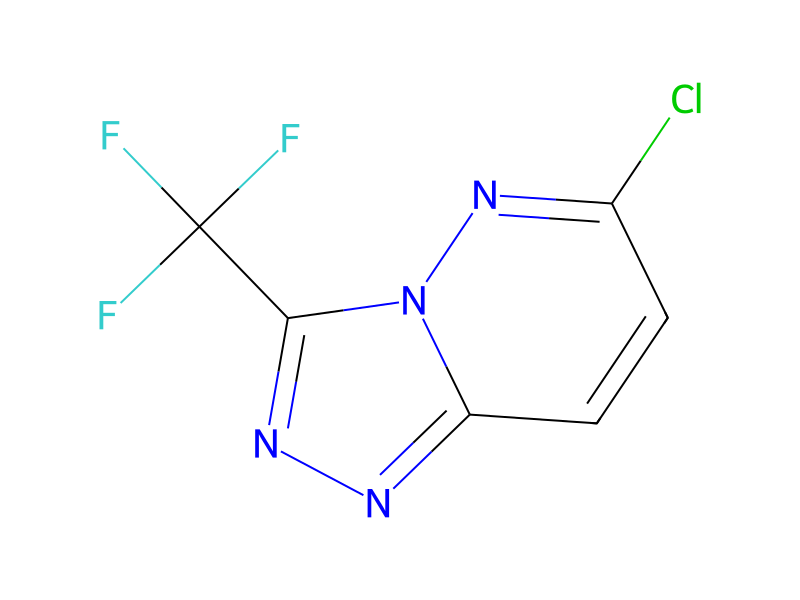
A mixture of 1-(5-bromopyridin-2-yl)piperazine and 6-chloro-3-(trifluoromethyl)-[1,2,4]triazolo[4,3-b]pyridazine in ethanol (7 mL) was stirred at 80° C. for 20 hours. The reaction mixture was concentrated and partitioned between dichloromethane (50 mL) and saturated aqueous sodium bicarbonate solution (25 mL). The aqueous phase was extracted twice with dichloromethane (2×50 mL). The organic phases were combined, washed with water (100 mL), and concentrated to give a residue that was purified by flash chromatography on silica-gel using ethyl acetate as eluant to give 6-[4-(5-bromopyridin-2-yl)piperazin-1-yl]-3-(trifluoromethyl)-[1,2,4]triazolo[4,3-b]pyridazine 0.353 g, 73.4%)