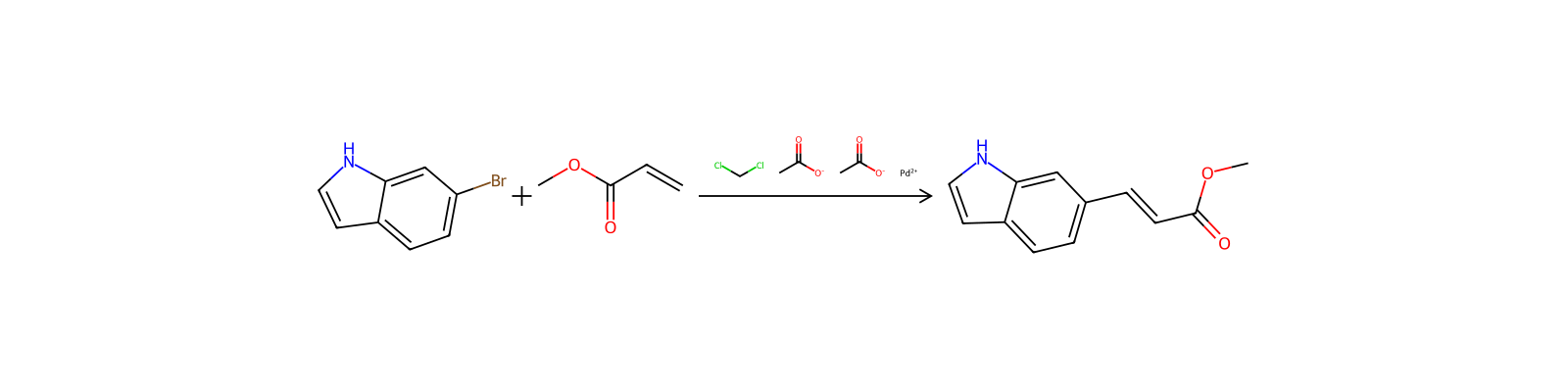
Br[C:2]1[CH:10]=[C:9]2[C:5]([CH:6]=[CH:7][NH:8]2)=[CH:4][CH:3]=1.[C:11]([O:15][CH3:16])(=[O:14])[CH:12]=[CH2:13]>C(Cl)Cl.CC([O-])=O.CC([O-])=O.[Pd+2]>[CH3:16][O:15][C:11](=[O:14])[CH:12]=[CH:13][C:2]1[CH:10]=[C:9]2[C:5]([CH:6]=[CH:7][NH:8]2)=[CH:4][CH:3]=1To a resealable reaction tube was added 6-bromoindole (5 g, 26 mmol), methyl acrylate (2.9 ml, 32 mmol), TEA (4.4 ml, 32 mmol), (o-Tol)3P (0.78 g, 2.6 mmol) and Pd(OAc)2 (0.29 g, 1.3 mmol). The reaction tube was sealed and the resulting mixture was stirred at 100° C. for 20 hours, then cooled to room temperature, diluted with DCM, and filtered through celite. The filter cake was washed with DCM. The filtrate was concentrated and purified via flash chromatography (hexane/EtOAc) to provide 3-(1H-indol-6-yl)-acrylic acid methyl ester XXX (3.8 g, 73% yield) as a bright yellow solid.
読み込み中…