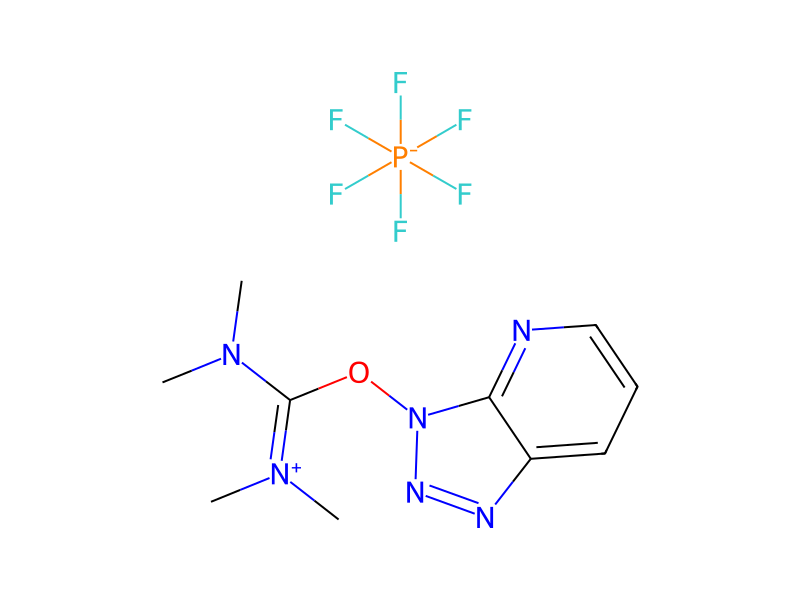
[N:1]1[CH:6]=[CH:5][C:4]([CH2:7][NH:8][C:9]2[CH:17]=[CH:16][CH:15]=[CH:14][C:10]=2[C:11]([OH:13])=O)=[CH:3][CH:2]=1.[NH2:18][C:19]1[CH:20]=[C:21]2[C:25](=[CH:26][C:27]=1[Cl:28])[NH:24][N:23]=[CH:22]2.CN1CCOCC1.F[P-](F)(F)(F)(F)F.N1(OC(N(C)C)=[N+](C)C)C2N=CC=CC=2N=N1>CN(C)C=O.O>[Cl:28][C:27]1[CH:26]=[C:25]2[C:21]([CH:22]=[N:23][NH:24]2)=[CH:20][C:19]=1[NH:18][C:11](=[O:13])[C:10]1[CH:14]=[CH:15][CH:16]=[CH:17][C:9]=1[NH:8][CH2:7][C:4]1[CH:3]=[CH:2][N:1]=[CH:6][CH:5]=1194 mg (0.85 mmol) of 2-(4-pyridylmethyl)aminobenzoic acid is mixed in 8 ml of dimethylformamide with 283 mg (1.69 mmol) of 5-amino-6-chloroindazole. Under argon and in a moisture-free environment, 215 mg (2.13 mmol) of N-methylmorpholine and 386 mg (1.02 mmol) of O-(7-azabenzotriazol-1-yl)-1,1,3,3-tetramethyluronium hexafluorophophate are added to this solution. This mixture is stirred for 4 hours at room temperature. It is then diluted with about 40 ml of water and extracted three times with 30 ml of ethyl acetate each. The combined organic phase is washed with water, dried, filtered and concentrated by evaporation. The residue is chromatographed on silica gel with methylene chloride:ethanol-10:1 as an eluant. 97 mg (30.2% of theory) of N-(6-chloroindazol-5-yl)-2-[(4-pyridyl)methyl]amino-benzoic acid amide with a melting point of 222.8° C. is obtained.