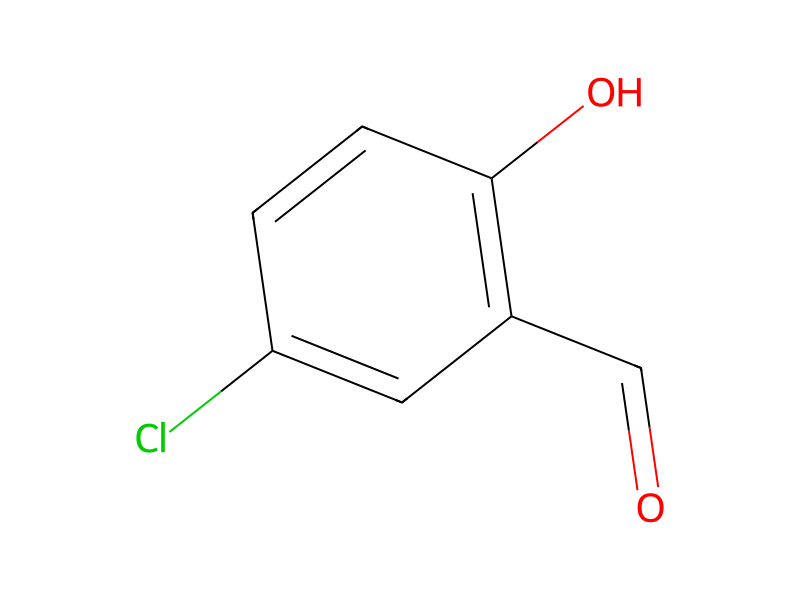
[Cl:1][C:2]1[CH:9]=[C:6]([CH:7]=[O:8])[C:5]([OH:10])=[CH:4][CH:3]=1.C([O-])([O-])=O.[K+].[K+].Br[CH2:18][CH2:19][O:20][Si:21]([C:24]([CH3:27])([CH3:26])[CH3:25])([CH3:23])[CH3:22]>CN(C)C=O.C(OCC)(=O)C>[C:24]([Si:21]([CH3:23])([CH3:22])[O:20][CH2:19][CH2:18][O:10][C:5]1[CH:4]=[CH:3][C:2]([Cl:1])=[CH:9][C:6]=1[CH:7]=[O:8])([CH3:27])([CH3:26])[CH3:25]Step A To a solution of 5-chlorosalicylaldehyde (2 g, 12.8 mmol) (Aldrich) in N,N-dimethylformamide (40 mL) was added K2CO3 (5.3 g, 38 mmol), and (2-bromo-ethoxy)-tert-butyl-dimethyl-silane (3.67 g, 15 mmol, Aldrich). The reaction mixture was heated at 60° C. for 18 h. The crude was cooled to room temperature, diluted with ethyl acetate, washed with water, brine. The organic layer was separated, concentrated, and the residue was purified by chromatography (EtOAc:Hexanes=1:8, then 1:4) to give 2-[2-(tert-butyl-dimethyl-silanyloxy)-ethoxy]-5-chloro-benzaldehyde as a brown oil (Yield 3.8 g, 91%).