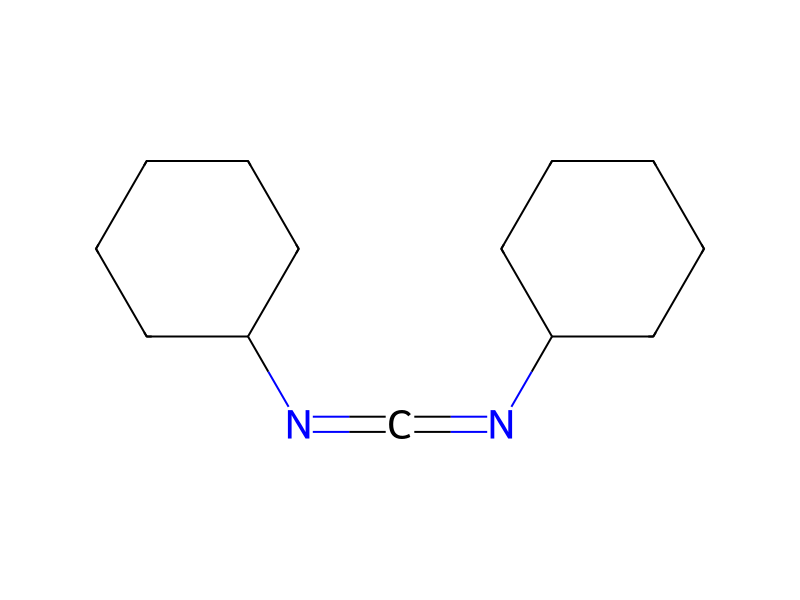
[CH2:1]([OH:17])[CH2:2][CH2:3][CH2:4][CH2:5][CH2:6][CH2:7][CH2:8][CH2:9][CH2:10][CH2:11][CH2:12][CH2:13][CH2:14][CH2:15][CH3:16].[C:18]([CH2:20][C:21](O)=[O:22])#[N:19].C1(N=C=NC2CCCCC2)CCCCC1.CCCCCC>ClCCl.C(OCC)(=O)C.CN(C)C1C=CN=CC=1>[C:18]([CH2:20][C:21]([O:17][CH2:1][CH2:2][CH2:3][CH2:4][CH2:5][CH2:6][CH2:7][CH2:8][CH2:9][CH2:10][CH2:11][CH2:12][CH2:13][CH2:14][CH2:15][CH3:16])=[O:22])#[N:19]The esterification reaction of hexadecanol was carried out under an inert atmosphere (Argon). To a solution of cyanoacetic acid (7.4853 g) and of hexadecanol (10.6674 g) in 50 ml of anhydrous dichloromethane and 5 ml of ethyl acetate, 50 ml of anhydrous dichloromethane containing 9.9864 g of dicyclohexylcarbodiimide (DCC) and 50 mg of 4-(dimethylamino)pyridine (DMAP) were added. The reaction mixture was stirred for 24 hours at room temperature. Then 50 ml of anhydrous hexane were added. The formed solid residue was separated by filtration under vacuum and washed with n-hexane (70 ml). The filtrate was concentrated under reduced pressure until obtaining an amorphous yellow solid, subsequently purified by flash chromatography (ligroin/ethyl acetate 9/1 v/v), yielding 14 g of a white solid.