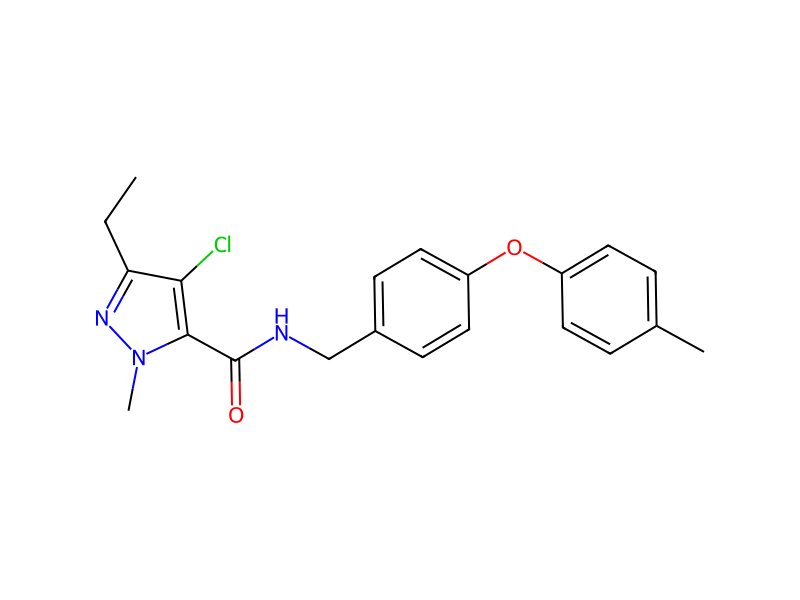
C(OCC)(=O)C.[C:7]1([S:13][C:14]2[CH:21]=[CH:20][C:17]([CH2:18][NH2:19])=[CH:16][CH:15]=2)[CH:12]=[CH:11][CH:10]=[CH:9][CH:8]=1.C(N(CC)CC)C.CC1C=CC(OC2C=CC(CN[C:41]([C:43]3[N:47]([CH3:48])[N:46]=[C:45]([CH2:49][CH3:50])[C:44]=3[Cl:51])=[O:42])=CC=2)=CC=1>O>[C:7]1([S:13][C:14]2[CH:21]=[CH:20][C:17]([CH2:18][NH:19][C:41]([C:43]3[N:47]([CH3:48])[N:46]=[C:45]([CH2:49][CH3:50])[C:44]=3[Cl:51])=[O:42])=[CH:16][CH:15]=2)[CH:8]=[CH:9][CH:10]=[CH:11][CH:12]=1Into 50 ml solution of ethyl acetate containing 3.50 g of 4-phenylthiobenzylamine and 2.2 g of triethylamine, was dropped 3.60 g of 4-chloro-3-ethyl-1-methyl-5-pyrazolecarboxylic acid chloride synthesized in Example 2. After the completion of dropping, the mixture was stirred for 1.5 hours, poured into iced water and then extracted with ethyl acetate. The ethyl acetate layer was washed with an aqueous solution of sodium carbonate, water and a saturated aqueous solution of sodium chloride. After drying over anhydrous sodium sulfate, the solution was concentrated under a reduced pressure. The residue was purified on silica gel column chromatography to obtain 4.70 g of the titled compound (No. 76) shown in Table 1.