Potassium Carbonate → 5-Chloro-3-dodecyl-2-ethynylthiophene
反応式

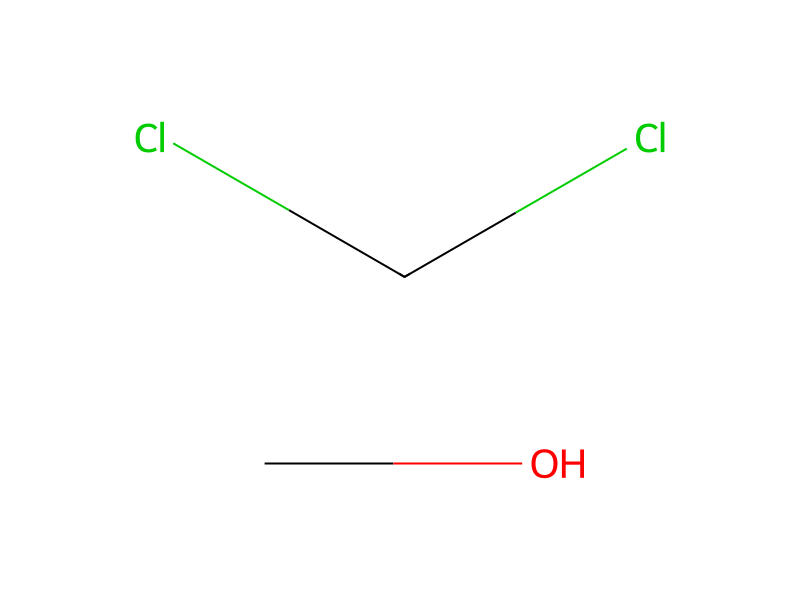
[Cl:1][C:2]1[S:6][C:5]([C:7]#[C:8][Si](C)(C)C)=[C:4]([CH2:13][CH2:14][CH2:15][CH2:16][CH2:17][CH2:18][CH2:19][CH2:20][CH2:21][CH2:22][CH2:23][CH3:24])[CH:3]=1.C(=O)([O-])[O-].[K+].[K+]>CO.ClCCl>[Cl:1][C:2]1[S:6][C:5]([C:7]#[CH:8])=[C:4]([CH2:13][CH2:14][CH2:15][CH2:16][CH2:17][CH2:18][CH2:19][CH2:20][CH2:21][CH2:22][CH2:23][CH3:24])[CH:3]=1参加物
4



実験手順
First, generally 2-bromo-5-chloro-3-dodecylthiophene can be prepared by brominating 3-dodecylthiophene with 1 molar equivalent of N-bromosuccinimide (NBS) in N,N-dimethylformamide (DMF) at room temperature (rt) (rt or room temperature refers to a temperature of from about 22° C. to about 25° C.). Thereafter, chlorination of 2-bromo-3-dodecylthiophene with 1 molar equivalent of N-chlorosuccinimide (NCS) at room temperature generates 2-bromo-5-chloro-3-odecylthiophene. Subsequently, 2-bromo-5-chloro-3-dodecylthiophene is reacted with trimethylsilylacetylene in the presence of dichlorobis(triphenylphosphine)palladium (II) for a suitable time like 24 hours, (Pd(PPh3)2Cl2) and copper(I) iodide (CuI) in triethylamine (Et3N) at elevated temperatures like 50° C. and at elevated temperatures like 80° C. for a suitable time like 3 hours under argon to form 5-chloro-3-dodecyl-2-(trimethylsilyl)ethynylthiophene. 5-Chloro-3-dodecyl-2-(trimethylsilyl)ethynylthiophene is then stirred in a mixture of methanol/dichloromethane (½, v/v) in the presence of 10 percent mol of potassium carbonate at room temperature for a suitable time like 1 hour to produce 5-chloro-3-dodecyl-2-ethynylthiophene. 5-Chloro-3-dodecyl-2-ethynylthiophene is further reacted with isopropylmagnesium chloride and then with benzo[1,2-b:4,5-b′]dithiophene (HQ1) (HQ1 is prepared according to Beimling, P., et al, Chem. Ber. 1986, 119, 3198, the disclosure of which is totally incorporated herein by reference), or with anthra[2,3-b:6,7-b′]dithiophene-5,11-dione/anthra[2,3-b:7,6-b′]dithiophene-5,11-dione (HQ2, a mixture of trans and cis isomers) (HQ2 is prepared according to De la Cruz, P., et al, J. Org. Chem. 1992, 57, 6192, the disclosure of which is totally incorporated herein by reference), at elevated temperatures like 50° C. in tetrahydrofuran (THF) under argon, followed by reduction with tin (II) chloride (SnCl2) solution in 10 percent HCl at elevated temperatures like 50° C. The resultant 4,8-bis((5-chloro-3-dodecylthienyl)ethynyl)benzo[1,2-b:4,5-b′]dithiophene (M1) and 5,11-bis((5-chloro-3-dodecylthienyl)ethynyl)anthra[2,3-b:6,7-b′]dithiophene/5,11-bis((5-chloro-3-dodecylthienyl)ethynyl)anthra[2,3-b:7,6-b′]dithiophene (M2, which can be a mixture of trans and cis isomers) are polymerized using zinc in the presence of nickel (II) chloride (NiCl2), 2,2′-dipyridil, triphenylphosphine (PPh3) in N,N-dimethylacetamide (DMAc) at elevated temperatures like 80° C. for a suitable time like 48 hours. Poly(4,8-bis(3-dodecylthienylethynyl)benzo[1,2-b:4,5-b′]dithiophene) (1a) and poly(5,11-bis(3-dodecylthienylethynyl)anthra[2,3-b:6,7-b′]dithiophene/5, 11-bis(3-dodecylthienylethynyl)anthra[2,3-b:7,6-b′]dithiophene) (2a) are obtained as products.