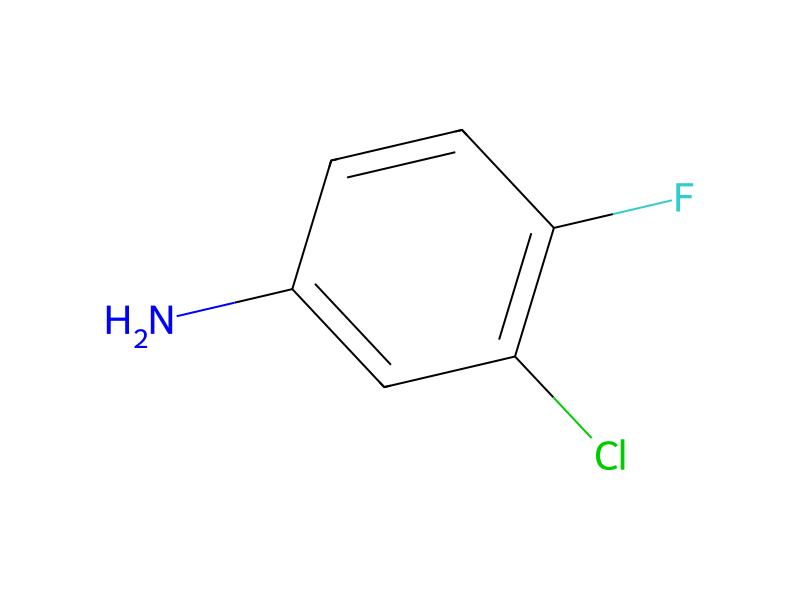
Cl[C:2]1[C:11]2[C:6](=[CH:7][N:8]=[C:9]([F:12])[CH:10]=2)[N:5]=[CH:4][C:3]=1[C:13]#[N:14].[Cl:15][C:16]1[CH:17]=[C:18]([CH:20]=[CH:21][C:22]=1[F:23])[NH2:19].C(=O)(O)[O-].[Na+]>C(O)C.[Cl-].[Na+].O>[Cl:15][C:16]1[CH:17]=[C:18]([NH:19][C:2]2[C:11]3[C:6](=[CH:7][N:8]=[C:9]([F:12])[CH:10]=3)[N:5]=[CH:4][C:3]=2[C:13]#[N:14])[CH:20]=[CH:21][C:22]=1[F:23]To 600 mg of 4-chloro-6-fluoro-[1.7]naphthyridine-3-carbonitrile in 15 mL of absolute ethanol was added 500 mg of 3-chloro-4-fluoroaniline. After refluxing the reaction under an inert atmosphere for 2 hours, the reaction mixture was poured into a mixture of brine and saturated aqueous sodium bicarbonate and the resultant crystals were filtered and washed with water. The product was then recrystallized from chloroform/hexanes. Drying in vacuo yielded 765 mg (83%) of 4-(3-chloro-4-fluoro-phenylamino)-6-fluoro-[1.7]naphthyridine-3-carbonitrile as yellow needles: melting point 108-111° C.; mass spectrum (m/e): M+H 316.8.