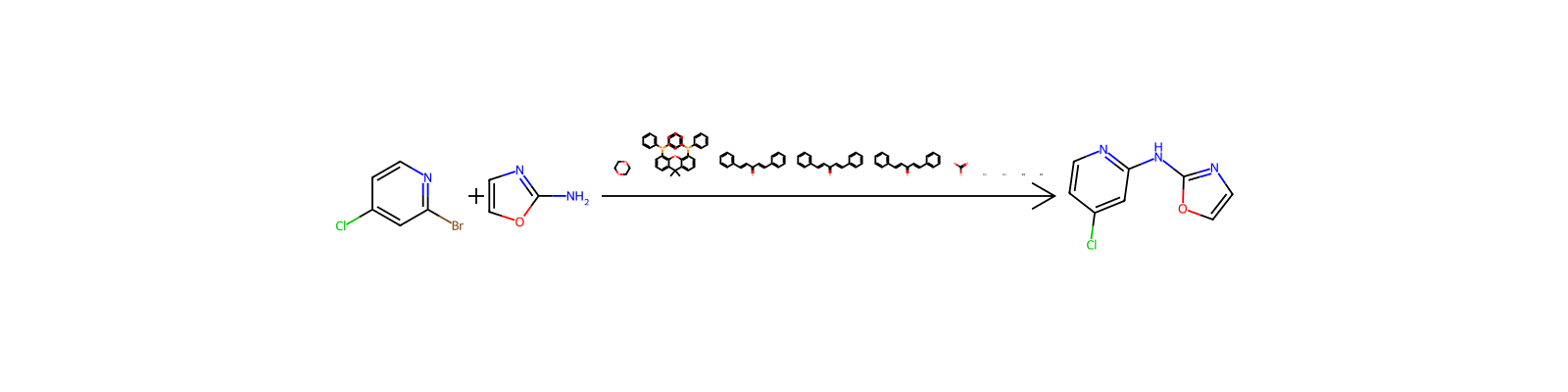
関与物質
| 役割 | 名称 | HCID | 仕込み量 |
|---|
| 反応物 | 2-Aminooxazole | HCID 558521 | — |
| 反応物 | 2-Bromo-4-chloropyridine | HCID 2762836 | — |
| 試薬 | Cesium carbonate | HCID 10796 | — |
| 触媒 | 1,1'-(9,9-Dimethyl-9H-xanthene-4,5-diyl)bis(1,1-diphenylphosphine) | HCID 636044 | — |
| 触媒 | Bis(dibenzylideneacetone)palladium | HCID 9811564 | — |
| 溶媒 | 1,4-Dioxane | HCID 31275 | — |
| 生成物 | N-(4-chloro-2-pyridinyl)-1,3-oxazol-2-amine | HCID 130016260 | 7.67% |
反応手順
Objective: To find out if the 2-bromopyridine is a more efficient coupling partner than the chloro analogue. Pd2(dba)3 (22.89 mg, 0.025 mmol), 9,9-dimethyl-4,5-bis(diphenylphosphino)xanthene (43.4 mg, 0.075 mmol), 2-bromo-4-chloropyridine (192 mg, 1.00 mmol), cesium carbonate (652 mg, 2.00 mmol) and oxazol-2-amine (84 mg, 1.00 mmol) were added to an oven dried microwave vial, the vial was capped and placed under an inert atmosphere, dioxane (4 mL) was added and the resulting mixture was heated at 140 °C for 1 h by microwave irradiation under a nitrogen atmosphere. The crude product was purified by flash silica chromatography, elution gradient 0 to 30% EtOAc in heptane. Pure fractions were evaporated to dryness to afford N-(4-chloropyridin-2-yl)oxazol-2-amine (15.00 mg, 7.67 %) as a white solid. Conclusion: A slightly improved yield of the desired product was formed with respect to the 2,4-dichloropyridine substrate, however the difference could not be taken to be significant.
情報源と証拠
| 出典データセット | 750 AstraZeneca ELN dataset |
|---|
| ORD ID | ord-25a2d29381d0432e90a88d041ce4da72 |
|---|
| 出典メモ | 750 AstraZeneca ELN dataset |
|---|