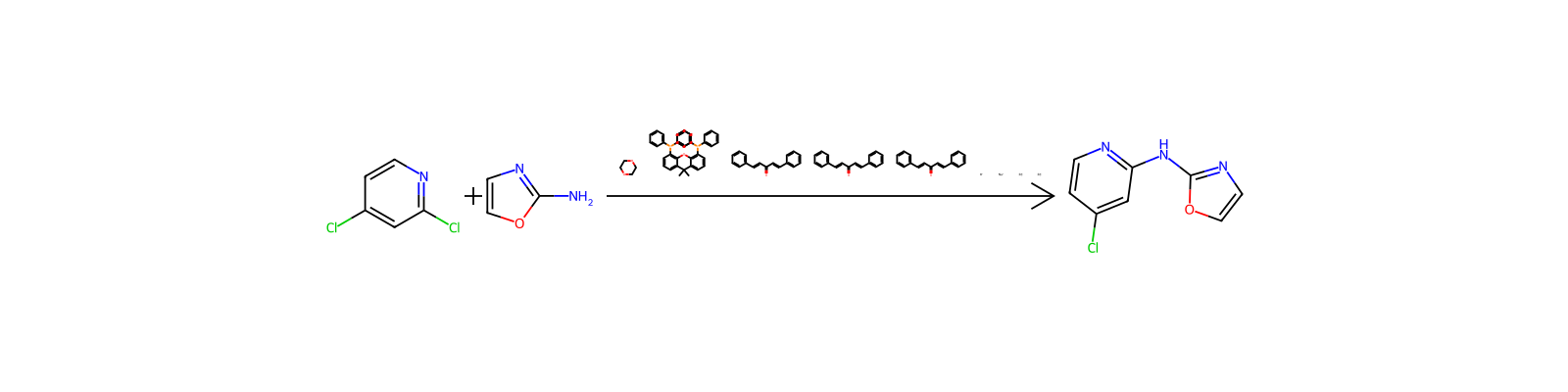
関与物質
| 役割 | 名称 | HCID | 仕込み量 |
|---|
| 反応物 | 2,4-Dichloropyridine | HCID 33515 | — |
| 反応物 | 2-Aminooxazole | HCID 558521 | — |
| 試薬 | Sodium hydride | HCID 24758 | — |
| 触媒 | 1,1'-(9,9-Dimethyl-9H-xanthene-4,5-diyl)bis(1,1-diphenylphosphine) | HCID 636044 | — |
| 触媒 | Bis(dibenzylideneacetone)palladium | HCID 9811564 | — |
| 溶媒 | 1,4-Dioxane | HCID 31275 | — |
| 生成物 | N-(4-chloro-2-pyridinyl)-1,3-oxazol-2-amine | HCID 130016260 | 3.03% |
反応手順
Objective: If deprotonation is rate-determining in this coupling quantitative deprotonation prior to subjection to coupling conditions should prove beneficial. To an oven dried microwave vial was added oxazol-2-amine (85 mg, 1.01 mmol) together with sodium hydride (40.5 mg, 1.01 mmol), the vial was capped and purged with nitrogen and dioxane (1 mL) was added. The mixture was then stirred at rt for 1 h (initially effervescence was observed but subsided within 20 min of stirring). To the above vial was added 2,4-dichloropyridine (0.109 mL, 1.01 mmol), TRIS(DIBENZYLIDENEACETONE)DIPALLADIUM(0) (22.89 mg, 0.02 mmol) and (9,9-dimethyl-9H-xanthene-4,5-diyl)bis(diphenylphosphine) (44.0 mg, 0.08 mmol) (Xantphos) as a solution in dioxane (2 mL) and the reaction mixture was heated to 140 °C for 1 h under microwave irradiation. Dichloromethane (10 mL) was added to the crude reaction mixture and the mixture was absorbed onto silica. The crude product was purified by flash silica chromatography, elution gradient 0 to 20% EtOAc in heptane. Pure fractions were evaporated to dryness to afford N-(4-chloropyridin-2-yl)oxazol-2-amine (6.00 mg, 3.03 %) as a pale yellow dry film. Conclusion: The formal deprotonation appears to have had no benificial effect on this coupling.
情報源と証拠
| 出典データセット | 750 AstraZeneca ELN dataset |
|---|
| ORD ID | ord-76fdaa39a364497293ede72dc7b21aee |
|---|
| 出典メモ | 750 AstraZeneca ELN dataset |
|---|