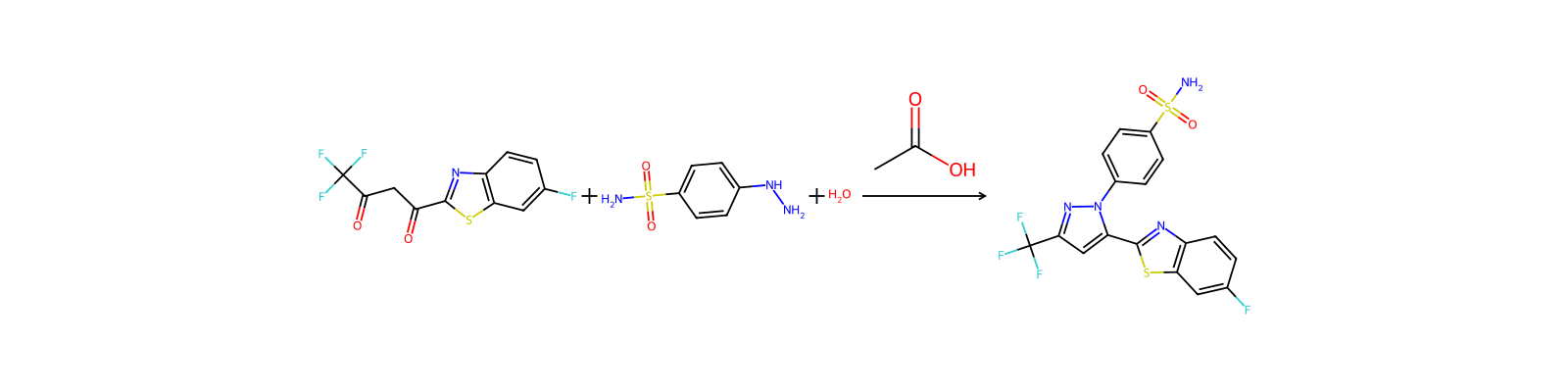
The mixture of 4,4,4-trifluoro-1-(6-fluorobenzothiazol-2-yl)butane-1,3-dione (800 mg, 2.7 mmol) and 4-sulfamoylphenyl-hydrazine (720 mg, 3.8 mmol) was heated under reflux in acetic acid (10 ml) for 16 hours. After cooling, the reaction mixture was poured into water and extracted with methylene chloride. The organic layer was washed with water, dried over magnesium sulfate, and then evaporated. The residue was subjected to purification using chromatography on silica gel to afford 4-[5-(6-fluorobenzothiazol-2-yl)-3-trifluoromethyl-1H-pyrazol-1-yl]benzenesulfonamide (510 mg, 42%) as a colorless needle. NMR(CDCl3 -DMSO-d6) δ: 6.70 (2H, bs), 7.22-7.39 (2H, m), 7.57-7.67 (3H, m), 7.91-7.96 (1H, m), 8.05 (2H, d, J=8.6 Hz); mp 260-261° C. (toluene)