関与物質
| 役割 | 名称 | HCID | 仕込み量 |
|---|
| 反応物 | Ammonium | HCID 223 | — |
| 反応物 | 4-Chloro-1,2-dinitrobenzene | HCID 33097 | — |
| 溶媒 | Ethanol | HCID 702 | — |
| 生成物 | 5-Chloro-2-nitroaniline | HCID 74218 | — |
反応手順
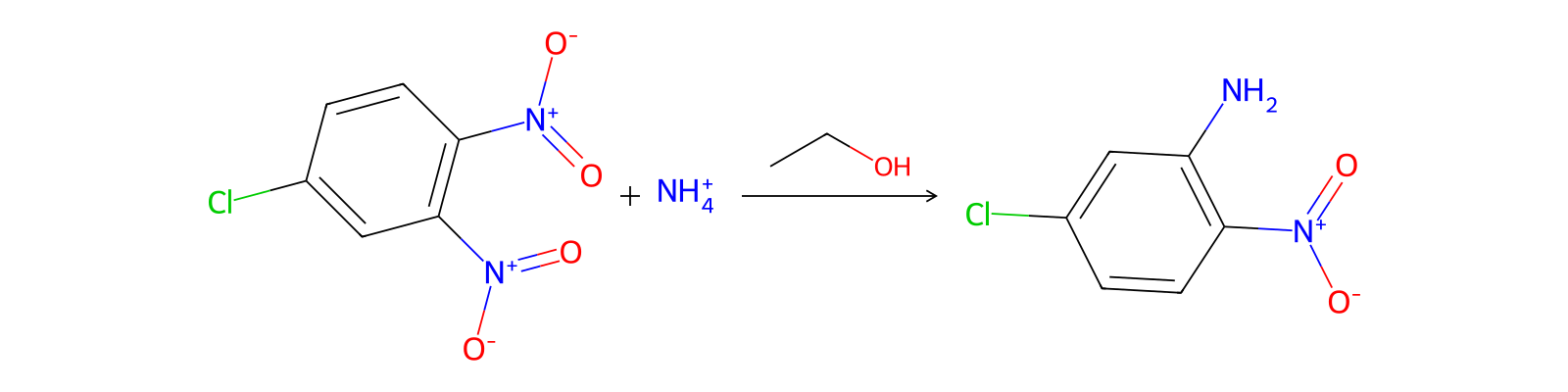
Compounds of formula I can be prepared without using the intermediate of formula II. For example, 3,4-dinitrochlorobenzene may be treated with liquid ammonium in a solvent such as ethanol to obtain 2-nitro-5-chloroaniline, which may then be treated with acetic anhydride in a solvent such as pyridine at 0°-5° C. to yield 2-nitro-5-chloroacetanilide. The 2-nitro-5-chloro acetanilide may then be converted to the corresponding 2-dialkylamino-5-chloroacetanilide by hydrogenating the nitro compound using platinum on carbon as catalyst in the presence of an aliphatic aldehyde (2:1 molar ratio to the nitro compound). The acetanilide can be hydrolyzed with a reagent such as sodium methoxide in a solvent such as methanol to give the corresponding 2-dialkylamino-5-chloroaniline. The chloroaniline can be treated with an appropriate reagent to give a 2-dialkylamino-5-substituted-aniline, e.g. the chloroaniline reacted with 1-propanethiol and sodium hydroxide in dimethylformamide/water at room temperature will yield 2-dialkylamino-5-propylthioaniline. This aniline may then be treated as the compound of formula III on page 5 to obtain a compound of formula I.
情報源と証拠
| DOI | 10.6084/m9.figshare.5104873.v1 |
|---|
| 特許番号 | US04723029 |
|---|
| 出典データセット | uspto-grants-1988_02 |
|---|
| ORD ID | ord-53a3ebdf15d441468909b1e846bdef45 |
|---|
| 出典メモ | uspto-grants-1988_02 |
|---|