反応式

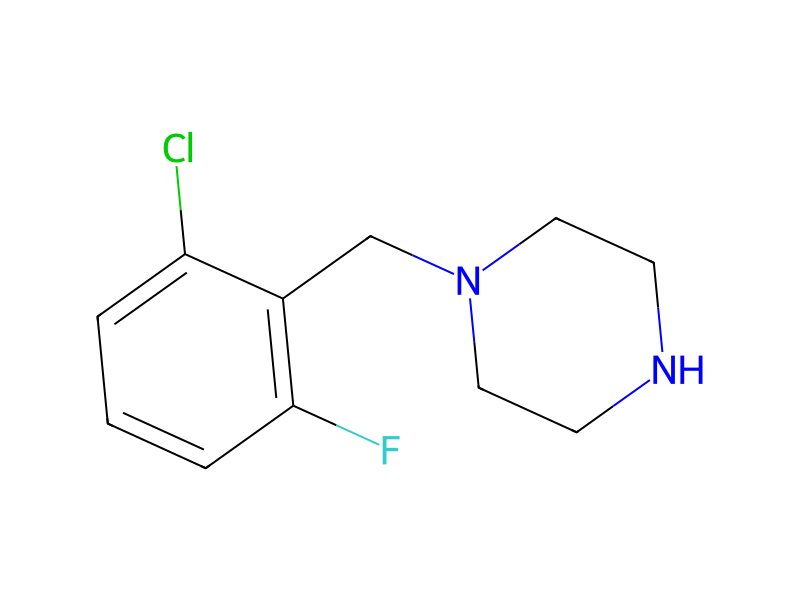
[Cl:1][C:2]1[CH:14]=[CH:13][CH:12]=[C:11]([F:15])[C:3]=1[CH2:4][N:5]1[CH2:10][CH2:9][NH:8][CH2:7][CH2:6]1.[NH2:16][C:17]1[C:22]([N+:23]([O-:25])=[O:24])=[C:21](Cl)[C:20]([Cl:27])=[CH:19][N:18]=1>C(O)(C)C>[Cl:27][C:20]1[C:21]([N:8]2[CH2:7][CH2:6][N:5]([CH2:4][C:3]3[C:11]([F:15])=[CH:12][CH:13]=[CH:14][C:2]=3[Cl:1])[CH2:10][CH2:9]2)=[C:22]([N+:23]([O-:25])=[O:24])[C:17]([NH2:16])=[N:18][CH:19]=1参加物


反応条件
- 温度
- 45 °C
実験手順
A mixture of 1-(2-chloro-6-fluorobenzyl)piperazine (0.063 g, 0.28 mmol), isopropanol (4.3 ml), and 2-amino-4,5-dichloro-3-nitropyridine (0.042 g, 0.20 mmol) was heated at 45° C. for 22 h. The reaction mixture was allowed to cool to room temperature, and concentrated in vacuo. The residue was absorbed on silica gel and the free running powder was placed on a 10 g isolute silica column which was eluted first with 30% petroleum ether 60-80° C., and then ethyl acetate. The title compound was obtained as a yellow solid (0.050 g, 62%); 1H-NMR (500 Mz, DMSO-d6) 2.56 (br s, 4H, piperazine N(CH2)2), 3.01 (br s, 4H, piperazine N(CH2)2), 3.66 (s, 2H, NCH2), 6.94 (s, 2H, 2-NH2), 7.23 (t, J=8.91 Hz, 1H) and 7.38 (m, 2H) (ArH), 8.06 (s, 1H, 6-H); LC-MS (ESI, m/z) 4.85 min—400, 402, 404 [(M+H)+, Cl2 isotopic pattern].
後処理
- temperatureto cool to room temperature
- concentrationconcentrated in vacuo
- customThe residue was absorbed on silica gel
- washwas eluted first with 30% petroleum ether 60-80° C.
出典と根拠
- ORDレコード
- ord-fe4819e48d10437488fe34d25a56f14f
- 出典データセット
- uspto-grants-2012_01
- 特許番号
- US08088761B2
関連ノート
読み込み中…