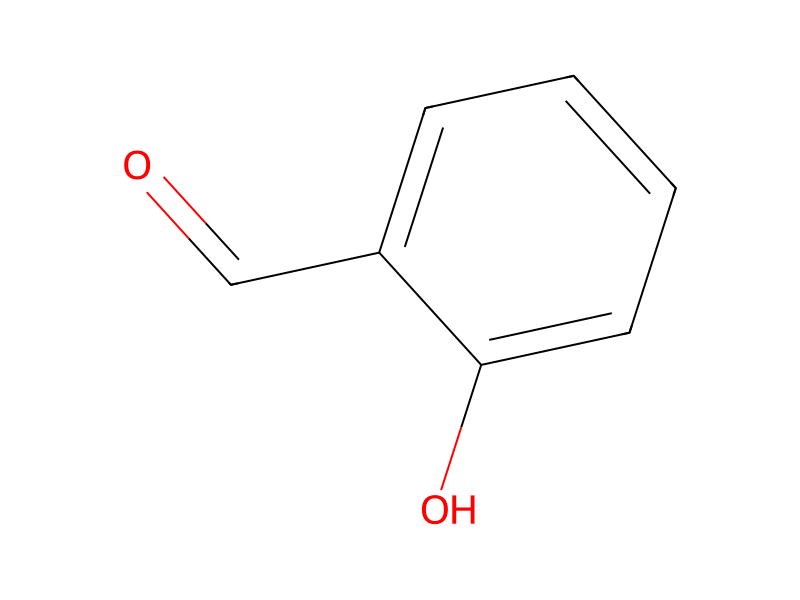
[CH:1](=[O:9])[C:2]1[C:3](=[CH:5][CH:6]=[CH:7][CH:8]=1)[OH:4].C(=O)([O-])[O-].[K+].[K+].Cl[CH2:17][C:18]([O:20][CH3:21])=[O:19]>O>[CH:1]([C:2]1[CH:8]=[CH:7][CH:6]=[CH:5][C:3]=1[O:4][CH2:17][C:18]([O:20][CH3:21])=[O:19])=[O:9]2. Approximately 509 g of the starting compound, salicylaldehyde (1) was introduced into a 4-liter Erlenmeyer flask with powdered potassium carbonate (569 g), dimethylformnamide (1,000 ml), and methyl chloroacetate (478 g) and mechanically stirred at 65° C. for about 24 hours. The stirring was stopped and the reaction mixture cooled to 25° C. The mixture was poured into cold water (0° C.) while stirring vigorously. An oil separated that suddenly solidified. Stirring was continued for 30 minutes and the solid isolated by filtration. The product was washed with water (2×1,000 ml) and pressed dry. The product can also be dried in vacuo at 25° C. A small sample (approx. 2 g) was purified by distillation. The boiling range of the pure product is 124-128° C. at 2 mm Hg and has a melting temperature range of about 50.2-50.6° C.