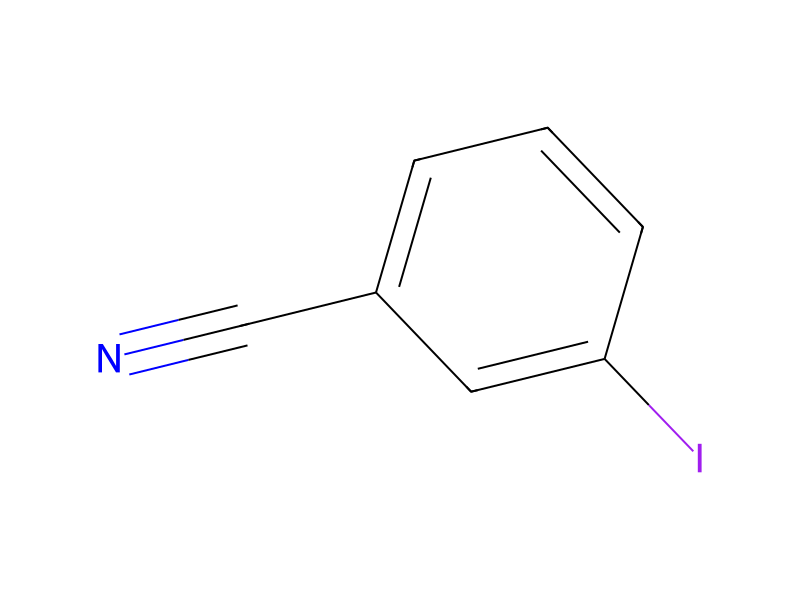
To a flame dried, argon purged screw-cap vial, containing copper (I) triflate.benzene complex (0.01 g, 0.03 mmol), 1,10-phenanthroline (0.10 g, 0.54 mmol), trans-dibenzylideneacetone (0.01 g, 0.03 mmol) and cesium carbonate (0.20g, 0.60 mmol) was added a solution of 4-(2-pyridyl)imidazole (0.08 g, 0.54 mmol) and 3-iodobenzonitrile (0.19 g, 0.82 mmol) in ortho-xylene (2 mL). The resulting brownish black reaction mixture was heated overnight at 120° C. After cooling, the reaction mixture was diluted with dichloromethane (20 mL) and washed sequentially with saturated ammonium chloride (20 mL) and brine (20 mL). The organic phase was then dried with sodium sulfate, filtered, and concentrated in vacuo. Silica gel chromatography of the crude residue using 1% methanol (2 M in ammonia) in dichloromethane afforded 11 mg of 4-(2-pyridyl)-1-(3-cyanophenyl)-1H-imidazole, as an off-white solid.