Cyclohexene → Dimethyl bicyclo[4.1.0]heptane-7,7-dicarboxylate
反応式

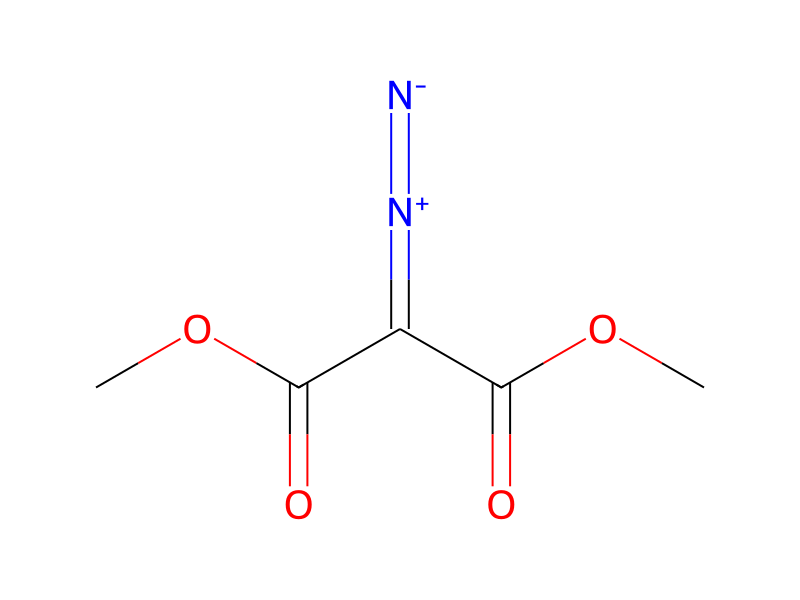
[CH:1]1[CH2:6][CH2:5][CH2:4][CH2:3][CH:2]=1.[N+](=[C:9]([C:14]([O:16][CH3:17])=[O:15])[C:10]([O:12][CH3:13])=[O:11])=[N-]>CC(CC(C)=O)=O.CC(CC(C)=O)=O.[Cu]>[CH:1]12[C:9]([C:14]([O:16][CH3:17])=[O:15])([C:10]([O:12][CH3:13])=[O:11])[CH:6]1[CH2:5][CH2:4][CH2:3][CH2:2]2参加物
4



実験手順
To stirred, refluxing mixture of 100.0 grams (1.22 mole) of cyclohexene and 0.037 gram (0.0001 mole) of cupric acetylacetonate was fed 22.7 grams (0.14 mole) of dimethyl diazomalonate over a 25-hour period by means of a syringe pump. Refluxing was continued for an additional 8 hours after which distillation of the reaction mixture was begun, employing a small Vigreux column. After removing about 32 grams of cyclohexene overhead, to a head temperature of 80° C., the residue was allowed to cool. The solidified residue was worked up by flash column chromatography on silica gel to give 17.53 grams (0.08 mole) of dimethyl bicyclo[4.1.0]heptane-7,7-dicarboxylate having a melting point of 83° C.-86° C. Elemental analysis of the product indicated the following: