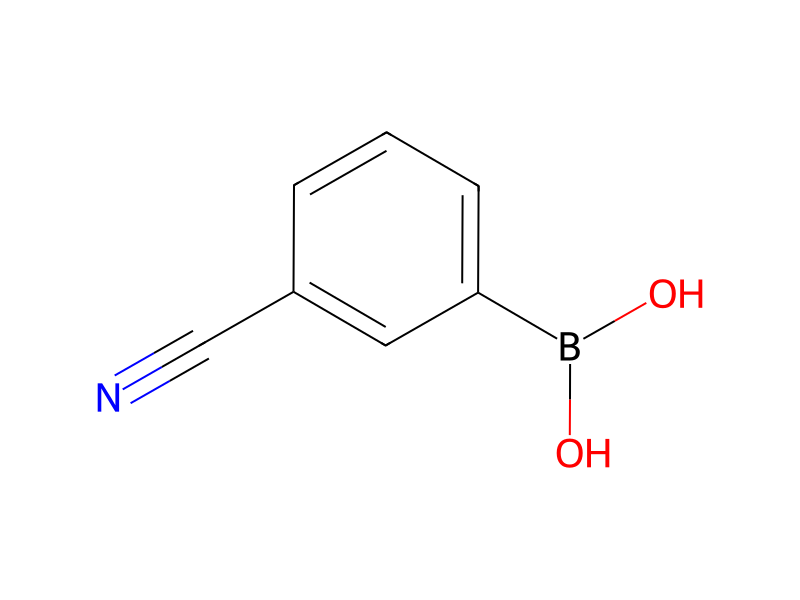
Cl[C:2]1[CH:11]=[CH:10][C:5]([C:6]([O:8][CH3:9])=[O:7])=[CH:4][N:3]=1.[C:12]([C:14]1[CH:15]=[C:16](B(O)O)[CH:17]=[CH:18][CH:19]=1)#[N:13].C(=O)([O-])[O-].[K+].[K+]>C1C=CC([P]([Pd]([P](C2C=CC=CC=2)(C2C=CC=CC=2)C2C=CC=CC=2)([P](C2C=CC=CC=2)(C2C=CC=CC=2)C2C=CC=CC=2)[P](C2C=CC=CC=2)(C2C=CC=CC=2)C2C=CC=CC=2)(C2C=CC=CC=2)C2C=CC=CC=2)=CC=1.O1CCOCC1>[C:12]([C:14]1[CH:19]=[C:18]([C:2]2[CH:11]=[CH:10][C:5]([C:6]([O:8][CH3:9])=[O:7])=[CH:4][N:3]=2)[CH:17]=[CH:16][CH:15]=1)#[N:13]Methyl 6-chloronicotinate (467 mg, 2.72 mmol) and (3-cyanophenyl)boronic acid (400 mg, 2.72 mmol) were added to 1,4-dioxane (25 mL). To this was added 6.80 mL of a 2 M solution of aqueous potassium carbonate and tetrakis(triphenylphosphine)palladium(0) (157 mg, 0.136 mmol). The above reagents were heated at reflux for 5 hours. The reaction was cooled to room temperature and partitioned between ethyl acetate (50 mL) and water (20 mL), the phases were separated and the organic layer was dried over anhydrous MgSO4, filtered and evaporated to a pale yellow solid. The solid was purified using chromatography on silica eluting with a mixture of heptane: ethyl acetate 90:10, 80:20, 70:30. The product fractions were combined and evaporated to give methyl 6-(3-cyanophenyl)nicotinate as a white solid (278 mg). LCMS (ES+) 239 (M+1) 1H NMR (400 MHz CDCl3) ppm 4.00 (s, 3H) 7.62 (t, J=8.2 Hz, 1H) 7.76 (m, 1H) 7.83 (d, J=10.6 Hz, 1H) 8.31 (m, 1H) 8.40 (m, 2H) 9.30 (s, 1H).