Potassium Fluoride → 2,6-Dimethyl-4-nitro-4'-(trifluoromethyl)biphenyl
反応式

Br[C:2]1[C:7]([CH3:8])=[CH:6][C:5]([N+:9]([O-:11])=[O:10])=[CH:4][C:3]=1[CH3:12].[F:13][C:14]([F:25])([F:24])[C:15]1[CH:20]=[CH:19][C:18](B(O)O)=[CH:17][CH:16]=1.[F-].[K+]>C1(C)C=CC=CC=1>[CH3:12][C:3]1[CH:4]=[C:5]([N+:9]([O-:11])=[O:10])[CH:6]=[C:7]([CH3:8])[C:2]=1[C:18]1[CH:19]=[CH:20][C:15]([C:14]([F:25])([F:24])[F:13])=[CH:16][CH:17]=1参加物
5




実験手順
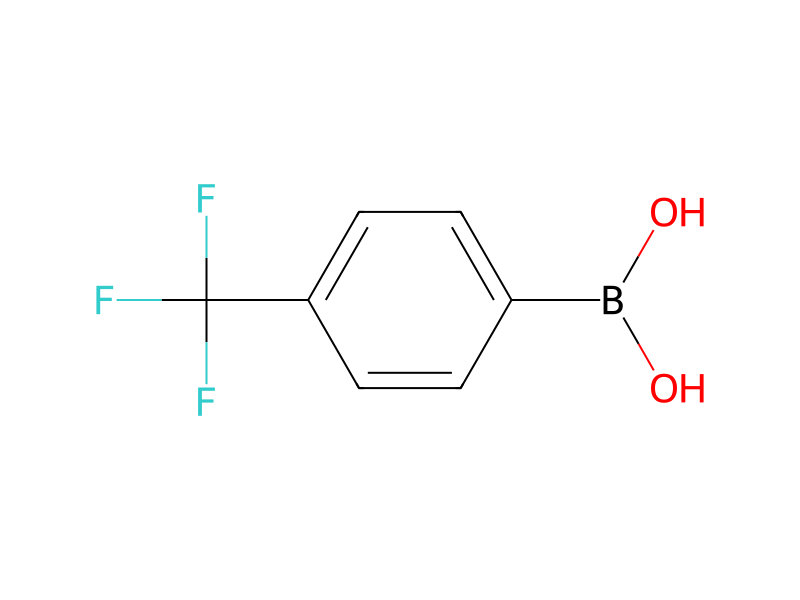
To a solution of 2-bromo-1,3-dimethyl-5-nitro-benzene (1 g, 4.3 mmol) in toluene (20 mL) is added palladium tetrakis triphenylphosphine (0.5 g, 0.43 mmol), 4-trifluoromethyl phenyl boronic acid (1.65 g, 8.7 mmol), and potassium fluoride (0.75 g, 12.9 mmol). The reaction is purged with nitrogen three times and heated to reflux under nitrogen. At the reflux temperature, water (5 mL) is added to the reaction and the reaction is allowed to reflux under nitrogen. The reaction is monitored by HPLC, and upon completion, allowed to cool to room temperature. The reaction is diluted with ethyl acetate and Celite® is added, followed by water. This mixture is then filtered through a pad of Celite®. The solution is poured into a separatory funnel and the organic layer is washed with water and brine. The organic layer is dried over anhydrous sodium sulfate and concentrated under reduced pressure. The resulting residue is purified by flash column chromatography eluting with ethyl acetate/hexanes to afford 0.68 g of the titled compound as a yellow solid. 1H-NMR.