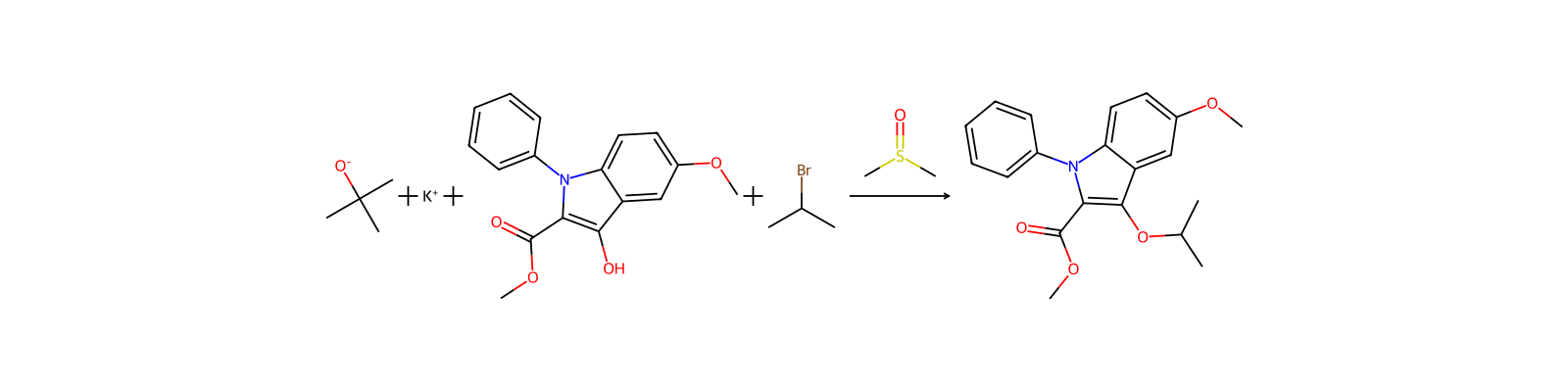
A stirred mixture of 24.8 g (0.22 mole) of potassium tert-butoxide in 100 ml of dimethyl sulfoxide (under a nitrogen atmosphere) was placed in a cold water bath. A solution of 44.6 g (0.15 mole) of 3-hydroxy-5-methoxy-1-phenyl-1H-indole-2-carboxylic acid methyl ester [P. C. Unangst and M. E. Carethers, J. Heterocyclic Chem., 21, 709 (1984)] in 100 ml of dimethyl sulfoxide was added over 30 minutes. The new mixture was stirred for an additional 45 minutes, and 25.0 ml (32.8 g, 0.27 mole) of 2-bromopropane was added in one portion. The cooling bath was removed, and the mixture was stirred at room temperature for 45 hours, then added to 2.5 kg ice water. The crude ester intermediate was removed by extracting with dichloromethane (4×800 ml). The combined organic layers were washed with water (1×2.0 l), 5% aqueous sodium bicarbonate (2×2.0 l), and water again (1×2.0 l), before being dried with anhydrous sodium sulfate. Evaporation (vacuum) yielded a crude residue of 5-methoxy-3-(1-methylethoxy)-1-phenyl-1H-indole-2-carboxylic acid methyl ester.