反応式

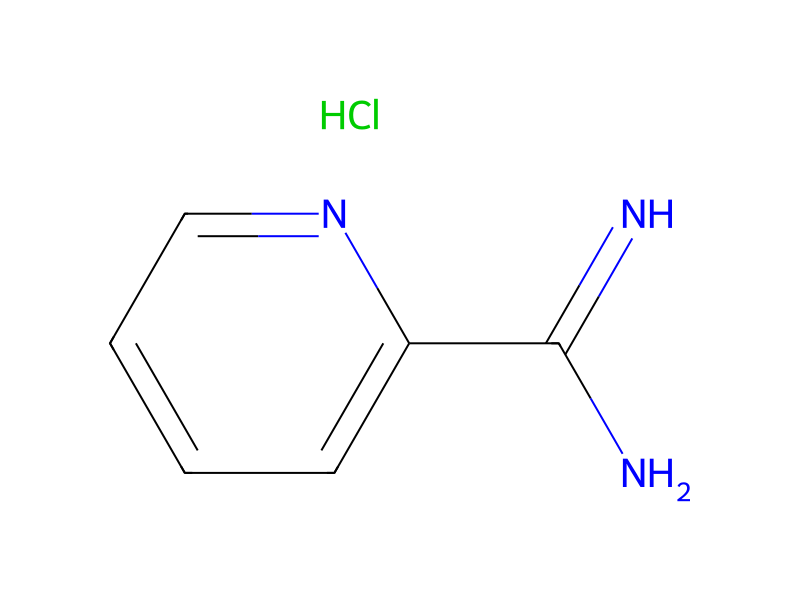
[Cl:1][C:2]1[CH:7]=[CH:6][N:5]=[C:4]([C:8]2[N:13]=[C:12]([C:14]3[CH:19]=[CH:18][CH:17]=[CH:16][N:15]=3)[N:11]=[C:10]([OH:20])[CH:9]=2)[CH:3]=1.Cl.C(C1C=CC=CN=1)(=N)N.Cl.C(C1C=C([Cl:41])C=CN=1)(=N)N>>[Cl:41][C:18]1[CH:17]=[CH:16][N:15]=[C:14]([C:12]2[N:11]=[C:10]([OH:20])[CH:9]=[C:8]([C:4]3[CH:3]=[C:2]([Cl:1])[CH:7]=[CH:6][N:5]=3)[N:13]=2)[CH:19]=1参加物
4


実験手順
The procedure is as described in the case of 6-(4-chloropyrid-2-yl)-2-pyrid-2-yl-pyrimidin-4-ol (ligand PM1) in Example 3 except that, instead of 2-amidinopyridine hydrochloride, the 2-amidino-4-chloropyridine hydrochloride from Example 8 is used. After recrystallisation from DMSO, 2,6-bis(4-chloropyrid-2-yl)-pyrimidin-4-ol (ligand PM5) is obtained in the form of a colourless solid. 1H-NMR (360 MHz, DMSO-d6): 12.53 (br s, 1H); 8.74 (d, J=5.0 Hz, 1H); 8.74 (s, 1H); 8.71 (d, J=5.0 Hz, 1H); 8.64 (d, J=2.3 Hz, 1H); 7.83 (dd, J=5.0, 2.3 Hz, 1H); 7.71 (dd, J=5.0, 2.3 Hz, 1H); 7.30 (s, 1H).
後処理
- customAfter recrystallisation from DMSO
出典と根拠
- ORDレコード
- ord-49718e6305944db88c08339234846550
- 出典データセット
- uspto-grants-2006_11
- 特許番号
- US07138363B2
関連ノート
読み込み中…