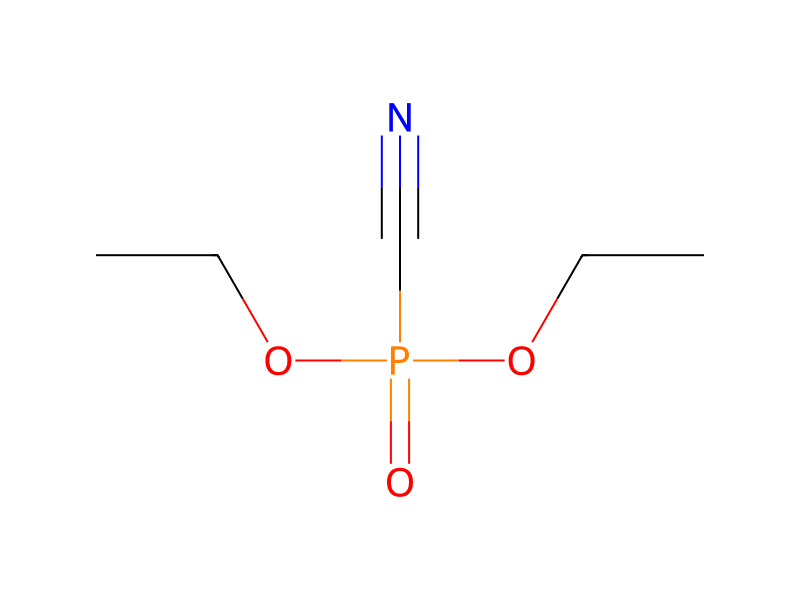
[Cl:1][C:2]1[CH:3]=[CH:4][C:5]2[N:6]([CH:8]=[C:9]([C:11]([OH:13])=O)[N:10]=2)[CH:7]=1.[CH3:14][O:15][C:16]1[CH:21]=[CH:20][C:19]([N:22]2[CH2:27][CH2:26][NH:25][CH2:24][CH2:23]2)=[CH:18][CH:17]=1.C(P(=O)(OCC)OCC)#N.C(N(CC)CC)C>ClCCl.CN(C=O)C>[Cl:1][C:2]1[CH:3]=[CH:4][C:5]2[N:6]([CH:8]=[C:9]([C:11]([N:25]3[CH2:24][CH2:23][N:22]([C:19]4[CH:18]=[CH:17][C:16]([O:15][CH3:14])=[CH:21][CH:20]=4)[CH2:27][CH2:26]3)=[O:13])[N:10]=2)[CH:7]=1To 6-chloroimidazo[1,2-a]pyridine-2-carboxylic acid (0.170 g) and 1-(4-methoxyphenyl)piperazine (Aldrich; 0.165 g) in dichloromethane (4mL) are added diethyl cyanophosphonate (Aldrich; 0.157 mL) and triethylamine (0.144 mL), followed by DMF (2 mL). After stirring overnight, the mixture is quenched with aqueous sodium bicarbonate and then partitioned between dichloromethane and aqueous sodium bicarbonate. The organic layers are filtered through sodium sulfate and concentrated, and the residue is chromatographed on silica gel using methanol/dichloromethane (2/98) to give 0.212 g of 1-[(6-chloroimidazo[1,2-a]pyridin-2-yl)carbonyl]-4-(4-methoxyphenyl)piperazine, mp 180-181° C.; IR (mineral oil) 1620, 1517, 1237, 1246, 1230 cm-1. 1HNMR (CDCl3) δ 3.16, 3.78, 3.97, 4.47, 6.86, 6.94, 7.21, 7.56, 8.10, 8.20.