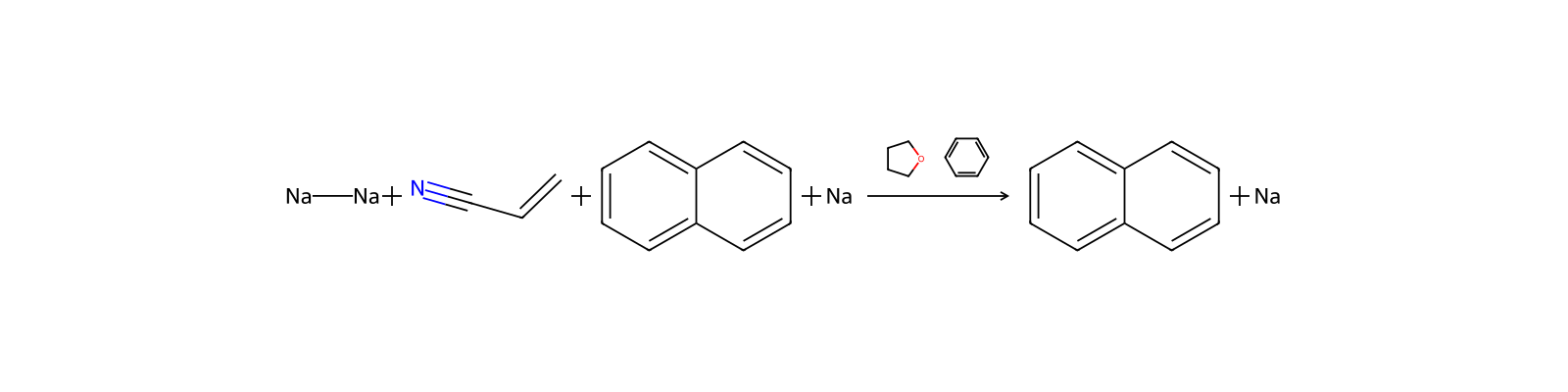
関与物質
| 役割 | 名称 | HCID | 仕込み量 |
|---|
| 反応物 | Naphthalene | HCID 931 | — |
| 反応物 | Acrylonitrile | HCID 7855 | — |
| 反応物 | Disodium | HCID 141233 | — |
| 反応物 | Sodium | HCID 5360545 | — |
| 溶媒 | Benzene | HCID 241 | — |
| 溶媒 | Tetrahydrofuran | HCID 8028 | — |
| 生成物 | Naphthalene sodium | HCID 66588811 | — |
反応手順
In this example, a triblock copolymer (PAN-PEO-PAN) consisting of polyethylene oxide (PEO) chain and polyacrylonitrile (PAN) chains is synthesized by living anion polymerization. Using a polyethylene oxide macromer (disodium salt of polyethylene oxide) as a reaction initiator, acrylonitrile is polymerized. Tetrahydrofuran and benzene used as solvents are distilled twice using lithium aluminum hydride as a desiccating agent under an argon gas flow, to which molecular sieves 4A is charged. The acrylonitrile employed as a monomer is washed successively with a saturated aqueous solution of NaHSO3, a saturated aqueous solution of NaCl containing 1% of NaOH, and a saturated aqueous solution of NaCl, and then vacuum-distilled using calcium chloride as a desiccating agent, and further vacuum-distilled using calcium hydride as a desiccating agent under an argon gas flow, to which molecular sieves 4A is charged. Sodium naphthalene is prepared by reacting naphthalene with metallic sodium in THF. Crown ether (dicyclohexyl-18-crown-6) is freeze-dried from a solution in benzene, and then is dissolved in benzene. Polyethylene oxide, which has OH groups at both ends, is freeze-dried from a solution in benzene immediately before use. AS for the polymerization apparatus, a pressure reactor (Taiatsu Glass Co., Ltd.) is employed. The reaction is carefully performed in an argon atmosphere under pressure of 4 atm so as to prevent an external air from entering the interior of the reaction system.
情報源と証拠
| DOI | 10.6084/m9.figshare.5104873.v1 |
|---|
| 特許番号 | US07090784B2 |
|---|
| 出典データセット | uspto-grants-2006_08 |
|---|
| ORD ID | ord-c210b05912fa4f4d9b61659fee74c384 |
|---|
| 出典メモ | uspto-grants-2006_08 |
|---|