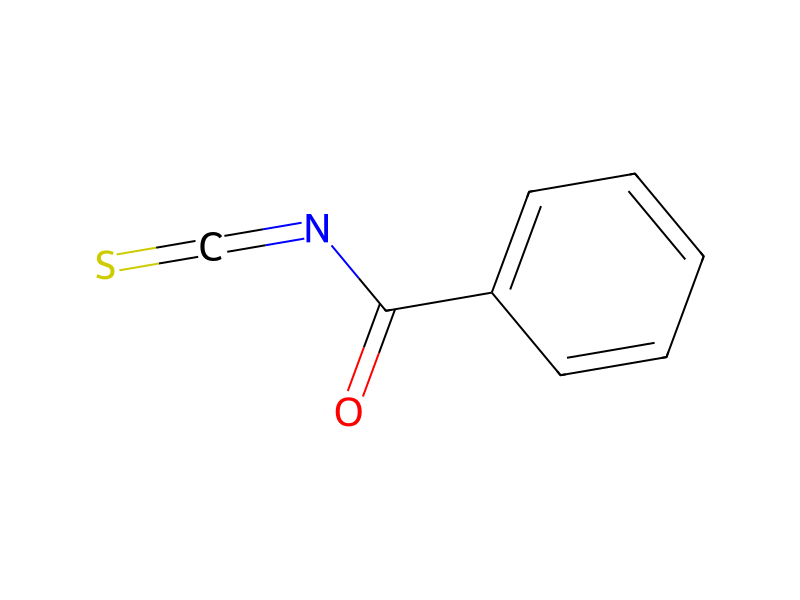
Benzoyl chloride → Benzoyl isothiocyanate
反応式

[C:1]([NH:9][C:10](N)=[S:11])(=[O:8])[C:2]1[CH:7]=[CH:6][CH:5]=[CH:4][CH:3]=1.[S-]C#N.[NH4+].C(Cl)(=O)C1C=CC=CC=1>ClCCl>[C:1]([N:9]=[C:10]=[S:11])(=[O:8])[C:2]1[CH:7]=[CH:6][CH:5]=[CH:4][CH:3]=1参加物
5




反応条件
- 温度
- 12.5 °C
実験手順
Benzoyl isothiocyanate was prepared as a starting material for benzoyl thiourea and derivatives thereof. In a 500 mL three-neck round-bottom flask (“RBF”), fitted with a condenser, thermo-probe, sealed system nitrogen purge, pressure-equilibrated addition funnel and mechanical stirrer, were placed solid ammonium thiocyanate (16.9 g, 0.22 mol) and dichloromethane (100 mL). The stirred mixture was cooled in an ice-water bath to a temperature of about 10-15° C. To the stirred mixture was added a solution of benzoyl chloride (28.4 g, 0.2 mol) in dichloromethane (50 mL) over a period of time of 20 minutes and the reaction mixture was warmed to a temperature near reflux (39° C.) for a period of time of 1 hour. Reaction completion was confirmed by FT-IR analysis. The solution was then cooled to a temperature of about 10-15° C. The solution can be concentrated to an oil to provide the benzoyl isothiocyanate. A boiling point of 128-131° C. at 15 mm Hg was measured.